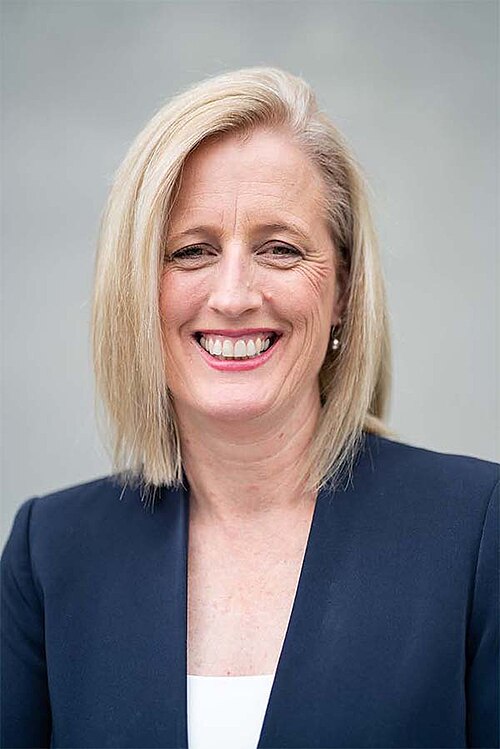
Katy Gallagher
Australian Labor Party Senator for ACT
Currently sitting
Photo: Australian Government, CC BY 4.0, via Wikimedia Commons
Seat and party history (2)
- Australian Labor Party - ACT (Senate) - 1 Jul 2019 to present
- Australian Labor Party - ACT (Senate) - 26 Mar 2015 to 10 May 2018
- Seat and party records: OpenAustralia member data.
Contact
Office: (02) 6230 0411
Unit 3, 40 Corinna Street, Phillip ACT 2606
Office details: Parliament of Australia, CC BY-NC-ND 4.0.
Contact details on aph.gov.au Profile on OpenAustraliaThese counts cover what is on this site only. They do not measure electorate work or committee work.
Compared with other members
Katy Gallagher compared with all 76 sitting senators.
Questions asked in Question Time
Lower than 87% of senators- This member
- 0
- Average
- 10.4
- Median
- 10
Debates spoken in
Higher than 93% of senators- This member
- 93
- Average
- 44.8
- Median
- 40
Votes cast
Lower than 74% of senators- This member
- 576
- Average
- 743.0
- Median
- 730
Share of divisions voted in
Lower than 75% of senators- This member
- 51%
- Average
- 69%
- Median
- 69%
Read these with care
- The median is the middle member: half did more, half did less. It is less affected by a few very active members than the average.
- Ministers answer questions rather than ask them, and the presiding officers rarely vote, so their patterns differ.
- Government backbenchers are often given arranged "Dorothy Dixer" questions, which raises their question counts.
- Votes only record ayes and noes, so a missed vote cannot be told apart from a pair (an agreed absence).
- Counts cover only what is on this site, and do not measure electorate or committee work. New members have less history.
Question Time
No questions recorded for this member.
Question from Lisa Darmanin
The senator asked the minister to outline the government's actions to achieve this improvement and its significance for women and girls in Australia.
Background: The World Economic Forum placed Australia eighth globally for gender equality, a marked rise from 50th in 2021.
Answer from Katy Gallagher
The minister attributed the improvement to policies implemented over time, including wages policy in feminized industries, extended paid parental leave with superannuation, superannuation reforms, free TAFE, and publishing gender pay gaps for large companies. In response to supplementary questions, she highlighted investments in women's health, such as listing a new breast cancer drug on the PBS to reduce costs from $1,300 to $25 per script. She also noted the introduction of laws to stop financial abuse within the child support framework, addressing nearly $2 billion in unpaid support.
Question from Jane Hume
The senator asked when the government expected inflation to return to the Reserve Bank's target band. In supplementary questions, she asked if the government accepted that higher inflation and interest rates were pressuring small businesses and why families should not be worried about the government's tax and spend agenda given internal concerns.
Background: Reports indicated Labor MPs were concerned about the inflationary impact of cost-of-living relief.
Answer from Katy Gallagher
The minister noted inflation had peaked at nearly 8 per cent in December 2022 and had since decreased to the three per cent range. She stated the government was taking responsibility for economic decisions while acknowledging global challenges. She defended cost-of-living support as targeted and non-inflationary, and accused the opposition of voting against tax cuts and wage increases while criticising the government's economic management.
Question from Varun Ghosh
The senator asked how the government's approach is strengthening the economy, repairing the budget, and providing cost-of-living support to Australians amidst global uncertainty.
Background: Global conflicts in the Middle East and Ukraine are creating challenging economic circumstances, prompting questions about the government's economic management.
Answer from Katy Gallagher
The minister reported that global headline inflation had increased by 4.7 per cent, but Australian inflation had decreased considerably. She highlighted that Australia's economic growth, employment growth, and participation rates outperformed those of Canada, France, Germany, Italy, Japan, the United Kingdom, and the United States. The minister stated that the budget exceeded the mid-year update by $44.9 billion and was over $250 billion stronger than when the government took office, citing fiscal discipline and debt reduction as key strategies.
Question from Lisa Darmanin
The senator asked for an update on global economic conditions and their impact on Australia. She also asked why retaining the AAA credit rating was important and how the government balanced spending with cost-of-living relief. Finally, she asked about the government's approach to supporting Australians while growing the economy.
Background: The IMF downgraded global growth and upgraded inflation due to the war in the Middle East, impacting Australian households.
Answer from Katy Gallagher
The minister reported that the IMF downgraded global growth to 3.1 per cent and revised up inflation to 4.4 per cent, driven by energy prices and supply chain disruptions from the Middle East conflict. She stated that the Australian economy had grown 0.4 per cent over the June quarter and 2.1 per cent over the year, matching or exceeding other advanced economies. She highlighted strong employment growth, low debt-to-GDP ratios, and historically low unemployment at 4.5 per cent. Regarding the AAA rating, she noted that Standard and Poor's reaffirmed it, endorsing the government's tax and saving reforms and modest debt levels. She emphasized that responsible budget management, including returning revenue windfalls to the budget, was key to maintaining fiscal discipline while delivering targeted relief such as cheaper medicines and tax cuts.
Question from Tyron Whitten
The senator asked if the government accepted that high immigration caused capital shallowing and was a material cause of the productivity slump. He followed up by citing Canada's experience with cutting immigration to boost per capita growth, and asked if the government supported One Nation's plan to reduce net overseas migration to negative for three years and then cap it at 130,000.
Background: Reserve Bank analysis suggested lack of capital deepening held back productivity, and One Nation blamed high immigration for capital shallowing.
Answer from Katy Gallagher
The minister rejected the claim that migration caused productivity issues, stating that productivity challenges were common across advanced economies. She noted that the government had cut net overseas migration by roughly 45 per cent from the post-COVID peak. She emphasized that the budget included 15 measures to drive productivity, including approvals reform and technology adoption. She stated that the government would not support One Nation's plan, citing feedback from business groups, farmers, and healthcare providers that such a policy would have a detrimental impact on economic growth and essential services.
Question from Malcolm Roberts
The senator asked why people could not find enough work under the government, citing rising underutilization. He followed up by asking if the government had failed to keep its promise of a paid job for everyone who wants one, given that unemployment had risen to 4.5 per cent, up from 3.4 per cent. He also asked why the government maintained high immigration levels when it allegedly took work from Australians.
Background: ABS data showed underutilization increased from 1.35 million in June 2022 to 1.68 million in July 2026.
Answer from Katy Gallagher
The minister stated that unemployment was at historically low levels, though she misspoke by saying 412 per cent before correcting the context. She highlighted that 1.3 million jobs had been created, with three out of five being full-time and five out of six in the private sector. She noted that the participation rate had risen from 66.3 per cent to 66.9 per cent, near record highs, and that the gender pay gap was at a record low. She argued that the labour market was resilient despite global uncertainty. Regarding migration, she stated that Australia had always relied on overseas workers to supplement the domestic workforce and that One Nation's policy would damage businesses and services.
Question from Marielle Smith
The member asked how many women had benefited from cheaper medicines under the government's women's health package and how these measures addressed cost-of-living challenges. She sought details on improvements to access, choice, and affordability for women's healthcare.
Background: During Women's Health Week, the question highlighted the historical dismissal of women's pain and high costs for contraceptives and menopause treatments. It sought to showcase the benefits of the government's women's health package.
Answer from Katy Gallagher
The minister stated that over one million women had accessed cheaper medicines for contraception, endometriosis, and menopause since the $800 million package was introduced. She noted that more than four million cheaper prescriptions had been filled, saving over $150 million. She highlighted the capping of PBS costs at $25, the listing of new contraceptive and menopause treatments, and the expansion of bulk-billing. She also mentioned the opening of 33 endo and pelvic pain clinics and a national menopause awareness campaign.
Question from Larissa Waters
The member asked when the government would act on recommendations to improve justice system responses to sexual assault, including trauma-informed training and access to independent lawyers. She also asked if a new review of consent education would implement expert recommendations for clearer language around sex and consent for young people.
Background: The Domestic, Family and Sexual Violence Commissioner's annual report highlighted system failures, and the government had received Law Reform Commission recommendations for 18 months.
Answer from Katy Gallagher
The minister stated that the government is undertaking a whole-of-government effort, including consulting on the second action plan for the National Plan to End Violence against Women and Children. She noted that Minister Rowland has been implementing recommendations through the Standing Council of Attorneys-General. Regarding the consent education review, she said the government is keen to see outcomes that ensure support is relevant and useful for young people, which will feed into the second action plan. She highlighted that over $4 billion has been invested in women's safety and the national legal access partnership.
Question from Carol Brown
The member asked the minister to outline actions the government is taking to address gender-based violence. She also asked why the government is protecting young people from harmful online content and how it is giving individuals greater control over their social media feeds.
Background: The Domestic, Family and Sexual Violence Commissioner's yearly report was tabled in parliament, acknowledging government progress but noting ongoing devastation.
Answer from Katy Gallagher
The minister outlined investments of $4.4 billion in frontline services and preventive programs, the permanent leaving violence payment of over $5,000, and 10 days of paid domestic violence leave. She noted that National Cabinet agreed to a new risk assessment framework. Regarding online safety, she explained that the digital duty of care will require providers to protect under-18s from harmful content. She stated that the 'My Feed, My Way' initiative allows Australians to switch off algorithms and see only content they choose to follow, giving control back to users.
Question from David Pocock
The member asked if the distribution of funds constituted pork-barrelling. He later asked for the rationale for departing from Commonwealth Grants Rules and Principles, which require merit-based processes, and questioned the difference between election commitments and pork-barrelling.
Background: An analysis showed that 73 per cent of the $560 million Major and Local Community Infrastructure Program went to notionally Labor-held seats.
Answer from Katy Gallagher
The minister stated that the funds were delivered election commitments, not pork-barrelling. She explained that the grants were administered through a closed, non-competitive round, which is permitted under the Commonwealth Grants Rules and Principles. She asserted that the government had been clear about this process beforehand and that commitments were made across various seat types, not just marginal ones.
Question from Malcolm Roberts
The member asked how the Treasurer's claim could be true if the private sector's share of jobs had fallen. He later asked what the government was doing to reverse the fall in labor market productivity and where the plan was to address economic issues like inflation and debt.
Background: The Treasurer stated that since 2022, the private sector had generated six of every seven new jobs, although figures indicated a drop in that sector's portion of the workforce.
Answer from Katy Gallagher
The minister defended the Treasurer's comments, noting that 1.3 million jobs had been created since May 2022, including growth in the care economy. She listed 15 areas of productivity improvement from the budget, including investment, innovation, and regulatory reform. She argued that employment, participation rates, and real wage growth were up, contradicting the member's portrayal of the economy.
Question from Pauline Hanson
The senator asked why the government would not allow Australians to use a small part of their future super contributions to pay for rent or mortgages. She argued that the money belonged to the workers and that the proposal was voluntary and limited.
Background: One Nation proposed a policy allowing workers to access 3 per cent of future super contributions as take-home pay for three years to help with cost of living pressures.
Answer from Katy Gallagher
The minister stated the government would not support the policy, arguing it weakened the superannuation system built by Labor. She emphasized that superannuation was a long-term investment for dignified retirement. The minister noted that debt was forecast to be $977 billion when the government took office. She criticized One Nation for not supporting wage increases, tax cuts, or housing affordability measures. The minister acknowledged that allowing seven million Australians to withdraw funds could be inflationary, a point raised in a press conference.
Question from Malcolm Roberts
The senator asked why the government brought in many new arrivals when there was insufficient work for 1.68 million underutilised Australians. He claimed mass immigration was creating a labor glut that pulled down real wages.
Background: The underutilisation rate of workers increased from 1.35 million in June 2022 to 1.68 million in June 2026. The wage price index showed a 1.5 per cent decline in real wages since the government took power.
Answer from Katy Gallagher
The minister stated that over a million jobs had been created and unemployment remained low, with participation rates at record highs. She noted that net overseas migration had fallen by roughly 45 per cent from the post-COVID high. The minister defended jobs in the non-market economy, such as health, aged care, and education, as legitimate and valuable. She criticized One Nation for opposing wage increases and argued that the government supported better wages and conditions for workers.
Question from Claire Chandler
The senator asked how much the Commonwealth pays in interest on its debt each minute and in total since the government took office. She followed up by arguing that debt servicing costs were wasting billions that could be spent on public services.
Background: National debt had reached $1 trillion, prompting questions about interest costs.
Answer from Katy Gallagher
The minister argued that the current debt burden is lower than it would have been under the previous government, which had doubled debt before the pandemic. She stated that the government had delivered two budget surpluses and that interest payments were lower than projected. She did not provide the specific per-minute or total interest figures requested. Instead, she questioned how the opposition would fund its proposed tax cuts, defence spending, and infrastructure projects, suggesting their policies would lead to higher debt.
Question from Richard Dowling
The senator asked the minister to outline the new reforms designed to protect retirement savings from financial misconduct and to detail how the government has acted to safeguard Australians' superannuation.
Background: The Assistant Treasurer announced new reforms to strengthen the superannuation system following the collapse of Shield and First Guardian master funds, which impacted around 12,000 people and $1 billion in savings.
Answer from Katy Gallagher
The minister outlined reforms including banning unlicensed real-time communications, tightening anti-hawking laws, and strengthening penalties for data harvesting. She noted that ASIC would be empowered to direct trustees to remediate failures, while APRA would ensure trustees offering high-risk products meet their responsibilities. She also mentioned progress on financial advice reforms and the introduction of a new class of adviser for super funds.
Question from Jana Stewart
The senator asked the minister to outline the purpose of superannuation, its benefits for working Australians, and how the government is strengthening the system. She specifically inquired about the impact of the requirement for employers to pay superannuation simultaneously with wages, and asked what threats exist to the system.
Background: The question sought to highlight the government's actions to strengthen the superannuation system for current and future workers.
Answer from Katy Gallagher
The minister stated that the government has increased the superannuation guarantee to 12 per cent and implemented payday super to close loopholes where workers missed out on contributions. She noted that approximately 1.3 million Australians, including 750,000 women and 550,000 young people, will benefit from an enhanced low-income super tax offset, providing up to $810 annually and a potential retirement benefit of $15,000. The minister explained that payday super prevents an average 35-year-old from losing approximately $32,000 in retirement savings due to delayed payments. She identified opposition parties and One Nation as threats to the system, citing their proposals to freeze the guarantee or allow early access.
Question from Lisa Darmanin
The member asked why compulsory superannuation is important and what it has delivered for Australians since its introduction in the 1990s. She requested details on how the Albanese government has built on this legacy to improve super outcomes for women.
Background: The member highlighted that while compulsory superannuation has created a large retirement savings pool, women still retire with less super than men on average.
Answer from Katy Gallagher
The minister stated that 18 million Australians have superannuation accounts, with the pool valued at approximately $412 trillion, making it the fourth largest globally. She outlined government reforms including legislating the objective of super, increasing the superannuation guarantee to 12 per cent, and introducing payday super, which adds around $6,000 to the retirement savings of an average 25-year-old. To address the 26 per cent gender gap, the government pays super on paid parental leave, with over 200,000 parents benefiting and $285 million paid into accounts. Additionally, reforms to the low-income super tax offset will benefit over 1.3 million Australians, of whom 750,000 are women.
Question from Bridget McKenzie
The member asked if the Minister for Finance would pledge that government ministers and agencies would work with and give evidence to the Victorian royal commission into CFMEU corruption. She questioned what action had been taken to ensure federal funds were not being siphoned off to criminal gangs.
Background: Reports indicated $15 billion of CFMEU corruption on Victoria's Big Build, with the Commonwealth providing $30 billion in funding.
Answer from Katy Gallagher
The minister stated that the Minister for Infrastructure was the responsible minister for infrastructure agreements and that the Attorney-General typically responds to royal commission requests. She confirmed that the federal financial agreement with states sought transparency and accountability, requiring delivery milestones and reporting of suspected criminal behavior. The minister highlighted that the government had appointed an administrator for the CFMEU and taken concrete action to clean up the industry, contrasting this with the previous government's inaction. She noted that the infrastructure minister had written to state ministers reinforcing their obligations to report corruption.
Question from Carol Brown
The member inquired about government measures to tackle gender-based violence and the outcomes of consultations regarding the subsequent stage of the National Plan.
Background: The government is consulting on the next phase of the National Plan to End Violence against Women and Children 2022-32.
Answer from Katy Gallagher
The minister reported that over 160 roundtables had been held with more than 1,100 people, and nearly 2,000 online submissions received. Key themes included the need for evidence-based prevention, early intervention, and addressing tech-facilitated abuse. She noted that consultations highlighted system abuse by perpetrators, leading to budget investments in child support reforms to reduce weaponization of the system.
Question from Varun Ghosh
The member asked why the government prioritised assistance with living expenses for workers and how sound economic management enabled these measures. He sought an explanation of the link between lifting wages and easing cost-of-living pressures, and how the expansion of paid parental leave contributes to economic security.
Background: The member highlighted recent income tax cuts, pay rises for three million workers, and payments for 2.6 million Australians.
Answer from Katy Gallagher
The minister attributed the ability to provide relief to budget savings that repair the budget and lower debt interest. She noted that the Reserve Bank held interest rates steady at 4.35 per cent as headline inflation fell for the third consecutive month. She listed measures including tax cuts, cheaper medicines, record hospital and education funding, and support for first home buyers. Regarding wages, she highlighted a 4.75 per cent increase in the national minimum wage, resulting in full-time minimum wage earners receiving over $1,000 per week. She also detailed the expansion of paid parental leave to 26 weeks at a rate of more than $1,000 per week, with superannuation contributions and higher income eligibility limits.
Question from Anne Ruston
The member asked whether the Prime Minister's refusal to accept responsibility for a specific gesture confirmed that he says one thing before elections and another afterwards. She sought clarification on why the Prime Minister apologised for previous comments about Kylie Minogue but not for the gesture in question, and whether the Minister for Women found the conduct demeaning.
Background: The member referenced a past promise by the Prime Minister to accept responsibility for mistakes and raised allegations regarding a gesture made during a conversation about a female prime minister.
Answer from Katy Gallagher
The minister declined to engage with the premise of the question, stating she was proud to work for a leader who prioritises women's economic security and respects women. She highlighted that the government has achieved a 50 per cent female cabinet and caucus, and has invested in women's safety, housing, and health issues such as endometriosis and menopause. She asserted that the Prime Minister's comments had been misinterpreted and weaponised by opponents, and reiterated that the government's record on women's policy was unprecedented.
Question from Jane Hume
The member asked why productivity was continuing to fall and whether increasing taxes on individuals, businesses, and construction was lowering productivity. She sought an explanation for the discrepancy between Treasury forecasts and actual productivity figures.
Background: The member cited Reserve Bank warnings about weak productivity growth and a revision of productivity growth to negative 0.5 per cent in the December quarter.
Answer from Katy Gallagher
The minister stated that the government had adopted more realistic Treasury advice on productivity assumptions, rejecting the previous government's higher assumptions. She highlighted regulatory reform bills aimed at reducing red tape and improving productivity, which she claimed the opposition had voted against. She listed budget measures including building homes, modernising energy markets, and unlocking data and AI. She rejected the proposition that tax increases were lowering productivity, citing Treasury advice that budget decisions supported productivity assumptions, and criticised the opposition for constraining wages in the past.
Question from Richard Dowling
The senator asked the minister to update the Senate on how the government's budget management is delivering cost-of-living relief and building services. He sought details on further support measures and investments in Medicare.
Background: The question highlighted the government's recent tax cuts, wage increases, and payment boosts, citing S&P Global's reaffirmation of Australia's AAA credit rating.
Answer from Katy Gallagher
The minister noted that S&P Global endorsed the government's fiscal management, citing sound fiscal performance and modest public debt. She stated that the government had found savings to meet unmet needs in health, aged care, and defence. She announced an expansion of the Commonwealth Prac Payment to 10 additional frontline health professions to support students. Regarding Medicare, she reported that the bulk-billing rate rose to 84.1 per cent in the June 2026 quarter, an increase of nearly five percentage points, with Tasmania seeing a rise to 80.8 per cent.
Question from Matthew Canavan
The member asked why the government was financing foreign renewable projects instead of supporting Australian exports and jobs.
Background: The member noted that Export Finance Australia provided a $250 million guarantee to a corporation owned by the Indian government for renewable energy projects, without any direct involvement from Australian companies.
Answer from Katy Gallagher
The minister declined to answer, stating the question was better directed to the Minister for Trade and Tourism, Senator Farrell.
Question from Michelle Ananda-Rajah
The member asked what support came into effect and how it would help workers, and how the government was supporting small businesses.
Background: The member highlighted the implementation of income tax cuts, pay rises, and expanded parental leave on 1 July.
Answer from Katy Gallagher
The minister stated that the average worker would save up to $2,800 a year through tax cuts, including a $1,000 instant tax deduction and the working Australian tax offset. She noted that three million workers benefited from minimum wage increases. For small businesses, she cited $312 billion in tax support measures and $25 million for the Digital Solutions program, which had assisted over 1,512 thousand small businesses with coaching and workshops. She emphasized that cost-of-living support was the government's top priority.
Question from Dean Smith
The member asked how the Prime Minister could claim his economic plan was working when families were paying more for essentials and mortgages.
Background: The member cited statistics showing significant increases in insurance, electricity, gas, rent, education, and food costs, along with 15 interest rate hikes.
Answer from Katy Gallagher
The minister argued that the government had inherited challenges and was cleaning up the budget, delivering surpluses, and reducing debt. She claimed the opposition had campaigned for tax increases and higher debt, including funding for nuclear power stations, which would have raised costs. She stated that the Australian people rejected the opposition's plan. She asserted that the government was addressing cost-of-living pressures through tax cuts, energy bill relief, and healthcare investments, while the opposition focused on internal conflicts.
Question from Karen Grogan
The member asked how the new suite of cost-of-living measures, including income tax cuts and expanded Paid Parental Leave, would support women and their families. She also asked why the government focused on care workers' pay and what other positive outcomes for women had been achieved.
Background: The member asked about new cost-of-living measures, including tax cuts and expanded parental leave, and their impact on women.
Answer from Katy Gallagher
The minister outlined that the government was delivering five tax cuts, with two already delivered and more coming in 2026, including the Working Australians Tax Offset. She noted that Paid Parental Leave had been expanded to six months, providing nearly $30,000 to families, double the previous entitlement. The minister highlighted that the national minimum wage had increased by six per cent to over $1,000 per week, and modern award wages by 4.75 per cent, benefiting 2.7 million workers. She stated that full-time women were earning an average of $300 more per week, and that Australia's gender equality ranking had improved from 43rd to 13th, with 650,000 new jobs created for women.
Question from Larissa Waters
The member asked why the government continued to subsidize fossil fuel industries with the Fuel Tax Credit scheme despite calls for its elimination. She later asked why mining handouts were prioritized over NDIS cuts and how the scheme aligned with climate targets.
Background: The member criticized the government for providing billions in fuel tax credits to mining corporations while cutting NDIS support.
Answer from Katy Gallagher
The minister stated that the government had not changed its view on the diesel fuel tax credit scheme, which had operated for a long time. She argued that the government was focused on delivering a transformation to a renewable energy future, reducing reliance on fossil fuels, and investing in storage and batteries. Regarding the NDIS, she stated that changes were necessary to slow the growth of the scheme, which had risen from $13 billion to over $50 billion annually and was projected to exceed $70 billion, making it unsustainable without intervention.
Question from Jane Hume
The member asked how many Australians would pay more in taxes this financial year given rising inflation. She later asked how many days it would take for bracket creep to negate tax cuts and if Australians would pay more for essentials due to government economic management.
Background: The member cited rising inflation and asked how many Australians would pay more in taxes this financial year.
Answer from Katy Gallagher
The minister stated that the government was delivering five income tax cuts, which the opposition had voted against. She argued that the opposition was not genuinely concerned about tax burdens given their voting record against wage increases and cost-of-living relief. The minister highlighted that the government was returning bracket creep through fairer tax cuts and the Working Australians Tax Offset. She stated that the government was focused on easing the cost-of-living burden through a better tax system, wage growth, and budget repair, contrasting this with the opposition's consistent rejection of reforms.
Question from Raff Ciccone
The member asked how the tax cuts and other cost-of-living help arriving on 1 July were making a difference for working people. He further asked how the expansion of paid parental leave to six months with superannuation was supporting parents and their retirement savings.
Background: A government senator asked the minister to outline the impact of the fifth tax cut and other cost-of-living measures commencing on 1 July.
Answer from Katy Gallagher
The minister outlined that from 1 July, the 16 per cent tax rate would reduce to 15 per cent, and the Working Australian Tax Offset of up to $250 would become permanent. She noted the $1,000 instant deduction, a six per cent increase in the national minimum wage, and indexation of social security payments for 2.6 million Australians. She highlighted that paid parental leave would extend to six months with superannuation paid on it, helping families share care and protecting retirement savings. She stated that once fully implemented, the five tax cuts would make the average worker $2,800 better off annually from 2028.
Question from Claire Chandler
The senator asked whether a 30 per cent minimum tax was in place before 1999 and if it currently applies under the government's tax laws. She followed up by asking about the existence of income averaging before 1999 and its current status. Finally, she inquired how many taxpayers earning less than $45,000 would be affected by the minimum tax.
Background: The Prime Minister stated that recent capital gains tax reforms returned the system to pre-1999 arrangements. Senator Chandler questioned whether a 30 per cent minimum tax existed before 1999 or exists under the current legislation.
Answer from Katy Gallagher
The minister stated that the reforms restored concession arrangements indexed for inflation rather than the previous 50 per cent discount. She noted that the legislation passed last week aimed to balance tax on wages and assets and assist first-home buyers. Regarding income averaging, she explained it was removed in 1999 for integrity reasons following a business tax review. She cited Treasury analysis indicating capital gains are predominantly realised by high-income earners. She confirmed that tax cuts for low-income earners, including those under $45,000, commence on 1 July.
Question from Varun Ghosh
The senator asked the minister to outline the benefits of the upcoming tax cuts for working Australians and how they assist with cost-of-living pressures. He subsequently asked how these cuts complement other relief measures such as wage increases and parental leave extensions. He also asked why the government continues to deliver tax cuts and when remaining legislative cuts will be implemented.
Background: The government is delivering its fifth round of tax cuts, with the average worker expected to keep up to $2,800 annually. Senator Ghosh asked for an outline of these cuts and their impact on the cost of living.
Answer from Katy Gallagher
The minister confirmed that tax cuts commence on 1 July, lowering the 16 per cent rate to 15 per cent for those earning under $45,000, with a further reduction to 14 per cent from 1 July 2027. She highlighted the Working Australians Tax Offset of up to $250 annually and a $1,000 instant deduction from 2026-27. She noted that the national minimum wage will rise by six per cent and modern award wages by 4.75 per cent. Paid parental leave will extend to 26 weeks, and social security payments will be indexed for 2.6 million Australians. She stated these measures are funded by reforms to negative gearing and capital gains tax.
Question from Barbara Pocock
The senator asked whether KPMG should retain its ethics training contract given its ethical failures. She followed up by asking if Peter de Cure, the TPB chair and former KPMG partner, should recuse himself from investigating KPMG due to a conflict of interest. Finally, she asked if the government would commit to structural reforms to regulate big four firms like corporations.
Background: KPMG has faced allegations of unethical behaviour, including lying to parliament and mistreating whistleblowers. Senator Pocock asked if KPMG should continue to be contracted for $1.3 million to provide ethics training to public sector leaders.
Answer from Katy Gallagher
The minister stated that existing contracts were entered into prior to the current concerns and that there is no evidence of unethical behaviour in current government contracts. She noted that ministers cannot cancel contracts as it would be unlawful. She confirmed a pause on new KPMG contracts until a review led by Dr Ian Watt is completed. Regarding the TPB chair, she stated she expected the board to manage any conflicts of interest appropriately. She noted that the Assistant Treasurer is releasing a discussion paper on regulating these firms.
Question from Sean Bell
The senator asked if the government's budget is designed to tax innovation and aspiration to fund spending. He followed up by asking where capital will go if the government makes investment in businesses and shares less attractive. Finally, he asked the minister to name a single productive industry that will not be taxed higher.
Background: Senator Bell claimed Labor's tax agenda punishes investment and productivity. He asked if the budget is designed to fuel spending by taxing innovation.
Answer from Katy Gallagher
The minister rejected the claim, stating the government has done more for productivity than any recent administration. She explained that tax reforms aim to create neutral tax settings so investment decisions are based on productivity rather than tax concessions. She noted that $3.8 billion is invested in business through R&D incentives and venture capital arrangements. She stated that the reforms ensure wage earners are not taxed more than asset owners, creating a fairer system across all industries.
Question from Malcolm Roberts
The senator asked why the government would not support indexation of tax brackets to prevent bracket creep. He followed up by asking if the government accepts that cutting taxes is the only way to restore worker incomes. Finally, he asked why the government has increased tax take and raised the fuel excise.
Background: Senator Roberts moved an amendment for tax bracket indexation to prevent bracket creep. He asked why the government would not support this and if it was happy to see workers pay more tax.
Answer from Katy Gallagher
The minister stated the government is cutting taxes five times in three ways, including the instant tax deduction and Working Australians Tax Offset. She noted that real wages have grown for the first time in a decade since the government took office. Regarding the fuel excise, she explained that the temporary halving was extended at a lower level to help households adjust as petrol prices fell. She emphasised that the government continues to roll out cost-of-living help, including Medicare investments and cheaper medicines.
Question from Richard Colbeck
The senator asked why Tas Farmers had not received a response to his letters regarding the Rushy Lagoon farm purchase. He followed up by asking when the government would respond to concerns about the deal. Finally, he asked why the government would not reject the deal.
Background: Senator Colbeck wrote to the Treasurer expressing concern about the Clean Energy Finance Corporation subsidising the purchase of Rushy Lagoon farm by a foreign investment company. He noted Tas Farmers had received no response.
Answer from Katy Gallagher
The minister stated she was not aware of the specific issue or the status of the response. She undertook to take the matter on notice, consult the Treasurer's office, and return to the senator directly with further information. She repeated this commitment in response to subsequent questions.
Question from Glenn Sterle
The member asked what the landmark tax reform package delivered for Australian workers, small businesses, and first home buyers. He sought details on the benefits and how consultation had shaped the final package.
Background: The first stage of the government's tax reform package had passed the Senate, including measures for tax cuts and housing affordability.
Answer from Katy Gallagher
The minister detailed that the bill included a $250 working Australian tax offset and a $1,000 instant deduction for over 13 million workers. She noted that negative gearing would be restricted to new constructions starting 1 July 2027, and cost-base indexation would be reintroduced for capital gains tax. She stated that the reforms would help 75,000 more people enter the housing market and that Treasury analysis showed more than 90 per cent of Australians would have fared better by age 30 if reforms had been in place since 2000. She also mentioned concessions for small businesses, including raising the threshold to $10 million.
Question from Ellie Whiteaker
The senator asked the minister to outline why the government prioritised investment in women's economic security, particularly paid parental leave. She also asked how broader reforms regarding health, the gender pay gap, and wages were improving outcomes for women.
Background: The Paid Parental Leave scheme was set to reach 26 weeks of support.
Answer from Katy Gallagher
The minister noted that from 1 July, eligible families would access 26 weeks of leave, receiving nearly $30,000 including superannuation. She stated that parents would be approximately $15,692 better off than under previous arrangements. She highlighted improvements in women's health, including PBS listings for contraceptives and menopause treatments, and the opening of endometriosis clinics. She dismissed criticisms of the scheme as incorrect analysis.
Question from David Pocock
The senator asked why the government treated death or divorce as a change in ownership that removed grandfathering protections. He questioned whether this disadvantaged women, who often have less superannuation and outlive men.
Background: Proposed tax reforms removed grandfathering for asset transfers due to death or divorce.
Answer from Katy Gallagher
The minister stated that the changes aimed to make the tax system fairer and simpler, aligning asset tax with income tax. She explained that grandfathering applied to assets owned at budget night, while new acquisitions followed new rules. She noted that the Women's Budget Statement addressed gender impacts and that the government sought to protect existing investments.
Question from Claire Chandler
The senator asked the minister to name a country with a higher tax rate on real capital gains than Australia. She sought to establish whether Australia's tax rates were excessively high internationally.
Background: The opposition questioned the level of capital gains tax in Australia compared to other nations.
Answer from Katy Gallagher
The minister stated that comparing tax arrangements internationally was difficult due to differences in laws. She argued that the reforms aimed to better align tax on assets with tax on income, noting that working people pay tax on real income. She cited an example where, assuming a 5.1 per cent return on the S&P/ASX 200, the tax rate was around 21.4 per cent. She claimed this was lower than rates in the UK (24 per cent), Germany (26 to 28 per cent), France (34 to 35 per cent), Ireland (33 per cent), the Netherlands (36 per cent), Denmark (42 per cent), and California. In response to supplementary questions, she defended the reforms as fairer for working people and noted that the opposition had promised higher taxes in the previous election.
Question from Malcolm Roberts
The senator asked for the total cost of the Snowy Hydro 2.0 scheme, including construction, capital costs, maintenance, transmission lines, and renewable energy installations. He sought a comprehensive figure for the project's lifetime cost.
Background: An Australian National Audit Office report highlighted shortcomings in the management of the Snowy Hydro 2.0 project.
Answer from Katy Gallagher
The minister stated that the project cost had been reset to approximately $12 billion after the government inherited it, as the initial $2 billion estimate lacked proper scoping and geological surveys. She noted that the Snowy board was undertaking a cost reassessment due to the government in late July. She emphasised that the project was more than half built and crucial for energy grid security. In response to supplementary questions, she refused to cancel the project, citing its importance for energy stability. She noted that the ANAO report found project management partially effective and that Snowy Hydro had accepted most recommendations. She argued that the market was not investing in new coal-fired power stations, whereas renewables were delivering cheaper and more reliable energy.
Question from Karen Grogan
The member asked the minister to outline how the budget supported Australians facing financial pressure and prepared the economy for the future. She sought details on how the tax reform package provided clarity for small businesses while ensuring fairness.
Background: The government had recently delivered its fifth budget, which included tax reforms and cost-of-living support measures.
Answer from Katy Gallagher
The minister described the budget as focused on relief, resilience, and reform, addressing cost-of-living pressures exacerbated by global conflicts. She outlined that tax reforms aimed to level the playing field, support homeownership, and improve productivity, lowering taxes for more than 13 million employees. The minister noted that the threshold for the 50 per cent small business capital gains tax discount was increased from $2 million to $10 million, making 2.7 million active small businesses eligible. She confirmed that consultation on the Innovative Business Capital Gains Tax Concession was open for three weeks. Additionally, she highlighted that over 14 million Australians would receive tax cuts of up to $268 from 1 July, with average wage earners paying up to $2,800 less tax than under the previous government.
Question from Malcolm Roberts
The member asked how 301,000 new permanent arrivals would impact GDP per hours worked. He questioned whether the low proportion of skilled migrants would cause productivity to continue falling.
Background: Data indicated a slight fall in productivity measures, and One Nation linked this to migration levels.
Answer from Katy Gallagher
The minister stated that productivity growth had been slow for decades and that the budget included measures to drive improvements, such as regulatory reform and infrastructure investment. She noted that Treasury had revised productivity assumptions downward based on evidence. The minister rejected the link between migration and low productivity, emphasizing the value of migrant contributions and stating that net overseas migration had decreased by 45 per cent. She highlighted that the government was addressing productivity challenges through various economic reforms.
Question from Jana Stewart
The member asked the minister to outline the priorities in the current Women's Budget Statement and explain how measures to improve gender outcomes would make a practical difference for Australian women. She also asked how the budget built on previous reforms to lock in lasting progress.
Background: The government delivered its fifth Women's Budget Statement, highlighting gender equality as central to the economic agenda.
Answer from Katy Gallagher
The minister stated that the budget included $182.6 million for child support reforms to reduce weaponisation and protect women from financial abuse. She noted continued investment in the National Plan to End Violence against Women and Children, including the Our Ways--Strong Ways First Nations safety plan, bringing total investment to over $4.4 billion since 2022. Regarding economic security, she explained that a woman earning $81,000 could be nearly $3,000 better off annually from 2027-28 due to the Working Australians Tax Offset and Instant Tax Deduction Benefit. The minister also highlighted investments in aged care, Medicare, mental health, reproductive health, and menopause services, noting that women had saved over $647 million on medicines since January 2023.
Question from Pauline Hanson
The member asked how the public could trust government statements on foreign ownership levels when 80 per cent of foreign owners allegedly failed to comply with disclosure laws. She further asked why the government did not require proof of citizenship for all real estate sales and when it would force foreigners to sell existing homes.
Background: The member cited freedom of information documents suggesting only one in five foreign purchasers submitted mandatory disclosure returns, implying widespread non-compliance.
Answer from Katy Gallagher
The minister stated that the budget prolonged the prohibition on overseas acquisitions of established residences until 2029. She noted that foreign buyer levels had dropped to 0.5 per cent of buyers after the ban started in 2025, compared to a peak of 1.8 per cent under the previous government. Regarding compliance, she referred to the Register of Foreign Ownership of Australian Assets and the ATO's role in monitoring acquisitions. The minister explained that the government supported investment in new housing construction to drive supply, which is why foreigners could still purchase new builds.
Question from Claire Chandler
The member asked whether the budget demonstrated that young Australians faced worsening economic conditions due to government spending. She further inquired if the budget projected national debt reaching $1.25 trillion, creating a financial burden for future generations, and whether interest costs would exceed $42 billion annually.
Background: The question addressed the impact of the newly released federal budget on young Australians, specifically regarding inflation, interest rates, and national debt levels.
Answer from Katy Gallagher
The minister denied the premise, stating the budget ensured fairness for future generations through responsible fiscal management. She argued that the previous government had doubled the debt before the pandemic and left a $1 trillion debt burden. The minister highlighted that the current budget reduced debt by $173 billion compared to inherited levels and saved approximately $70 billion in interest payments. She emphasized that net debt growth remained lower than when the government took office.
Question from Helen Polley
The member asked how the government's budget supported Australians facing cost-of-living pressures and delivered for all citizens. She further inquired about the budget's contribution to fiscal repair and why this task was important.
Background: The question sought to highlight the government's responsible budget approach amidst global oil shocks and inflationary pressures.
Answer from Katy Gallagher
The minister outlined the budget's five-part economic strategy, including fuel security, assistance with living expenses, productivity, tax reform, and responsible management. She noted a new $250 Working Australians Tax Offset for 13.3 million workers from late 2027, bringing total tax cuts to up to $2,816 for the average worker by 2028. The minister stated the budget was $44.9 billion stronger than the mid-year economic and fiscal outlook and included $63.8 billion in savings, contributing to almost $180 billion in total savings since the government took office.
Question from Jordon Steele-John
The member asked if the minister was proud of cutting $185 billion from the NDIS over the decade. She further inquired if the government could guarantee that no disabled person would lose support or be left worse off, and what alternative supports were funded for autistic adults and teenagers.
Background: The question addressed significant budget cuts to the NDIS and concerns about support for disabled people.
Answer from Katy Gallagher
The minister stated the reforms were necessary to ensure the long-term sustainability of the NDIS, which had grown beyond initial projections of $13 billion annually to over $50 billion. She explained that the budget aimed to manage scheme growth and return the NDIS to its original focus. The minister highlighted investments in rebuilding support systems outside the NDIS for those who do not qualify, ensuring that people without private funds could still access necessary care.
Question from Larissa Waters
The senator asked why the government had not insisted that suppliers immediately lower prices to pass on the excise cut or introduced stronger anti-price-gouging laws. She questioned the delay in relief reaching consumers.
Background: Fuel prices had risen significantly since the start of the conflict, and the government had announced a halving of the fuel excise.
Answer from Katy Gallagher
The minister explained that the excise cut would flow through to prices as contracted supplies were purchased, which might take some time. She stated that the ACCC was monitoring prices to ensure reductions were realized at the pump. In response to supplementary questions about direct cost-of-living relief and AUKUS, she emphasized targeted assistance for businesses and households, noting that the budget would reflect current economic circumstances. She firmly rejected the suggestion that the government would withdraw from AUKUS.
Question from Deborah O'Neill
The senator asked for an update on how global economic impacts, particularly fuel prices, were shaping the broader economic outlook and the upcoming budget.
Background: The Treasurer had indicated that the Middle East conflict would be a defining influence on the upcoming May budget.
Answer from Katy Gallagher
The minister stated that the conflict was intensifying inflation and uncertainty, reinforcing challenges of high inflation and weak productivity. She highlighted that the economy remained strong with low unemployment and consistent wage growth. The minister outlined new measures announced that day, including temporary tax relief for businesses affected by fuel issues and an extension of the small business responsible lending obligation exemption for 10 years. She emphasized that the budget would focus on resilience and reform.
Other Parliamentary Activity
-
Wage Justice for Early Childhood Education and Care Workers (Special Account) (Extending Support and Strengthening Safety) Bill 2026; Third Reading
Senate · Tuesday 15 September 2026 · Third Reading
Contributed to this debate
-
Regulatory Reform Omnibus Bill 2026; Third Reading
Senate · Monday 14 September 2026 · Third Reading
Contributed to this debate
-
Artificial Intelligence
Senate · Monday 14 September 2026 · General Debate
Contributed to this debate · Position: oppose
-
Treasury Laws Amendment (Strengthening Accountability for Tax Adviser Misconduct and Other Measures) Bill 2026; Third Reading
Senate · Thursday 10 September 2026 · Third Reading
Contributed to this debate
-
Regulatory Reform Omnibus Bill 2026; In Committee
Senate · Thursday 10 September 2026 · In Committee
Responded as minister
-
Domestic, Family and Sexual Violence Commission
Senate · Wednesday 9 September 2026 · Ministerial Statement
Opened this debate
-
Combatting Illicit Tobacco Bill 2026; Limitation of Debate
Senate · Thursday 20 August 2026 · Limitation of Debate
Contributed to this debate
-
Australian Security Intelligence Organisation Amendment Bill (No. 2) 2025; Limitation of Debate
Senate · Thursday 20 August 2026 · Limitation of Debate
Contributed to this debate
-
Australia's Foreign Relations (State and Territory Arrangements) Amendment Bill 2026; Limitation of Debate
Senate · Thursday 20 August 2026 · Limitation of Debate
Contributed to this debate
-
Treasury Laws Amendment (Tax Reform No. 2) Bill 2026; Second Reading
Senate · Wednesday 19 August 2026 · Second Reading
Opened this debate
-
Treasury Laws Amendment (Tax Reform No. 2) Bill 2026; First Reading
Senate · Wednesday 19 August 2026 · First Reading
Contributed to this debate
-
Interactive Gambling Amendment (Gambling Reform) Bill 2026, National Self-exclusion Register (Cost Recovery Levy) Amendment Bill 2026, Interactive Gambling (Cost Recovery Levy) Bill 2026; Second Reading
Senate · Wednesday 19 August 2026 · Second Reading
Opened this debate
-
Interactive Gambling Amendment (Gambling Reform) Bill 2026, National Self-exclusion Register (Cost Recovery Levy) Amendment Bill 2026, Interactive Gambling (Cost Recovery Levy) Bill 2026; First Reading
Senate · Wednesday 19 August 2026 · First Reading
Contributed to this debate
-
Aged Care
Senate · Tuesday 18 August 2026 · General Debate
Responded as minister
-
Taxation
Senate · Tuesday 11 August 2026 · General Debate
Responded as minister
-
Regulatory Reform Omnibus Bill 2026; Second Reading
Senate · Thursday 2 July 2026 · Second Reading
Opened this debate
-
Regulatory Reform Omnibus Bill 2026; First Reading
Senate · Thursday 2 July 2026 · First Reading
Contributed to this debate
-
Treasury Laws Amendment (Tax Reform No. 1) Bill 2026, Income Tax Rates Amendment (Tax Reform No. 1) Bill 2026; Limitation of Debate
Senate · Thursday 25 June 2026 · Limitation of Debate
Responded as minister
-
Treasury Laws Amendment (Tax Reform No. 1) Bill 2026, Income Tax Rates Amendment (Tax Reform No. 1) Bill 2026; In Committee
Senate · Thursday 25 June 2026 · In Committee
Responded as minister
-
Crossin, Ms Patricia Margaret (Trish), AM
Senate · Wednesday 24 June 2026 · Condolence
Contributed to this debate
-
Treasury Laws Amendment (Tax Reform No. 1) Bill 2026, Income Tax Rates Amendment (Tax Reform No. 1) Bill 2026; Second Reading
Senate · Monday 22 June 2026 · Second Reading
Opened this debate
-
Treasury Laws Amendment (Tax Reform No. 1) Bill 2026, Income Tax Rates Amendment (Tax Reform No. 1) Bill 2026; First Reading
Senate · Monday 22 June 2026 · First Reading
Opened this debate
-
Excise Tariff Amendment (Draught Beer) Bill 2025, Customs Tariff Amendment (Draught Beer) Bill 2025; Limitation of Debate
Senate · Wednesday 1 April 2026 · Limitation of Debate
Opened this debate
-
Corporations Amendment (Digital Assets Framework) Bill 2025; Limitation of Debate
Senate · Wednesday 1 April 2026 · Limitation of Debate
Opened this debate
-
Commonwealth Parole Board Bill 2025, Commonwealth Parole Board (Consequential and Transitional Provisions) Bill 2025; Limitation of Debate
Senate · Wednesday 1 April 2026 · Limitation of Debate
Contributed to this debate
-
Appropriation (Fuel Security Response) Bill (No. 1) 2025-2026, Appropriation (Fuel Security Response) Bill (No. 2) 2025-2026; Limitation of Debate
Senate · Wednesday 1 April 2026 · Limitation of Debate
Opened this debate
-
Treasury Laws Amendment (Fuel Excise Relief) Bill 2026; Third Reading
Senate · Tuesday 31 March 2026 · Third Reading
Contributed to this debate
-
Treasury Laws Amendment (Fuel Excise Relief) Bill 2026; Second Reading
Senate · Tuesday 31 March 2026 · Second Reading
Contributed to this debate · Position: support
-
Australian Defence Force
Senate · Tuesday 31 March 2026 · General Debate
Contributed to this debate · Position: oppose
-
Fuel
Senate · Monday 30 March 2026 · General Debate
Contributed to this debate · Position: oppose
-
Treasury Laws Amendment (Doubling Penalties for ACCC Enforcement) Bill 2026; Second Reading
Senate · Thursday 26 March 2026 · Second Reading
Opened this debate
-
Treasury Laws Amendment (Doubling Penalties for ACCC Enforcement) Bill 2026; In Committee
Senate · Thursday 26 March 2026 · In Committee
Responded as minister
-
Treasury Laws Amendment (Doubling Penalties for ACCC Enforcement) Bill 2026; First Reading
Senate · Thursday 26 March 2026 · First Reading
Contributed to this debate
-
Social Security and Other Legislation Amendment (Technical Changes No. 1) Bill 2026; Second Reading
Senate · Thursday 26 March 2026 · Second Reading
Responded as minister
-
Social Security and Other Legislation Amendment (Technical Changes No. 1) Bill 2026; In Committee
Senate · Thursday 26 March 2026 · In Committee
Responded as minister · Position: oppose
-
Treasury Laws Amendment (Supporting Choice in Superannuation and Other Measures) Bill 2025; Second Reading
Senate · Wednesday 11 March 2026 · Second Reading
Responded as minister
-
Treasury Laws Amendment (Supporting Choice in Superannuation and Other Measures) Bill 2025; In Committee
Senate · Wednesday 11 March 2026 · In Committee
Responded as minister
-
Australian Defence Force
Senate · Tuesday 3 March 2026 · General Debate
Responded as minister
-
Racism: Islamophobia
Senate · Monday 2 March 2026 · General Debate
Contributed to this debate · Position: oppose
-
Middle East
Senate · Monday 2 March 2026 · General Debate
Contributed to this debate
-
High Seas Biodiversity Bill 2026; Second Reading
Senate · Wednesday 4 February 2026 · Second Reading
Opened this debate
-
High Seas Biodiversity Bill 2026; First Reading
Senate · Wednesday 4 February 2026 · First Reading
Contributed to this debate
-
Bondi Beach: Attack
Senate · Monday 19 January 2026 · Condolence
Contributed to this debate
-
Social Security and Other Legislation Amendment (Technical Changes No. 2) Bill 2025; Third Reading
Senate · Wednesday 26 November 2025 · Third Reading
Contributed to this debate
-
Social Security and Other Legislation Amendment (Technical Changes No. 2) Bill 2025; In Committee
Senate · Wednesday 26 November 2025 · In Committee
Responded as minister
-
Social Security and Other Legislation Amendment (Technical Changes No. 2) Bill 2025; In Committee
Senate · Tuesday 25 November 2025 · In Committee
Responded as minister
-
Hanson, Senator Pauline Lee; Censure
Senate · Tuesday 25 November 2025 · General Debate
Contributed to this debate · Position: support
-
Social Security and Other Legislation Amendment (Technical Changes No. 2) Bill 2025; Second Reading
Senate · Monday 24 November 2025 · Second Reading
Responded as minister
-
Social Security and Other Legislation Amendment (Technical Changes No. 2) Bill 2025; In Committee
Senate · Monday 24 November 2025 · In Committee
Opened this debate
-
Freedom of Information Amendment Bill 2025; Second Reading
Senate · Monday 24 November 2025 · Second Reading
Opened this debate
- Votes recorded
- 576
- Aye votes (32.8%)
- 189
- No votes (67.2%)
- 387
Showing the latest 50 votes.
-
Corruption in the Construction Industry Select Committee; Appointment
17 Sep 2026 · Ayes 23, Noes 31 · Failed
VOTED NO -
Foreign Affairs, Defence and Trade References Committee; Reference
17 Sep 2026 · Ayes 34, Noes 21 · Passed
VOTED NO -
Environment and Communications References Committee; Reference
17 Sep 2026 · Ayes 23, Noes 32 · Failed
VOTED NO -
Selection of Bills Committee; Report
17 Sep 2026 · Ayes 12, Noes 28 · Failed
VOTED NO -
Personal Information and Privacy; Order for the Production of Documents
16 Sep 2026 · Ayes 30, Noes 19 · Passed
VOTED NO -
Maritime Industry; Order for the Production of Documents
16 Sep 2026 · Ayes 16, Noes 23 · Failed
VOTED NO -
Climate Change; Order for the Production of Documents
16 Sep 2026 · Ayes 16, Noes 23 · Failed
VOTED NO -
Census; Order for the Production of Documents
16 Sep 2026 · Ayes 23, Noes 30 · Failed
VOTED NO -
ASECA Judicial Seminar; Order for the Production of Documents
16 Sep 2026 · Ayes 12, Noes 28 · Failed
VOTED NO -
Middle East; Order for the Production of Documents
16 Sep 2026 · Ayes 13, Noes 27 · Failed
VOTED NO -
North to East Australia Pipeline; Order for the Production of Documents
16 Sep 2026 · Ayes 18, Noes 25 · Failed
VOTED NO -
Artificial Intelligence Joint Select Committee; Appointment
16 Sep 2026 · Ayes 17, Noes 25 · Failed
VOTED NO -
Artificial Intelligence Joint Select Committee; Appointment
16 Sep 2026 · Ayes 17, Noes 26 · Failed
VOTED NO -
Improved Native Forest Management; Order for the Production of Documents
16 Sep 2026 · Ayes 26, Noes 31 · Failed
VOTED NO -
Rural and Regional Affairs and Transport References Committee; Reference
16 Sep 2026 · Ayes 27, Noes 31 · Failed
VOTED NO -
Middle East
16 Sep 2026 · Ayes 32, Noes 20 · Passed
VOTED AYE -
Cost of Living
14 Sep 2026 · Ayes 22, Noes 32 · Failed
VOTED NO -
Digital Seller Underperformance Policy; Order for the Production of Documents
14 Sep 2026 · Ayes 32, Noes 18 · Passed
VOTED NO -
Health Care; Order for the Production of Documents
14 Sep 2026 · Ayes 23, Noes 28 · Failed
VOTED NO -
Intergenerational Trust Fund for the People of the Republic of Nauru; Order f...
14 Sep 2026 · Ayes 35, Noes 19 · Passed
VOTED NO -
Rural and Regional Affairs and Transport References Committee; Reference
14 Sep 2026 · Ayes 35, Noes 19 · Passed
VOTED NO -
Regulatory Reform Omnibus Bill 2026; In Committee
14 Sep 2026 · Ayes 21, Noes 32 · Failed
VOTED NO -
Regulatory Reform Omnibus Bill 2026; In Committee
14 Sep 2026 · Ayes 31, Noes 22 · Passed
VOTED AYE -
Consideration of Legislation
14 Sep 2026 · Ayes 19, Noes 33 · Failed
VOTED AYE -
Artificial Intelligence
14 Sep 2026 · Ayes 14, Noes 24 · Failed
VOTED NO -
Carbon Farming Initiative--Improved Forest Management in Multiple-use Public ...
10 Sep 2026 · Ayes 27, Noes 34 · Failed
VOTED NO -
Statute Update Bill 2026; Limitation of Debate
10 Sep 2026 · Ayes 35, Noes 20 · Passed
VOTED NO -
Statute Update Bill 2026; Limitation of Debate
10 Sep 2026 · Ayes 22, Noes 32 · Failed
VOTED NO -
Statute Update Bill 2026; Limitation of Debate
10 Sep 2026 · Ayes 35, Noes 20 · Passed
VOTED NO -
Statute Update Bill 2026; Limitation of Debate
10 Sep 2026 · Ayes 35, Noes 20 · Passed
VOTED NO -
Regulatory Reform Omnibus Bill 2026; In Committee
10 Sep 2026 · Ayes 12, Noes 24 · Failed
VOTED NO -
Treasury Laws Amendment (Strengthening Accountability for Tax Adviser Miscond...
10 Sep 2026 · Ayes 35, Noes 4 · Passed
VOTED AYE -
Defence Properties; Order for the Production of Documents
10 Sep 2026 · Ayes 36, Noes 21 · Passed
VOTED NO -
Rearrangement
10 Sep 2026 · Ayes 21, Noes 36 · Failed
VOTED AYE -
Housing; Order for the Production of Documents
10 Sep 2026 · Ayes 37, Noes 21 · Passed
VOTED NO -
Selection of Bills Committee; Report
10 Sep 2026 · Ayes 17, Noes 26 · Failed
VOTED NO -
Taxation; Order for the Production of Documents
9 Sep 2026 · Ayes 27, Noes 33 · Failed
VOTED NO -
Senate Estimates: Questions on Notice; Order for the Production of Documents
9 Sep 2026 · Ayes 37, Noes 22 · Passed
VOTED NO -
Rural and Regional Affairs and Transport References Committee; Reference
9 Sep 2026 · Ayes 23, Noes 35 · Failed
VOTED NO -
Climate Change
7 Sep 2026 · Ayes 11, Noes 27 · Failed
VOTED NO -
International Relations: Australia and the United States of America
7 Sep 2026 · Ayes 14, Noes 28 · Failed
VOTED NO -
Animal Welfare; Order for the Production of Documents
7 Sep 2026 · Ayes 13, Noes 25 · Failed
VOTED NO -
Social Security (Administration) Legislation Amendment (Income Management and...
7 Sep 2026 · Ayes 13, Noes 24 · Failed
VOTED NO -
Consideration of Legislation
7 Sep 2026 · Ayes 25, Noes 33 · Failed
VOTED NO -
Treasury Laws Amendment (Strengthening Accountability for Tax Adviser Miscond...
7 Sep 2026 · Ayes 36, Noes 4 · Passed
VOTED AYE -
Treasury Laws Amendment (Strengthening Accountability for Tax Adviser Miscond...
7 Sep 2026 · Ayes 4, Noes 40 · Failed
VOTED NO -
Treasury Laws Amendment (Strengthening Accountability for Tax Adviser Miscond...
7 Sep 2026 · Ayes 25, Noes 32 · Failed
VOTED NO -
Australian Security Intelligence Organisation Amendment Bill (No. 2) 2025; Li...
20 Aug 2026 · Ayes 26, Noes 15 · Passed
VOTED AYE -
Australian Security Intelligence Organisation Amendment Bill (No. 2) 2025; Li...
20 Aug 2026 · Ayes 11, Noes 26 · Failed
VOTED NO -
Australian Security Intelligence Organisation Amendment Bill (No. 2) 2025; Li...
20 Aug 2026 · Ayes 26, Noes 36 · Failed
VOTED NO
About this page
This page tracks Katy Gallagher's parliamentary activity: questions asked and answered in Question Time, debates spoken in, and votes in divisions. Summaries are in reported speech, not transcripts; each one links to the official record.