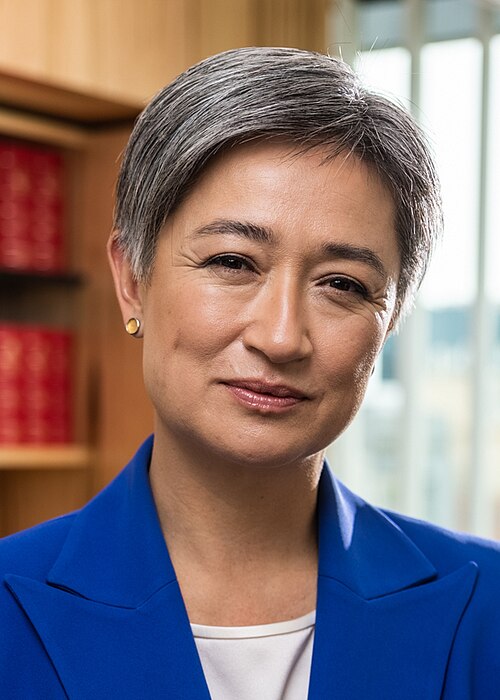
Penny Wong
Australian Labor Party Senator for SA
Currently sitting
Photo: Department of Foreign Affairs and Trade, CC BY 4.0, via Wikimedia Commons
Seat and party history (1)
- Australian Labor Party - SA (Senate) - 1 Jul 2002 to present
- Seat and party records: OpenAustralia member data.
Contact
Office: (08) 8212 8272
Level 4, 19 Gouger Street, Adelaide SA 5000
Office details: Parliament of Australia, CC BY-NC-ND 4.0.
Contact details on aph.gov.au Profile on OpenAustraliaThese counts cover what is on this site only. They do not measure electorate work or committee work.
Compared with other members
Penny Wong compared with all 76 sitting senators.
Questions asked in Question Time
Lower than 87% of senators- This member
- 0
- Average
- 10.4
- Median
- 10
Debates spoken in
Lower than 71% of senators- This member
- 30
- Average
- 44.8
- Median
- 40
Votes cast
Lower than 96% of senators- This member
- 153
- Average
- 743.0
- Median
- 730
Share of divisions voted in
Lower than 99% of senators- This member
- 14%
- Average
- 69%
- Median
- 69%
Read these with care
- The median is the middle member: half did more, half did less. It is less affected by a few very active members than the average.
- Ministers answer questions rather than ask them, and the presiding officers rarely vote, so their patterns differ.
- Government backbenchers are often given arranged "Dorothy Dixer" questions, which raises their question counts.
- Votes only record ayes and noes, so a missed vote cannot be told apart from a pair (an agreed absence).
- Counts cover only what is on this site, and do not measure electorate or committee work. New members have less history.
Question Time
No questions recorded for this member.
Question from Anne Ruston
The senator asked whether the Prime Minister had any involvement in Mr Muldoon obtaining his position with Senator Dowling. She noted that Mr Muldoon had attended the Prime Minister's wedding and that Senator Dowling had praised his political instincts. In supplementary questions, she asked if the Prime Minister had personally approved Mr Muldoon's appointment as an Australia Day Ambassador in 2024 despite his known views, and whether the government expected the public to believe the Prime Minister was unaware of his history.
Background: Rhys Muldoon, a staffer for Senator Richard Dowling and friend of the Prime Minister, was dismissed following the release of racist and sexually explicit social media posts.
Answer from Penny Wong
The minister stated that the comments were unacceptable and that the Prime Minister had made this clear. She confirmed that Senator Dowling had taken immediate action regarding the employment. Regarding the ambassadorship, she corrected the record, noting Mr Muldoon had been an ambassador since 2014, not 2024, and that he would not serve in that role again following action by the assistant minister. She reiterated that the Prime Minister found the comments unacceptable.
Question from Michaelia Cash
The senator asked why the Prime Minister continued to oppose legislation to restore common sense to the Sex Discrimination Act and safeguard the rights of biological women and girls in female-only spaces. In supplementary questions, she asked why the Prime Minister did not care about the privacy and safety of women in these spaces and why women should trust a Prime Minister who repeatedly refused to support sex-based rights.
Background: The High Court refused special leave in the Tickle v Giggle case, upholding a ruling against a women-only networking app.
Answer from Penny Wong
The minister emphasised respect and dignity for all people, citing former Senator Marise Payne's call for sensitivity. She highlighted the government's focus on women's equality, including the National Plan to End Violence against Women and Girls and efforts to address the gender pay gap. She challenged the opposition to condemn comments regarding consent in marriage and to support development assistance for girls' education and rights in developing countries.
Question from Lidia Thorpe
The senator asked if the government agreed that a genocide had occurred on the continent. In supplementary questions, she cited the new research showing up to two million people were wiped out and asked if any federal government had investigated whether a genocide occurred.
Background: New research published in Nature suggests 2.2 million First Peoples lived on the continent before invasion.
Answer from Penny Wong
The minister acknowledged the history of brutality, death, and dispossession faced by First Nations people. She stated that while different people use different words, the government supports truth-telling about this painful history. She argued that better understanding of history would lead to more respect for First Nations people.
Question from Matthew Canavan
The senator asked how the government could claim net zero policies create secure jobs when 500 workers are losing jobs and sovereign capacity is at risk. In supplementary questions, he asked if Australia would retain the ability to produce structural steel independently and when the government would abandon net zero targets in favour of all energy resources.
Background: The blast furnace at the Whyalla Steelworks was announced to be permanently closed, contradicting previous government statements about its future.
Answer from Penny Wong
The minister agreed steelmaking is a critical national capability and stated the government is working with stakeholders to ensure Whyalla's future. She attributed the closure to years of underinvestment and safety failures by the owner, GFG Alliance, rather than government policy. She cited the Tomago Aluminium facility as an example where renewables and gas, not coal, were required to keep the facility open.
Question from Kerrynne Liddle
The member asked whether the government could deliver more than industrial destruction and job losses, citing the closure of Whyalla alongside other facilities like Tomago and Bell Bay, despite previous commitments to secure manufacturing jobs.
Background: The blast furnace at Whyalla was permanently shut down, resulting in up to 500 job losses, despite a $500 million commitment from the Future Made in Australia Green Iron Investment Fund.
Answer from Penny Wong
The minister stated that the government is committed to securing a future for Whyalla through consultation with unions and workers, contrasting this with previous Liberal policies that allegedly encouraged industry departures. She noted that the failure to invest by the previous owner, GFG Alliance, had negative consequences for the community. The minister affirmed that the government would work with industry and unions to find a sustainable path forward for the site.
Question from Susan McDonald
The senator asked when the government would abolish the safeguards tax and remove regulatory shackles from the industrial sector, arguing that the tax contributed to the facility's failure.
Background: The Whyalla blast furnace closed despite a $2.4 billion government allocation, with the opposition attributing this to high energy costs and the safeguards tax.
Answer from Penny Wong
The minister affirmed that securing domestic structural steel capability at Whyalla was essential and that the government was prepared to invest taxpayer funds to support the transition. She attributed the facility's state to underinvestment by the previous owner and criticized the opposition for complaining about government intervention in industries like Tomago. The minister reiterated the government's commitment to working with the South Australian government, unions, and communities to ensure a future for Whyalla.
Question from Matt O'Sullivan
The senator asked what the Prime Minister would say to Australians who bought homes under Labor and were now financially worse off due to negative equity and higher repayments.
Background: Analysis suggested 20 per cent of recent home buyers were facing higher repayments and falling property values, with some in negative equity.
Answer from Penny Wong
The minister stated that housing affordability issues were fundamentally about supply and demand, noting that investor loans for new builds had increased by 27.5 per cent and construction loans by 20 per cent due to tax incentives. She reported that less than one per cent of mortgage holders were in negative equity, compared to over two per cent when the opposition was in government. The minister argued that increasing supply and removing competitive advantages for investors over first-home buyers were the correct strategies to improve affordability.
Question from Michaelia Cash
The senator asked whether the Prime Minister agreed with Mr Kelty's assessment that Australians cannot pay their bills because real wages are declining while interest rates rise. She further asked if the Prime Minister agreed with Mr Kelty's criticism of the Treasurer's focus on wage share rather than real wage growth, and his analysis that falling property prices do not equate to improved affordability.
Background: Former ACTU head Bill Kelty criticized the government's economic management, stating that real wages are falling and housing affordability is worsening due to rising interest rates.
Answer from Penny Wong
The minister acknowledged the pressure on households from global shocks, including the pandemic, conflicts in Europe and the Middle East, and energy market disruptions. She highlighted government actions such as free doctor visits, cheaper medicines, support for first-home buyers, and free TAFE. Regarding wages, she noted that annual wage growth had exceeded three per cent for 16 consecutive quarters, unemployment was at a half-century low, and 1.3 million jobs had been created. She emphasized that the national minimum wage had increased by more than $12,000 annually, a rise of over 30 per cent, and that pay rises were delivered for early educators and aged care workers. On housing, she stated the government was implementing tax cuts and ensuring fair conditions for investors and first-home buyers to ensure equity.
Question from Richard Dowling
The senator asked how the digital duty of care would make the internet safer for children and why basic online safety standards were important. He also asked about responses from community groups and faith-based organizations, and whether there were any risks to the government's plan.
Background: The government announced a digital duty of care to safeguard youth against online social media risks and provide adults with greater internet choice.
Answer from Penny Wong
The minister explained that tech companies would have a legally enforceable duty to prevent harm, protecting children from harmful content and features across all online services. She noted that users would gain choice over their feeds, including the ability to opt out of algorithms. She cited examples of online harms, such as AI-generated nude images of children, chatbots promoting disordered eating, and grooming on platforms like Roblox. She stated that community groups, including Equality Australia and the Executive Council of Australian Jewry, welcomed the duty of care and wanted parliament to go further. She emphasized that the government was consulting on the standards to ensure they were robust and would work with parliament to implement them.
Question from Jane Hume
The senator asked what rate of productivity growth the government was assuming across the forward estimates. She followed up by asking if the government agreed with the BCA's calculation that average productivity growth would only be 0.2 per cent annually even if Treasury's 1.2 per cent assumption was met. Finally, she asked what Treasury currently estimated average labour productivity growth to be for the 2020s, and what rate would be needed to make up the lost productivity.
Background: The Business Council of Australia reported that labour productivity had declined by an average of 0.1 per cent annually under the government, predicting the 2020s would be the worst decade for productivity growth since 1960.
Answer from Penny Wong
The minister acknowledged productivity as a long-standing challenge for governments of both persuasions since the Hawke-Keating era. She noted that productivity had fallen for seven quarters before the pandemic. She stated that the budget included 15 productivity reforms aimed at attracting investment and cutting regulatory costs by $10.2 billion annually. These measures included reducing red tape, building a single national market, modernizing energy markets, and unlocking data and AI opportunities. She confirmed that the long-run assumption for productivity growth was 1.2 per cent, which had been revised down in the first term based on Treasury advice. She did not provide a specific figure for the rate required to make up for lost productivity, instead focusing on the government's reform agenda.
Question from Sarah Hanson-Young
The senator asked when the government would introduce a moratorium on new AI data centres or ensure forthcoming AI legislation applied retrospectively to protect Australians. She pressed for a commitment to retrospective laws or a moratorium, citing concerns that corporations were rushing projects before guardrails were in place.
Background: New York and Texas imposed moratoriums on AI data centres, and tech CEOs called for regulation due to catastrophic risks.
Answer from Penny Wong
The minister stated that AI had enormous potential benefits and risks, requiring agreed guidelines for deployment. She confirmed that the government would legislate Australian standards for AI, ensuring large data centres met minimum requirements for energy, water, and location. She emphasized the need to keep Australians safe while spreading the benefits of the technology. She did not commit to a moratorium or retrospective legislation, instead focusing on the development of standards and guardrails to ensure safe rollout.
Question from Andrew Bragg
The senator asked if the government was aware that its taxes were reducing home loans and homeownership opportunities. He followed up by asking if the minister stood by the claim that rents would rise by only $2 a week, given projections of $200-a-week rises in Sydney. He also asked who benefited from the $77 billion in new housing taxes.
Background: NAB reported that loans to owner-occupiers were down 15 per cent since the budget.
Answer from Penny Wong
The minister countered that loan approvals had risen by 8.9 per cent compared with the previous year, reaching their peak since 2021, while commencements grew by 15.2 per cent. She stated that more first-home buyers were entering the market under the government, with over 490,000 accessing it and 260,000 using a five per cent deposit. Regarding rents, she affirmed that Treasury modelling indicated weekly increases of less than $2, noting transitional arrangements for negative gearing. She did not directly answer who benefited from the taxes, instead focusing on the increase in supply and first-home buyer activity.
Question from Anne Ruston
The member asked whether the Prime Minister had been truthful in parliament regarding his non-use of the Marrickville golf club facilities, given video evidence from 2019 where he stated he had been using the club for decades. She also queried the justification for the $6 million grant to the club.
Background: The Prime Minister received an honorary membership at the Marrickville golf club, which received a $6 million government grant. A 2019 video surfaced showing the Prime Minister stating he had used the club for decades, contradicting his recent parliamentary claims that he did not use the facilities.
Answer from Penny Wong
The minister stated she would refer the member to the Prime Minister's answers in the House of Representatives. She defended the grant as the delivery of a transparent election commitment, noting that the Audit Office supports using properly designed grants programs for such purposes. She emphasized that the process followed Commonwealth Grants Rules and Principles. In response to supplementary questions, she highlighted that the grant included environmental works and compared the process to other election commitments delivered by both parties, including a $1.8 million grant for a park in the Groom electorate.
Question from James Paterson
The member asked whether the Prime Minister or his office raised the commitment to fund the Marrickville golf club with the Department of the Prime Minister and Cabinet before the project list was provided to the infrastructure department. He sought to establish who authorized the list and whether the Prime Minister was a decision-maker in the grant process.
Background: Senate estimates showed that the Department of the Prime Minister and Cabinet provided the roster of exclusive initiatives for the Major and Local Community Infrastructure Program. The inquiry centred on the Prime Minister's part in approving the $6 million payment to the Marrickville golf club.
Answer from Penny Wong
The minister confirmed the commitment was raised prior to the list being provided, as it was a public election commitment. She stated that the Prime Minister was not the decision-maker, as the grant was delivered through standard departmental processes and Commonwealth grant guidelines. She argued that the commitments were authorized by the Australian people through the election and that the same process would have been used by the coalition if they had won.
Question from Mehreen Faruqi
The member asked why the government had not banned trade with illegal Israeli settlements like other allies, citing recent settler violence and the killing of Palestinian teenagers. She questioned whether the government was prioritizing relations with the US and Israel over human rights concerns.
Background: Several countries, including the UK, Canada, and France, announced bans on trade with illegal Israeli settlements. The question highlighted recent violence against Palestinians and asked why Australia had not implemented similar bans.
Answer from Penny Wong
The minister rejected the assertion that the government was placating Israel, noting Israeli displeasure with Australian actions. She detailed existing sanctions on extremist settlers and entities responsible for violence, which already prohibit trade with them. She explained that Australian law bans importing goods from sanctioned entities. In response to supplementaries, she affirmed that the government is pursuing further targeted measures to deter illegal settlements while avoiding unintended consequences for Palestinian livelihoods, coordinating with the UK and Canada.
Question from Jane Hume
The member asked when inflation would return to the Reserve Bank's target, citing warnings from the Deputy Governor about public anger over rising prices. She questioned whether the government would change its fiscal policy if interest rates rose again.
Background: The Deputy Governor of the Reserve Bank warned of persistent inflation and potential interest rate rises. The question challenged the government on its failure to reduce inflationary pressure and its impact on household purchasing power.
Answer from Penny Wong
The minister acknowledged inflation remains a challenge but noted it is lower than when the government took office. She highlighted economic progress, including low unemployment and wage growth above three per cent for 16 consecutive quarters. She criticized the opposition for opposing tax cuts, wage increases, and cost-of-living measures. She stated the government is focused on relieving inflationary pressures and cost-of-living costs, without committing to specific fiscal policy changes in response to potential rate hikes.
Question from Matthew Canavan
The member asked how many Australians were facing negative equity, citing data that recent buyers in Sydney and Melbourne were seeing their home values drop below purchase prices. He questioned the impact of government policies on housing market stability.
Background: Property analysts suggested recent buyers were at risk of negative equity due to government tax changes. The question challenged the government on the number of Australians facing losses on their home values.
Answer from Penny Wong
The minister cited Commonwealth Bank and Reserve Bank data showing negative equity had dropped to 0.5 per cent, less than half the rate under the previous government. She argued that the opposition was talking down the market and failing to support young Australians entering the housing market. She highlighted government initiatives like the five per cent deposit scheme and a fairer tax system to support homeownership. She criticized the coalition for not wanting more young people in the housing market.
Question from James McGrath
The member asked why the Prime Minister's local golf club was uniquely invited to apply for funding under the $560 million community infrastructure program, while no other golf clubs in Australia were given the same opportunity. He sought clarification on whether the Prime Minister directed $6 million in taxpayer funds to the facility.
Background: The Prime Minister's local Marrickville Golf Club was the sole entity invited to apply for a specific grant under the government's community infrastructure program.
Answer from Penny Wong
The minister stated that the grant was part of a specific program to deliver on public election commitments, following proper processes under the Commonwealth Grants Rules and Principles. She noted that the government had also made $2 billion available through open and competitive funding for community infrastructure. In response to supplementary questions, she reiterated that the Prime Minister was not the decision-maker for the grant and that the commitment was transparently made during the election campaign. She referred the matter to the Minister for Infrastructure, who administers the program.
Question from Jana Stewart
The member asked the minister to explain how the government's plan would help Australians take back control of their online experiences. She also inquired about how the digital duty of care legislation builds on existing social media age laws and what risks might hinder the plan's success.
Background: The Prime Minister announced new measures to empower Australians to control their social media feeds and protect young people from harmful content.
Answer from Penny Wong
The minister explained that the 'My Feed, My Way' initiative gives users choice over their platforms, requiring social media companies to provide tools for genuine control without penalizing users who opt out. She stated that the digital duty of care legislation imposes safety standards on online services, similar to those for cars or food, to protect children from harmful algorithms. In response to supplementary questions, she cited the story of Wayne Holdsworth to highlight the need for action and criticized opposition parties for aligning with One Nation on free speech arguments, claiming they had abandoned previous commitments to stronger safeguards.
Question from Paul Scarr
The member asked what steps the Prime Minister had taken to verify his membership status at the Marrickville Golf Club, given conflicting statements from the club and the Prime Minister. He further asked whether the Prime Minister had declared any conflicts of interest under the code of conduct before the $6 million grant was committed.
Background: Conflicting reports emerged regarding whether the Prime Minister held an honorary membership at the Marrickville Golf Club, which received a government grant.
Answer from Penny Wong
The minister confirmed that paid social membership at the club costs $5 for two years and stated the Prime Minister is engaged in his local community. She emphasized that the Prime Minister was not the decision-maker for the grant. Regarding conflict of interest declarations, she noted that registers of members' interests generally do not require disclosure for membership in local community or sporting organizations. She reiterated that the grant was a transparent election commitment delivered according to Commonwealth rules.
Question from Lidia Thorpe
The member asked what unintended consequences the government was concerned about regarding a ban on imports from illegal settlements. She also asked why the Israeli ambassador was allowed in the private members' dining room and whether the government needed his permission to act.
Background: The government announced it would not pursue a full ban on imports from illegal Israeli settlements due to concerns about unintended consequences.
Answer from Penny Wong
The minister explained that Australian law already bans trading with sanctioned individuals and entities, with penalties including imprisonment and fines up to $3.64 million for businesses. She stated that the government is pursuing further targeted measures to deter illegal settlements and settler violence, noting that Israel had revoked visas for Australian diplomats in Ramallah in response. Regarding the ambassador's presence in the dining room, she said she was unaware of it and that facility use is a matter for presiding officers. She emphasized that the government disagrees strongly with the Netanyahu government's position on settlements.
Question from Leah Blyth
The member asked if the Prime Minister intended to tax families for having children, given claims that adding a newborn to a family trust would revoke exemptions and tax income at 47 per cent. She asked how many families would be affected by these changes.
Background: Critics claimed the government's trust tax changes would penalize families adding newborns to family trusts.
Answer from Penny Wong
The minister stated that the changes are part of a consultation process and not the only way to arrange discretionary trusts. She clarified that a 30 per cent minimum levy on payments from such trusts applies from July 2028, with exemptions for farming income, testamentary trusts, and over 90 per cent of small businesses. She argued that the vast majority of Australians will not be affected because they do not use trusts to minimize tax, and the package includes tax cuts for wage-earning Australians.
Question from Ross Cadell
The member asked how the government allowed veterans to feel they had to fight for promised health care. He asked if the Veterans' Minister was fit for purpose given claims of a lack of empathy and whether the government would remove the $5,000 threshold causing concern.
Background: Veterans protested against changes to health care entitlements, specifically a $5,000 threshold for allied health services.
Answer from Penny Wong
The minister thanked veterans for their service and stated that the government is listening through consultations and meetings with veteran groups. She clarified that the $5,000 threshold does not prevent access to clinically necessary allied health services. She acknowledged that the process might need careful consideration and that the consultation process would address these issues. She affirmed that the Veterans' Minister has secured additional funding to implement royal commission recommendations.
Question from Jonathon Duniam
The member asked how Australians could trust the government's understanding of the illicit tobacco crisis when a senior minister appeared unaware of a violent incident in his own community. He questioned whether the government recognized the scale of the problem.
Background: Assistant Treasurer Daniel Mulino reportedly stated he was unaware of a tobacco-related firebombing in his electorate, prompting questions about government awareness of the illicit tobacco crisis.
Answer from Penny Wong
The minister stated that the government viewed illicit tobacco as a serious organized crime issue funding other harms. She noted that enforcement activity had increased by $350 million and border interceptions had tripled. She emphasized that cooperation between federal and state governments was essential, noting that states regulate tobacco sales. The minister highlighted that tobacco excise had increased by over 215 per cent under the previous government and by less than 40 per cent under the current administration, arguing the policy had bipartisan support.
Question from Dave Sharma
The member asked which RSL and veterans' representatives the government had engaged with regarding the proposed cap and which supported the policy. He later asked what specific concerns veterans had raised and why the Prime Minister had not scrapped the cap despite advice from the New South Wales premier that the policy was hindering police efforts against organized crime.
Background: The government proposed a $5,000 cap on allied health services for veterans, leading to concerns from veterans' groups.
Answer from Penny Wong
The minister stated that the government had increased fees for allied health professionals and adjusted thresholds based on royal commission recommendations. She noted that the Prime Minister had met with veterans and that consultations were underway. She clarified that support beyond the $5,000 threshold would continue if there was a clinical need. The minister mentioned that 42,000 veteran compensation claims had been unprocessed under the previous government and that the RSL and other organizations were urging participation in consultations.
Question from Michaelia Cash
The senator asked why the government had not reversed cuts to veterans' health services despite the protest. She cited the disappointment expressed by fourth-generation soldier Andy Cullen, who felt betrayed by the government's approach and was discouraging his son from joining the Australian Defence Force.
Background: Australian military veterans protested outside Parliament House by laying down their medals in response to government changes to veterans' health services.
Answer from Penny Wong
The minister expressed respect for veterans and noted that Minister Keogh had started talks after publishing a consultation paper. She stated that the $5,000 threshold for health services would not apply to those on special rate disability pension, totally and permanently incapacitated pension, or those determined to be catastrophically injured. The minister highlighted a $169.7 million investment in allied health provider fees, the largest in over a decade, responding to Royal Commission recommendation 71. She also criticized the opposition for not addressing a backlog of 42,000 veteran compensation claims during their time in government.
Question from Andrew Bragg
The senator asked why the Prime Minister was persisting with tax policies that allegedly worsened the housing shortage. He cited claims that tax changes made new projects harder to finance and presell, leading to fewer homes being built and higher rents.
Background: The Property Council claimed that Labor's housing taxes had reduced buyer confidence and caused new housing supply to drop significantly.
Answer from Penny Wong
The minister defended the government's focus on increasing supply through a $47 billion Homes for Australia plan. She stated that tax arrangements were changed to favor first-home buyers over investors. The minister cited data showing building approvals were 8.9 per cent higher than the previous year and commencements were 15.2 per cent higher, the highest levels since 2021. She rejected the premise that tax changes were causing a decline in construction, attributing improvements in approvals and commencements to government interventions.
Question from Larissa Waters
The senator asked how approving fossil fuel projects was consistent with the government's commitment to a safe climate. She referenced the Prime Minister's comments on the Nepal glacier collapse disaster and the approval of the Beetaloo gas fracking project amidst warnings of a super El Nino.
Background: The government approved an extension to a coal mine in Queensland on the same day the UN warned that global warming might exceed 1.12 degrees. The senator noted 37 coal and gas projects had been approved since May 2022.
Answer from Penny Wong
The minister acknowledged the seriousness of climate change and the El Nino event. She criticized the Greens for voting with Tony Abbott and others against climate action in the past. The minister stated that 146 renewable energy projects had been approved as of 7 September 2026. Regarding the Saraji mine, she clarified it was not a new mine and was covered by the safeguard mechanism with a baseline declining to zero by 2050. She emphasized the government's commitment to transitioning the economy to lower emissions through thoughtful policy.
Question from David Shoebridge
The senator asked why the government had allowed the US to use Australian bases in a way that could draw Australia into US conflicts. He cited fears from residents near bases and asked for an example of the government denying US access to bases.
Background: Reports indicated the US had access to over 100 Australian military bases for surveillance, troop deployment, and munitions storage, raising concerns about Australia becoming a forward operating base.
Answer from Penny Wong
The minister affirmed that the US alliance contributed to Australian sovereignty and provided access to capabilities Australia would not otherwise have. She stated that all facilities remained under Australian command and that US access occurred in rotation, by mutual agreement, and at Australia's request. The minister rejected the view that the alliance compromised sovereignty, emphasizing that the government's actions were aimed at deterring conflict in the region.
Question from Jane Hume
The senator asked if the Prime Minister admitted failure in allowing the illicit tobacco market to become an organized crime problem. She cited over 200 tobacco-related arsons in Victoria in three years and estimated criminal profits of $4 billion to $7 billion annually.
Background: A firebombing of an illicit tobacco shop in Richmond, Victoria, destroyed 10 small businesses. Illicit tobacco accounted for around 80 per cent of the market, with consumption rising by 30 per cent.
Answer from Penny Wong
The minister acknowledged illicit tobacco as a serious organized crime crisis. She stated the government had allocated over $365 million to improve border detection and joint enforcement activities. The Illicit Tobacco National Disruption Group was established to target criminals. The minister emphasized the need for cooperation between states and the federal government, noting that states regulate tobacco sales. She rejected opposition proposals to reduce excise, citing concerns about increasing smoking rates and the rise in vaping.
Question from Bridget McKenzie
The senator asked who Labor's economy was working for, given the record mortgage stress and falling house prices. She noted that more Australians were under mortgage stress than when the government took power.
Background: The Prime Minister stated his goal was to make the economy work for people. However, 1.79 million Australians were at risk of mortgage stress after three interest rate increases, and house prices were falling.
Answer from Penny Wong
The minister acknowledged cost-of-living pressures and stated the government was focused on delivering relief through tax cuts and other measures. She noted that five rounds of tax cuts had been implemented, which the Nationals had opposed. The minister criticized the Nationals for chasing One Nation's voter base and advocating for policies such as cutting wages and superannuation. She argued that the Nationals were not capable of managing the economy due to their focus on higher taxes and deficits.
Question from Dave Sharma
The senator asked whether the government could confirm that national debt had hit $1 trillion. He subsequently questioned whether the government would continue to increase debt despite rising interest expenses, and requested a projection of the peak level of gross government debt.
Background: Reports indicated that Australia's national debt had reached $1 trillion for the first time.
Answer from Penny Wong
The minister stated that the government maintains transparency regarding debt levels and noted that under the previous coalition government, debt would have exceeded $1.2 trillion. She cited Budget Statement 1, which projected gross debt at $1,051.0 billion by 30 June 2027, a figure $18.0 billion lower than the May Economic and Fiscal Outlook and $173.0 billion below the 2022 Pre-Election Economic and Fiscal Outlook. She emphasized that the government has delivered two budget surpluses and that the current debt trajectory is lower than what was inherited. Regarding the specific peak projection, she directed the senator to the budget papers and reiterated that the debt position is better than it would have been under the opposition.
Question from James McGrath
The senator asked when the Prime Minister would sack the Veterans Affairs Minister, citing claims of contempt towards veterans and internal Labor criticism. He followed up by asking why the Prime Minister retained confidence in the minister and whether the minister had been asked to resign or offered his resignation.
Background: Allegations arose that the Veterans Affairs Minister had failed to meet with veterans and was facing calls for resignation.
Answer from Penny Wong
The minister affirmed the government's respect for veterans and noted that the Veterans Affairs Minister had acknowledged the error in not holding an initial meeting and has since engaged with the community. She highlighted that the current administration has spent more on veterans affairs than any prior government, including $2 billion in funding following the royal commission. She confirmed that the Prime Minister retains confidence in the minister and stated that no resignation had been requested or offered.
Question from Mehreen Faruqi
The senator asked if the government accepted responsibility for failing to secure justice for the murdered aid workers and whether it would expel the Israeli ambassador. She cited UN figures on aid worker deaths and criticized the reliance on Israeli self-investigation.
Background: The Israeli government announced it would not investigate the deaths of Australian aid workers killed in Gaza.
Answer from Penny Wong
The minister described the Israeli decision not to investigate as outrageous and insulting to the victims' families and the Australian public. She confirmed that she had conveyed this view privately to the Israeli ambassador and stated that the government would continue to advocate for answers. She clarified that maintaining diplomatic relations allows Australia to advance its interests and convey its views directly, rather than serving as an endorsement of the Israeli government's actions. She did not agree with assertions that the aid workers were responsible for their own deaths.
Question from Ross Cadell
The senator asked what additional costs Australians would face at the pump due to a proposed carbon tax on fuel. He followed up by asking for the specific cost impact on diesel for truckies and why the government was withholding cost modelling.
Background: A consultation paper on fuel security and low-carbon liquid fuels was released.
Answer from Penny Wong
The minister denied that there would be additional costs, stating that the consultation paper on fuel security and low-carbon liquid fuels was welcomed by the National Farmers' Federation and GrainCorp. She emphasized that the policy aims to diversify supply chains and improve fuel resilience, particularly in light of global disruptions. She clarified that the allowable level of ethanol in petrol is already established under fuel quality standards and that the government does not plan to change or increase these limits. She characterized the opposition's concerns as a scare campaign not supported by industry feedback.
Question from Michaelia Cash
The senator asked whether the Prime Minister retained confidence in Minister Keogh given that veterans described his conduct as disrespectful and indicated they had lost trust in him after he initially refused to meet with them.
Background: Veterans expressed dissatisfaction following a meeting with Minister Matt Keogh, citing dismissive conduct and a lack of trust in his leadership regarding the $5,000 allied health threshold and previous policy reversals.
Answer from Penny Wong
The minister confirmed the Prime Minister had confidence in Minister Keogh. She noted that the minister had acknowledged his error in not meeting the veterans initially. She reiterated that veterans with clinical needs would retain access to allied health services above the $5,000 threshold. She highlighted government investments in the Department of Veterans' Affairs to address a backlog of approximately 42,000 compensation claims.
Question from Bridget McKenzie
The senator asked how many times Minister Keogh needed to admit mistakes or reverse policies before the Prime Minister lost confidence in him, given veterans' ongoing concerns.
Background: Senator McKenzie cited a pattern of Minister Keogh admitting errors or reversing decisions on retrospective medals, Invictus Australia funding, travel support for the Baird family, and the allied health threshold.
Answer from Penny Wong
The minister stated the Prime Minister retained confidence in the minister, who had acknowledged his errors. She emphasized the government's commitment to implementing royal commission recommendations, noting over $2 billion invested in veterans' wellbeing. She defended the government's record, citing the resolution of a 42,000-claim backlog inherited from the previous administration.
Question from Jane Hume
The senator asked the minister to guarantee that no Australian renter would pay more than $2 a week additional rent due to the government's increased taxes on housing.
Background: Treasury forecasts suggested Labor's housing tax changes would increase rents by only $2 a week, while opposition claims suggested larger impacts.
Answer from Penny Wong
The minister guaranteed that the changes were motivated by increasing housing supply and that opposition policies would have reduced supply. She clarified that existing negative gearing arrangements were grandfathered and that incentives remained for new builds. She cited ABS data showing investor lending for new constructions rose by 27 per cent in the June quarter.
Question from Matthew Canavan
The senator asked whether the Prime Minister would meet with veterans to listen to their concerns about the $5,000 allied health threshold. He cited reports that the Veterans' Affairs minister had been dismissive and that four veteran suicides were linked to distress over the policy. He asked if the government was considering scrapping the cap.
Background: Veterans had met with the Minister for Veterans' Affairs to protest a new $5,000 annual cap on allied health services, alleging the minister was dismissive during the meeting.
Answer from Penny Wong
The minister acknowledged Vietnam Veterans' Day and stated that the Prime Minister regularly engages with veteran groups. She clarified that the $5,000 threshold is not a hard limit if there is a clinical need, ensuring veterans continue to receive necessary care. She noted that the Prime Minister's office has been briefed on the issues raised by the veteran delegation. The minister did not confirm whether the cap would be scrapped, stating only that the government's position would be considered carefully.
Question from Richard Colbeck
The senator asked how the government could justify the algorithm's decision to deny additional support to a deteriorating 96-year-old. He asked if the government believed this was the best outcome and why it rejected a bill allowing human override of the algorithm.
Background: A 96-year-old woman with serious health needs was denied additional funding by the government's assessment algorithm, a decision criticized by experts as flawed.
Answer from Penny Wong
The minister stated that the specific case has been referred to the department for review. She highlighted two improvements to the assessment system: a rapid review of prioritization and a legislated review process for changing care levels. She noted an additional $3.7 billion investment in aged care in the budget. She did not directly answer whether the specific outcome was correct, instead emphasizing the government's commitment to dignity and the ongoing refinement of the system.
Question from Jane Hume
The member asked whether the government accepted the administrator's assertion that five years was the maximum sanction available under current rules, regardless of the severity of the conduct. She sought clarification on whether the government would consider amending legislation to remove this limit.
Background: CFMEU administrator Michael Crosby stated on ABC's 7.30 that union rules limited his ability to suspend John Setka for more than five years, suggesting the rules might need changing.
Answer from Penny Wong
The minister noted that John Setka had been expelled from the Australian Labor Party years ago, a process not subject to the five-year rule. She affirmed the government's zero tolerance for corruption, criminality, and violence in the construction industry, stating that the administrator had achieved significant progress in cleaning up the union. The minister indicated that the government would carefully consider any advice from the administrator regarding necessary changes to disciplinary powers, emphasizing that the current administration had taken stronger action than previous governments.
Question from Jessica Collins
The member asked how the government could claim its housing policies were working given reports of falling buyer confidence, fewer homes, and higher rents. She cited investor loan commitments falling 8.6 per cent and questioned whether the Prime Minister agreed with the Treasurer's characterization of drying finance as an encouraging sign.
Background: Metricon reported a 40 per cent fall in sales in some markets, and government budget forecasts predicted 35,000 fewer homes due to tax changes.
Answer from Penny Wong
The minister rejected the premise that policies were failing, stating the housing package would boost supply by at least 30,000 homes and help 75,000 young people buy homes. She noted that over 660,000 homes had been built since Labor was elected and approvals were up for three consecutive years. The minister highlighted that nearly 75,000 people in New South Wales had bought homes with a five per cent deposit and that 9,400 social and affordable homes were being delivered in the state. She argued that tax changes tilted the scales in favor of first-home buyers, redistributing ownership from investors to owner-occupiers, which she described as leveling the playing field.
Question from Leah Blyth
The member asked if the minister could identify a single year since Labor took office where productivity growth hit the long-run average needed to sustainably raise living standards. She questioned why the government had not produced sustained improvement after four years and asked for a date when Australians would see positive effects.
Background: ABS figures indicated that productivity dropped by 0.7 per cent during 2024-25, while GDP per hour worked decreased by 0.6 per cent in the March quarter.
Answer from Penny Wong
The minister acknowledged productivity as a longstanding challenge and highlighted the budget's 15 reforms aimed at increasing productivity, including the incentivising investment and innovation package with $312 billion in new measures. She noted that productivity had declined multiple times under the previous Morrison government. The minister argued that the opposition voted against key productivity measures such as EPBC reforms and regulatory reform. She stated that the government was cutting red tape by roughly $10 billion annually and focusing on a multifactor approach to attract investment and lower compliance costs.
Question from David Shoebridge
The member asked if the government was treating the Royal Commission with seriousness and providing necessary support. He specifically asked if the government would intervene to grant a visa to a former ASIO source denied entry, to ensure his evidence could be heard by the commission.
Background: The Royal Commission was established to investigate antisemitism and social cohesion, including the role of security services.
Answer from Penny Wong
The minister affirmed the government's support for the Royal Commission's independence and its wide powers. Regarding the visa denial, she stated that the government acts on advice from security agencies and respects the statutory framework, implying that national interest considerations guided the decision. On the gun buyback, she expressed pleasure that New South Wales was cooperating with the Commonwealth and urged all other states to engage with the reform in a similar manner to ensure national consistency.
Question from Jane Hume
The member asked why the Prime Minister refused to admit fault regarding his comments about the Japanese Prime Minister, despite video evidence and previous denials of breaking promises on energy bills, superannuation, and tax policy.
Background: The Prime Minister faced criticism for comments and gestures regarding Japan's Prime Minister, with video evidence cited by the opposition.
Answer from Penny Wong
The minister stated that the opposition had opposed energy assistance and tax cuts. She highlighted the Japanese ambassador's statement on personal trust between leaders and accused the opposition of creating a diplomatic issue through media stunts and summoning the ambassador. She emphasized the government's commitment to strengthening the strategic partnership with Japan.
Question from Tony Sheldon
The member asked about the significance of the $2.5 billion joint investment to secure the site's future beyond 2028 and its importance for national resilience.
Background: The Prime Minister and the NSW Premier announced a joint plan to keep the Tomago Aluminium smelter open.
Answer from Penny Wong
The minister confirmed the $2.5 billion investment, shared equally between state and federal governments, would keep the smelter open and support jobs in the Hunter region. She noted the plan enables commercially viable operations after 2028 and increases renewable energy capacity, including almost three gigawatts of new clean energy and stabilisation capacity. She emphasized the importance of domestic aluminium production for economic resilience.
Question from Maria Kovacic
The member asked why the Prime Minister required protection from the NSW Premier when answering questions about his lewd comments and gestures.
Background: The NSW Premier intervened during a press conference to shield the Prime Minister from questions about his comments regarding the Japanese Prime Minister.
Answer from Penny Wong
The minister criticized the opposition for focusing on press conference awkwardness rather than the announcement of job protections in the Hunter. She stated the Prime Minister was there to announce measures to protect jobs and that the government was proud of this outcome. She reiterated that the focus should be on the economic announcement rather than political point-scoring.
Question from Paul Scarr
The member asked if the minister would guarantee that Australian charities and not-for-profits would not lose out due to the tax changes, specifically regarding non-deductible gifts.
Background: Estimates suggested Labor's proposed trust tax could cost charities $2.9 billion in lost giving over five years.
Answer from Penny Wong
The minister reiterated that amendments ensure deductible gifts reduce capital gains subject to minimum tax and that minimum tax does not apply to charitable trusts. She noted that DGR status remains tax deductible for discretionary trusts and that the government is consulting on implementation details, including arrangements for donations. She declined to provide further guarantees beyond the consultation process.
Question from Susan McDonald
The member asked why Labor's gas policies were causing Australia to become a less reliable source for Japan to meet its energy requirements and if the Prime Minister accepted that policy uncertainty was giving competitors market share.
Background: Japanese companies are signing long-term LNG deals with the US, raising concerns about Australia's reliability as a supplier.
Answer from Penny Wong
The minister affirmed the importance of the relationship with Japan and stated the government was designing the gas reservation policy in consultation with industry and partners. She emphasized objectives of ensuring sufficient domestic gas for jobs and investment certainty. She guaranteed that Australia would remain a reliable long-term supplier while maximizing benefits for the country through domestic manufacturing and energy security.
Question from Dean Smith
The member asked whether the Prime Minister would ensure that payments from discretionary trusts to registered charities, tax-exempt not-for-profits, and faith-based groups would be exempt from the 30 per cent trust tax. He sought confirmation that vital funding for vulnerable Australians would not be stripped by the legislation.
Background: The member raised concerns that the government's proposed trust tax could reduce funding for charities and not-for-profits, citing warnings from religious leaders.
Answer from Penny Wong
The minister confirmed the government is consulting on implementation details, including arrangements for donations to charities and tax-exempt entities. She stated that the overarching purpose of the tax reforms is to make the system fairer by aligning the treatment of income from work with income from assets. In response to supplementary questions, she clarified that deductible gifts and donations reduce capital gains subject to the minimum tax, and that the minimum tax does not apply to charitable trusts. She noted that donations to deductible gift recipient organisations remain tax-deductible for discretionary trusts, and highlighted government measures to streamline the process for organisations to gain deductible gift recipient status.
Other Parliamentary Activity
-
Denman, Ms Kay Janet
Senate · Monday 14 September 2026 · Condolence
Contributed to this debate
-
Ocean of Peace Alliance and Fiji-Australia Vuvale Union
Senate · Tuesday 11 August 2026 · Ministerial Statement
Opened this debate
-
Treasurer, Minister Representing the Treasurer; Censure
Senate · Monday 29 June 2026 · General Debate
Responded as minister
-
Crossin, Ms Patricia Margaret (Trish), AM
Senate · Wednesday 24 June 2026 · Condolence
Contributed to this debate
-
Treasury Laws Amendment (Tax Reform No. 1) Bill 2026, Income Tax Rates Amendment (Tax Reform No. 1) Bill 2026; First Reading
Senate · Monday 22 June 2026 · First Reading
Responded as minister
-
Australia-Indonesia Treaty on Common Security
Senate · Thursday 14 May 2026 · Ministerial Statement
Opened this debate
-
Muddle, Warrant Officer Class 2 Lachlan
Senate · Tuesday 12 May 2026 · Condolence
Contributed to this debate
-
Export Finance and Insurance Corporation Amendment (Strategic Reserve) Bill 2026; Second Reading
Senate · Tuesday 31 March 2026 · Second Reading
Responded as minister
-
Fuel Security
Senate · Thursday 12 March 2026 · General Debate
Responded as minister
-
Boswell, Hon. Ronald (Ron) Leslie Doyle, AO
Senate · Tuesday 3 March 2026 · Condolence
Contributed to this debate
-
Closing the Gap
Senate · Monday 2 March 2026 · Ministerial Statement
Responded as minister
-
Middle East
Senate · Monday 2 March 2026 · General Debate
Responded as minister
-
Hanson, Senator Pauline Lee; Censure
Senate · Monday 2 March 2026 · General Debate
Opened this debate
-
Picton, Mr Tim
Senate · Wednesday 4 February 2026 · Condolence
Contributed to this debate
-
Bolkus, Hon. Nick
Senate · Tuesday 3 February 2026 · Condolence
Contributed to this debate
-
Combatting Antisemitism, Hate and Extremism (Criminal and Migration Laws) Bill 2026; Second Reading
Senate · Tuesday 20 January 2026 · Second Reading
Responded as minister
-
Bondi Beach: Attack
Senate · Monday 19 January 2026 · Condolence
Contributed to this debate
-
Environment Protection Reform Bill 2025, National Environmental Protection Agency Bill 2025, Environment Information Australia Bill 2025, Environment Protection and Biodiversity Conservation (Customs Charges Imposition) Bill 2025, Environment Protection and Biodiversity Conservation (Excise Charges Imposition) Bill 2025, Environment Protection and Biodiversity Conservation (General Charges Imposition) Bill 2025, Environment Protection and Biodiversity Conservation (Restoration Charge Imposition) Bill 2025; In Committee
Senate · Thursday 27 November 2025 · In Committee
Contributed to this debate · Position: support
-
Richardson, Hon. Graham Frederick, AO
Senate · Tuesday 25 November 2025 · Condolence
Contributed to this debate
-
Hanson, Senator Pauline Lee; Censure
Senate · Tuesday 25 November 2025 · General Debate
Opened this debate
-
Question Time
Senate · Monday 3 November 2025 · General Debate
Responded as minister
-
Watson, Mr John Odin Wentworth, AM
Senate · Tuesday 2 September 2025 · Condolence
Contributed to this debate
-
Cameron, Mr Martin Bruce
Senate · Tuesday 29 July 2025 · Condolence
Contributed to this debate
-
Parliamentary Standards
Senate · Thursday 24 July 2025 · Ministerial Statement
Responded as minister
-
Faruqi, Senator Mehreen
Senate · Wednesday 23 July 2025 · General Debate
Opened this debate
-
Environment Protection and Biodiversity Conservation Amendment (Reconsiderations) Bill 2025; Reference to Committee
Senate · Tuesday 25 March 2025 · Reference to Committee
Responded as minister
-
Crowley, Hon. Dr Rosemary Anne, AO
Senate · Tuesday 25 March 2025 · Condolence
Contributed to this debate
-
Early Childhood Education and Care (Three Day Guarantee) Bill 2025; First Reading
Senate · Thursday 13 February 2025 · First Reading
Contributed to this debate
-
Hughes, Hon. Thomas Eyre Forrest (Tom), AO, KC
Senate · Wednesday 12 February 2025 · Condolence
Contributed to this debate
-
Antisemitism
Senate · Tuesday 4 February 2025 · General Debate
Responded as minister
- Votes recorded
- 153
- Aye votes (50.3%)
- 77
- No votes (49.7%)
- 76
Showing the latest 50 votes.
-
Carbon Farming Initiative--Improved Forest Management in Multiple-use Public ...
10 Sep 2026 · Ayes 27, Noes 34 · Failed
VOTED NO -
Statute Update Bill 2026; Limitation of Debate
10 Sep 2026 · Ayes 35, Noes 20 · Passed
VOTED NO -
Statute Update Bill 2026; Limitation of Debate
10 Sep 2026 · Ayes 22, Noes 32 · Failed
VOTED NO -
Statute Update Bill 2026; Limitation of Debate
10 Sep 2026 · Ayes 35, Noes 20 · Passed
VOTED NO -
Statute Update Bill 2026; Limitation of Debate
10 Sep 2026 · Ayes 35, Noes 20 · Passed
VOTED NO -
Australia's Foreign Relations (State and Territory Arrangements) Amendment Bi...
20 Aug 2026 · Ayes 30, Noes 9 · Passed
VOTED AYE -
Australia's Foreign Relations (State and Territory Arrangements) Amendment Bi...
20 Aug 2026 · Ayes 30, Noes 9 · Passed
VOTED AYE -
Veterans
19 Aug 2026 · Ayes 32, Noes 21 · Passed
VOTED NO -
National Disability Insurance Scheme Amendment (Securing the NDIS for Future ...
18 Aug 2026 · Ayes 30, Noes 12 · Passed
VOTED AYE -
National Disability Insurance Scheme Amendment (Securing the NDIS for Future ...
18 Aug 2026 · Ayes 12, Noes 30 · Failed
VOTED NO -
Aged Care
18 Aug 2026 · Ayes 34, Noes 23 · Passed
VOTED NO -
Rearrangement
18 Aug 2026 · Ayes 28, Noes 16 · Passed
VOTED AYE -
Rearrangement
18 Aug 2026 · Ayes 28, Noes 16 · Passed
VOTED AYE -
Consideration of Legislation
13 Aug 2026 · Ayes 25, Noes 33 · Failed
VOTED NO -
Consideration of Legislation
13 Aug 2026 · Ayes 34, Noes 26 · Passed
VOTED AYE -
Consideration by Estimates Committees
1 Jul 2026 · Ayes 26, Noes 11 · Passed
VOTED AYE -
Consideration of Legislation
29 Jun 2026 · Ayes 25, Noes 32 · Failed
VOTED NO -
Treasurer, Minister Representing the Treasurer; Censure
29 Jun 2026 · Ayes 33, Noes 21 · Passed
VOTED AYE -
Treasurer, Minister Representing the Treasurer; Censure
29 Jun 2026 · Ayes 24, Noes 33 · Failed
VOTED NO -
Treasurer, Minister Representing the Treasurer; Censure
29 Jun 2026 · Ayes 32, Noes 25 · Passed
VOTED AYE -
Rearrangement
25 Jun 2026 · Ayes 25, Noes 32 · Failed
VOTED NO -
Rearrangement
25 Jun 2026 · Ayes 32, Noes 25 · Passed
VOTED AYE -
Treasury Laws Amendment (Tax Reform No. 1) Bill 2026, Income Tax Rates Amendm...
25 Jun 2026 · Ayes 35, Noes 25 · Passed
VOTED AYE -
Treasury Laws Amendment (Tax Reform No. 1) Bill 2026, Income Tax Rates Amendm...
25 Jun 2026 · Ayes 26, Noes 34 · Failed
VOTED NO -
Consideration of Legislation
25 Jun 2026 · Ayes 26, Noes 34 · Failed
VOTED NO -
Consideration of Legislation
25 Jun 2026 · Ayes 34, Noes 26 · Passed
VOTED AYE -
Treasury Laws Amendment (Tax Reform No. 1) Bill 2026, Income Tax Rates Amendm...
25 Jun 2026 · Ayes 33, Noes 23 · Passed
VOTED AYE -
Treasury Laws Amendment (Tax Reform No. 1) Bill 2026, Income Tax Rates Amendm...
25 Jun 2026 · Ayes 11, Noes 33 · Failed
VOTED NO -
Rearrangement
23 Jun 2026 · Ayes 36, Noes 29 · Passed
VOTED AYE -
Rearrangement
23 Jun 2026 · Ayes 36, Noes 29 · Passed
VOTED AYE -
Rearrangement
23 Jun 2026 · Ayes 36, Noes 29 · Passed
VOTED AYE -
Rearrangement
23 Jun 2026 · Ayes 36, Noes 29 · Passed
VOTED AYE -
Rearrangement
23 Jun 2026 · Ayes 36, Noes 29 · Passed
VOTED AYE -
Community Affairs Legislation Committee; Reporting Date
23 Jun 2026 · Ayes 38, Noes 29 · Passed
VOTED AYE -
Community Affairs Legislation Committee; Reporting Date
23 Jun 2026 · Ayes 38, Noes 29 · Passed
VOTED AYE -
Community Affairs Legislation Committee; Reporting Date
23 Jun 2026 · Ayes 38, Noes 29 · Passed
VOTED AYE -
Community Affairs Legislation Committee; Reporting Date
23 Jun 2026 · Ayes 38, Noes 29 · Passed
VOTED AYE -
Community Affairs Legislation Committee; Reporting Date
23 Jun 2026 · Ayes 37, Noes 29 · Passed
VOTED AYE -
Treasury Laws Amendment (Tax Reform No. 1) Bill 2026, Income Tax Rates Amendm...
22 Jun 2026 · Ayes 32, Noes 23 · Passed
VOTED AYE -
Treasury Laws Amendment (Tax Reform No. 1) Bill 2026, Income Tax Rates Amendm...
22 Jun 2026 · Ayes 32, Noes 23 · Passed
VOTED AYE -
National Disability Insurance Scheme Amendment (Securing the NDIS for Future ...
22 Jun 2026 · Ayes 29, Noes 25 · Passed
VOTED NO -
National Disability Insurance Scheme Amendment (Securing the NDIS for Future ...
22 Jun 2026 · Ayes 29, Noes 23 · Passed
VOTED NO -
Treasury Laws Amendment (Fuel Excise Relief) Bill 2026; Second Reading
31 Mar 2026 · Ayes 10, Noes 32 · Failed
VOTED NO -
Rearrangement
30 Mar 2026 · Ayes 37, Noes 31 · Passed
VOTED AYE -
Rearrangement
30 Mar 2026 · Ayes 37, Noes 31 · Passed
VOTED AYE -
Rearrangement
30 Mar 2026 · Ayes 37, Noes 31 · Passed
VOTED AYE -
Rearrangement
30 Mar 2026 · Ayes 37, Noes 31 · Passed
VOTED AYE -
Public Transport
30 Mar 2026 · Ayes 13, Noes 29 · Failed
VOTED NO -
Selection of Bills Committee; Report
26 Mar 2026 · Ayes 30, Noes 12 · Passed
VOTED AYE -
Selection of Bills Committee; Report
26 Mar 2026 · Ayes 30, Noes 12 · Passed
VOTED AYE
About this page
This page tracks Penny Wong's parliamentary activity: questions asked and answered in Question Time, debates spoken in, and votes in divisions. Summaries are in reported speech, not transcripts; each one links to the official record.