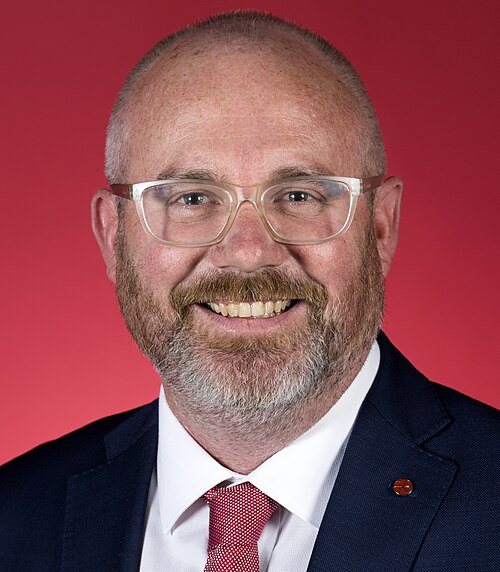
Tim Ayres
Australian Labor Party Senator for NSW
Currently sitting
Photo: (AUSPIC/DFAT), CC BY 4.0, via Wikimedia Commons
Seat and party history (1)
- Australian Labor Party - NSW (Senate) - 1 Jul 2019 to present
- Seat and party records: OpenAustralia member data.
Contact
Office: (02) 9159 9330
Level 3, 1A Lawson Square, Redfern NSW 2016
Office details: Parliament of Australia, CC BY-NC-ND 4.0.
Contact details on aph.gov.au Profile on OpenAustraliaThese counts cover what is on this site only. They do not measure electorate work or committee work.
Compared with other members
Tim Ayres compared with all 76 sitting senators.
Questions asked in Question Time
Lower than 87% of senators- This member
- 0
- Average
- 10.4
- Median
- 10
Debates spoken in
Higher than 95% of senators- This member
- 96
- Average
- 44.8
- Median
- 40
Votes cast
Higher than 51% of senators- This member
- 736
- Average
- 743.0
- Median
- 730
Share of divisions voted in
Lower than 51% of senators- This member
- 66%
- Average
- 69%
- Median
- 69%
Read these with care
- The median is the middle member: half did more, half did less. It is less affected by a few very active members than the average.
- Ministers answer questions rather than ask them, and the presiding officers rarely vote, so their patterns differ.
- Government backbenchers are often given arranged "Dorothy Dixer" questions, which raises their question counts.
- Votes only record ayes and noes, so a missed vote cannot be told apart from a pair (an agreed absence).
- Counts cover only what is on this site, and do not measure electorate or committee work. New members have less history.
Question Time
No questions recorded for this member.
Question from Deborah O'Neill
The senator asked how the government is securing a future made in Australia and helping industry invest and grow.
Background: The government has invested in various industrial facilities across Australia to secure future manufacturing capacity.
Answer from Tim Ayres
The minister listed supported facilities including Tomago Aluminium, Boyne smelter, and Whyalla steel. He criticized opposition claims about energy costs as deliberate falsehoods. In response to supplementary questions, he reported a 43 per cent increase in manufacturing exports, $56 billion in additional exports, and a 35 per cent rise in manufacturing investment. He stated there are 7,000 more manufacturing firms than when the government took office and that the manufacturing share of GDP had risen by 22 per cent. He identified the risk as dishonest political campaigns that undermine industrial progress.
Question from Helen Polley
The senator asked how the gas reservation reform would deliver affordable gas and support long-term industrial futures. In supplementary questions, she asked why the government prioritised this approach and whether the policy would increase gas supply and lower electricity prices, citing a previous speech by a senator.
Background: The government announced a plan to reserve domestic gas for Australian households and industry first.
Answer from Tim Ayres
The minister stated the plan reserves gas for Australians and industry, strengthening the economy and supporting the energy transition. He argued that opposing gas reservation is incompatible with supporting manufacturing and blue-collar jobs. He confirmed that the policy would increase gas supply and lower electricity and gas prices, noting that Senator Hanson had previously supported this view before changing her position.
Question from Fatima Payman
The senator asked what commitments the government would make at COP31 to connect climate action with women's welfare. In supplementary questions, she asked if the government would commit to a gender-transformative climate finance framework and whether it would close the gap in per capita climate finance compared to the UK and Germany.
Background: ActionAid advocates raised concerns about the disproportionate impact of climate change on women.
Answer from Tim Ayres
The minister acknowledged the disproportionate impact of climate change on women and regional security. He stated the government is developing its approach to climate negotiations in the national interest, focusing on security and competitive advantage in energy. He did not provide specific commitments on finance frameworks or closing the per capita gap, instead highlighting global clean energy investment and the role of renewables in saving industrial jobs like Tomago Aluminium.
Question from Larissa Waters
The senator asked why the government was prioritizing gas corporations over Australians and climate safety by proposing a weak gas reservation instead of a substantial export tax. She asked if the government planned to deal with the Coalition to benefit gas corporations rather than introducing a tax that would raise $17 billion annually and lower energy prices. She also asked if the minister acknowledged that gas export taxes were fundamentally broken.
Background: The government proposed a 20 per cent gas reservation instead of a 25 per cent gas export tax, with potential carve-outs for corporations.
Answer from Tim Ayres
The minister described the gas reservation plan as the most significant reform in Australian gas history, designed to ensure sovereign resilience, industrial competitiveness, and lower prices for households and industry. He argued that the reservation would secure sufficient gas for Australian manufacturing and heavy industry, supporting blue-collar jobs. He characterized the gas tax as merely a revenue measure, whereas the reservation was a structural reform to ensure future competitiveness. He stated that the reform placed a heavy obligation on gas producers in the national interest and would be brought to parliament.
Question from Varun Ghosh
The member asked what actions the government was taking to secure affordable gas for Australian households and businesses, citing previous energy crises under the former coalition government. He sought details on how the new plan would strengthen national resilience.
Background: The government announced a plan for a domestic gas reservation to address energy shortages and price shocks. The question sought to highlight the government's actions to secure affordable gas for households and businesses.
Answer from Tim Ayres
The minister announced a domestic gas reservation plan reserving up to 20 per cent of gas exports for domestic use to lower prices and fix supply shortages. He noted that gas prices had fallen from around $60 a gigajoule and highlighted support from manufacturers like BlueScope and Manufacturing Australia. He criticized the previous government's lack of action and contrasted the current plan with the opposition's previous proposals. In response to supplementaries, he warned against policies proposed by One Nation that could threaten the Tomago aluminium smelter and rail investments.
Question from Vanessa Bleyer
The member asked if the government would immediately require a decrease in stocking levels at Macquarie Harbour following the announcement. She later asked if the government would end industrial-scale fish farming to protect the endangered Maugean skate from oxygen depletion and extreme weather events.
Background: Animals Australia announced findings of unlawful and inhumane treatment of salmon at Tasmanian fish farms, citing overstocking at Macquarie Harbour.
Answer from Tim Ayres
The minister stated that the government supported the aquaculture industry, which contributed over $1.3 billion to the Tasmanian economy. He noted that state governments held constitutional responsibility for managing aquaculture within three nautical miles, limiting federal intervention. He emphasized the government's commitment to both environmental protection and job delivery, stating that the industry must operate responsibly. He did not commit to ending the industry or reducing stocking levels, citing the need for balanced outcomes.
Question from Charlotte Walker
The member asked how these changes were helping Australians buy their first home. She later asked what economists and stakeholders were saying about the reforms and how the government's policy compared with others.
Background: The government announced reforms to help first home buyers, including limiting negative gearing and replacing the capital gains tax discount.
Answer from Tim Ayres
The minister stated that house prices had risen by 400 per cent since 1999 and that the government was setting a target of 1.2 million homes. He highlighted reforms including limiting negative gearing to new builds and expanding the five per cent home deposit scheme. He cited support from organizations like ACOSS and National Shelter, and noted that NAB's chief economist predicted owner-occupiers would benefit.
Question from Tammy Tyrrell
The senator asked what the government was doing to help Australians achieve homeownership. She followed up by asking how the government ensures homes are safe and decent, and what alternative approaches might risk safety.
Background: Concerns persisted about housing affordability and safety standards.
Answer from Tim Ayres
The minister outlined a $47 billion housing package, including five per cent home deposits and the construction of social and affordable homes. He emphasized that decent housing standards include safety features such as swimming pool barriers, smoke alarms, and protections against bushfires and floods. He criticized the opposition's policy development unit and suggested that their alternative approaches risked lowering standards, referencing international housing disasters. He did not provide specific details on the opposition's proposed policies beyond general criticism.
Question from Barbara Pocock
The senator asked what the government would say to a worker facing potential homelessness due to rising rents, and why the government had not implemented rent caps or freezes to address the rental crisis.
Background: A nurse described severe housing insecurity and high rent costs, prompting a question about the government's failure to cap rents despite rising costs outpacing wages.
Answer from Tim Ayres
The minister argued that rent caps hinder new home construction and are ineffective policy measures. He highlighted the government's agenda to deliver 55,000 social and affordable rental homes and 100,000 homes for first-home buyers. He criticized the Greens for blocking the Housing Affordability Future Fund legislation and noted $47 billion in measures for home construction.
Question from Deborah O'Neill
The senator asked the minister to explain how the government's manufacturing investments, including the Tomago Aluminium project, contribute to national resilience and create well-paid jobs in regional areas.
Background: The government announced a $2.5 billion investment with New South Wales to secure the future of the Tomago Aluminium smelter, supporting over 6,000 jobs.
Answer from Tim Ayres
The minister stated that the investment secured 6,000 jobs in the Hunter region through renewable energy and storage initiatives. He highlighted that over 35,000 jobs had been secured across regional economies through the Future Made in Australia approach. He noted that 712,000 more manufacturing businesses existed than before the government took office, with over $1.65 billion invested via the National Reconstruction Fund.
Question from David Pocock
The senator asked if Australia was doomed to repeat mining boom mistakes by failing to capture tax benefits from AI investments. He asked if the government would mandate sovereign Australian capability in procurement to ensure local companies benefit from the AI value chain.
Background: The Assistant Minister for Science had given a speech on AI economic benefits without mentioning tax contributions from multinational tech companies.
Answer from Tim Ayres
The minister stated that all firms investing in Australia must pay their fair share of tax, noting Australia's leadership in OECD multinational tax discussions. He emphasized the government's focus on legislating AI standards for data centres to ensure they support the national electricity grid and economic resilience. He affirmed the goal of capturing as much AI training investment and technology stack development as possible within Australia, from critical minerals to chip manufacturing.
Question from Deborah O'Neill
The member asked how the investment would strengthen job security for Hunter workers and the local economy, and what it meant for Australia's manufacturing capability.
Background: The government announced a plan to secure the future of Tomago Aluminium and the Hunter region's industrial base.
Answer from Tim Ayres
The minister stated the deal provides certainty for the facility through to 2038-39, supporting 1,000 direct employees and 512,000 related jobs. He highlighted the shared approach with the NSW government to build necessary electricity infrastructure. He emphasized that the investment would deliver hundreds of apprenticeships and strengthen Australia's industrial capability and fairness.
Question from Pauline Hanson
The member asked why the government was interfering in land purchases to turn farmland into carbon credits, risking national food security, and whether a conflict of interest existed regarding the Clean Energy Finance Corporation chair.
Background: The government approved the sale of Rushy Lagoon to foreign owners for conversion to forest for carbon credits, with Clean Energy Finance Corporation funding.
Answer from Murray Watt; Tim Ayres
Minister Watt initially deferred to the Treasurer or Climate Change Minister. Minister Ayres then responded, stating the land is classified as Class 5 and 6, not prime agricultural land, and that both agriculture and forestry will continue. He confirmed that Steven Skala recused himself from the Foreign Investment Review Board decision. He noted the project would create around 190 jobs and that the land was previously targeted for forestry by the Liberal government.
Question from Barbara Pocock
The member asked how the government could allow property investors to exploit the five per cent deposit scheme during a housing crisis. She questioned the effectiveness of the Housing Australia Future Fund given that social housing stock grew by only 56 houses last year, and asked how the government addressed the needs of 640,000 Australians in extreme housing stress.
Background: The member criticised the five per cent deposit scheme for allegedly turbocharging prices and allowing investors to flip homes, and cited low growth in social housing stock.
Answer from Tim Ayres
The minister stated that 270,000 Australians, mostly young people, had accessed homes through the scheme, and dismissed claims about flipping as hyperbolic. He cited individual success stories of first home buyers. In response to questions about social housing, he noted that over 660,000 homes had been constructed since the government was elected, with more than 7,000 completed with Commonwealth investment. He highlighted a $47 billion program for social and affordable housing and provided another example of a first home buyer in Melbourne who used the scheme to purchase a unit.
Question from Malcolm Roberts
The member asked if energy companies were profiteering or if the government was hiding the real cost of electricity, and whether Australians were deceived about the benefits of rooftop solar.
Background: The member cited increases in daily connection fees for solar customers, rising from 26 cents to $1.46 a day, and falling feed-in tariffs.
Answer from Tim Ayres
The minister accused the previous energy minister of concealing price rises. He stated that the government had provided three free hours of solar power for 455,000 Australians with home batteries, resulting in zero electricity costs for those households. He argued that these benefits primarily aided people in outer suburbs and regions. In supplementary answers, he claimed that One Nation opposed solar electricity and that the previous government had wrecked the electricity system and fuel refineries, causing energy insecurity.
Question from Glenn Sterle
The member asked how the government was helping small businesses grow and create jobs. He later asked how these measures supported regional communities and why the government had taken this approach.
Background: The member asked about government measures to support small businesses, including recent announcements of financial support.
Answer from Tim Ayres
The minister stated that the government was providing over $3.8 billion in fresh initiatives, such as making the $20,000 instant asset write-off and two-year loss carry-back permanent from 1 July. He mentioned tax reductions for 1.5 million sole traders, such as the $250 Working Australians Tax Offset, and $8 billion for mental health and financial wellbeing. The minister pointed out that the National Reconstruction Fund had lent hundreds of millions to small businesses in freight and logistics, and that the government was securing fertiliser and fuel supplies for regional agriculture.
Question from David Pocock
The member asked why there was no detailed funding profile for NCRIS in the budget and if the government could guarantee funding post-2028-29. He later asked about the delay in implementing recommendations from the Strategic Examination of Research and Development.
Background: The member noted the absence of a detailed funding profile for NCRIS in the budget and asked about the 2028-29 funding cliff.
Answer from Tim Ayres
The minister stated that the government assessed research infrastructure requirements as part of normal budget processes. He highlighted an additional $387.4 million for the CSIRO in the budget, on top of existing funding. Regarding the Strategic Examination report, he stated that a substantial part had been dealt with in the budget and that the government was delivering substantial funding rather than just talking. He noted the establishment of the National Resilience and Science Council, which would be legislated to direct research and development efforts.
Question from Raff Ciccone
The member asked what actions the government was taking to strengthen the manufacturing industry and support businesses facing global supply chain pressures. He specifically asked about the Economic Resilience Program.
Background: The government had announced support for the manufacturing sector, including the Economic Resilience Program.
Answer from Tim Ayres
The minister stated that the government had delivered the biggest pro-manufacturing package in history, with 712,000 more manufacturing firms since 2020 and a 43 per cent increase in exports. He detailed that the Economic Resilience Program had approved over $220 million in zero-interest loans for more than 240 firms, primarily small and medium businesses in freight and logistics. He highlighted support for specific industries, including smelters and steel production, and criticised the opposition for lacking industrial policy.
Question from Carol Brown
The senator asked how the Cheaper Home Batteries Program helped households weather energy shocks. She also asked about the risks to energy security if renewable policies were reversed.
Background: Global energy markets were under pressure, and the government announced new energy storage projects.
Answer from Tim Ayres
The minister stated that the Cheaper Home Batteries Program had facilitated 450,000 installations, providing 12 gigawatts of capacity. He noted that 15 new large-scale storage projects were announced, attracting $6 billion in private investment. He argued that renewables secured energy supply against global shocks and criticised the opposition for wrecking electricity investment.
Question from Josh Dolega
The senator asked what actions the government had taken to shield Australians from the impacts of the conflict on fuel prices and supply. He sought details on specific measures to ensure fuel security.
Background: Global energy markets were disrupted by conflict in the Middle East, raising concerns about fuel supply in Australia.
Answer from Tim Ayres
The minister reported that Australia had 44 days' worth of petrol, 39 days' worth of diesel, and 32 days' worth of jet fuel, all increases since the conflict began. He noted that fuel stocks were at their highest level since the minimum stockholding obligation commenced in 2023, with 51 ships en route and 3.9 billion litres contracted for delivery. In response to supplementary questions, he stated that Export Finance Australia had secured an additional 50 million litres of diesel and that a shipment of urea had docked in Brisbane. He confirmed that supplies of diesel totalling 800 million litres, jet fuel amounting to 155 million litres, and 340,000 tonnes of fertiliser had been secured. He also highlighted a $14.8 billion budget package for fuel security, including $3.2 billion for a strategic fuel reserve.
Question from Carol Brown
The member asked how budget measures would help Australians buy homes and impact housing supply. She further inquired about progress in delivering social and affordable homes and the benefits of increased supply for renters and buyers.
Background: The question sought to highlight the government's achievements in building homes and making housing fairer.
Answer from Tim Ayres
The minister stated that changes to capital gains tax and negative gearing leveled the playing field for young Australians. He noted that over 660,000 homes had been built since the government took office, with housing starts up 26 per cent. The minister highlighted the delivery of 55,000 affordable new homes, with more than 6,000 already completed, and a further $2 billion investment in infrastructure to unlock tens of thousands of additional homes.
Question from David Pocock
The member asked if mandatory offsetting rules confirmed that voluntary expectations were insufficient. He further inquired about the trade-offs between data centre development and housing construction, and the lack of clear guardrails.
Background: The question addressed reports that the government might require data centres to offset their power usage, questioning the sufficiency of voluntary expectations.
Answer from Tim Ayres
The minister denied that voluntary expectations were insufficient, stating they were being operationalized through state planning approvals. He emphasized the need for data centre developers to invest in additional electricity generation and transmission to lower prices. The minister highlighted the government's commitment to securing tech investment in Australia's national interest while ensuring cooperation with states to manage energy impacts.
Question from Varun Ghosh
The senator asked what actions the government was taking to secure Australia's fuel and supply chains. Supplementary questions asked how the gas reservation policy would benefit households and businesses, and what the risks were if energy sovereignty was not strengthened.
Background: Global energy markets were disrupted by war in the Middle East, prompting government focus on energy sovereignty.
Answer from Tim Ayres
The minister detailed a $10 billion investment in fuel and fertiliser security, including a $7.5 billion facility for Export Finance Australia to derisk shipments. He announced a $3.2 billion Australian fuel security reserve for long-term diesel and aviation fuel, and an increase in minimum stockholding obligations to 50 days. Regarding gas reservation, he stated it would deliver cheaper gas, shield the economy from shocks, and preserve export relationships. He contrasted this with the previous government's record, citing poor energy infrastructure and high gas prices.
Question from David Pocock
The senator asked what modelling the government had commissioned regarding the fiscal and labour market impacts of AI, and when it would be made public. Supplementary questions asked if the government would commit to taxing tech companies like Microsoft to address unemployment risks, and whether Treasury had modelled the projected reduction in income tax from AI impacts.
Background: Warnings were issued that AI could lead to significant job losses, and concerns were raised about tech companies capturing productivity gains.
Answer from Tim Ayres
The minister referred to a publicly released report from Jobs and Skills Australia and the National AI Plan, which aimed to spread benefits across regions. He mentioned data centre expectations and commitments from proponents regarding energy additionality. In response to the supplementary questions, he stated he had not heard the specific figure of 600,000 job losses. He emphasized the importance of securing sovereign AI capacity and ensuring Australia remained competitive, rather than focusing on specific tax modelling for tech companies.
Question from David Pocock
The senator asked how the voluntary expectations for data centres would be enforced, given that legislation was required for other tech regulations. He asked how the government would ensure big tech companies complied with commitments on water, energy, and jobs.
Background: The government released voluntary national expectations for data centres.
Answer from Tim Ayres
The minister explained that enforcement relied on federal support being conditional on alignment with the expectations. He stated that proposals not meeting the expectations would not receive federal support. He noted that state and territory planning approvals would embed these principles, and that the government was working with states to ensure no race to the bottom occurred. He emphasized that the Artificial Intelligence Safety Institute would also play a role in ensuring investments delivered for Australians.
Question from Ellie Whiteaker
The senator asked what the government was doing to protect regional communities from energy and supply chain shocks. She specifically asked about the importance of new Export Finance Australia powers for regional areas and actions to strengthen sovereign supply chain capability.
Background: Rising fuel and fertiliser prices were impacting regional communities and farmers.
Answer from Tim Ayres
The minister highlighted the halving of the fuel excise and the reduction of heavy vehicle road user charges to zero for three months. He explained that new EFA powers would de-risk additional fertiliser and fuel shipments, keeping markets flexible. He cited the government's intervention to support the Mount Isa copper smelter, which produces domestic fertiliser, as an example of strengthening sovereign capability through the Future Made in Australia agenda and gas reservation strategy.
Question from Helen Polley
The member asked for an update on the new powers granted to Export Finance Australia to underwrite imports and how these would help secure fuel supply.
Background: National Cabinet met to coordinate future planning and action regarding disrupted global energy market supply chains.
Answer from Tim Ayres
The minister confirmed that legislation to enable Export Finance Australia to underwrite extra fuel and fertiliser cargoes would be introduced. This measure aimed to de-risk private-sector shipments and address regional shortages without replacing domestic market operations. He also noted the government's intervention to keep the Dyno Nobel Phosphate Hill facility operating as a domestic fertiliser producer.
Question from Barbara Pocock
The member asked whether the government would commit to scrapping tax breaks for property investors in the May budget to address housing inequality.
Background: The government faced criticism for allocating $53 billion to tax breaks for affluent property owners, with assertions that this exacerbated the housing crisis.
Answer from Tim Ayres
The minister stated that tax policy announcements would be made in the budget, but the government's focus remained on delivering tax cuts for every taxpayer. He argued that intergenerational equity was addressed through these tax cuts and that the government's housing agenda focused on increasing supply through the Housing Affordability and Future Fund and other measures.
Question from Jana Stewart
The member asked for an update on the status of Australia's fertiliser market amidst global supply chain disruptions. She sought to understand how the government was ensuring national resilience in this sector.
Background: Disruptions in the Middle East were affecting global fertiliser markets, with Australia relying heavily on imports for urea.
Answer from Tim Ayres
The minister stated that Australia imported more than 65 per cent of its fertiliser-grade urea, but near-term planting demand was largely covered. He noted that the government was exploring contingency sources in South-East Asia. He highlighted that the purchase of Phosphate Hill secured domestic production of MAP and DAP fertilisers. He confirmed that ministers had met with industry representatives, including the National Farmers' Federation, and that the ACCC was working to allow sector coordination. He linked these measures to the Future Made in Australia agenda, citing interventions in steel, critical minerals, and gas reservation as strengthening national resilience.
Question from Pauline Hanson
The member asked if the government would declare a fuel emergency to stop alleged price gouging by major oil companies and ensure supply to regional independents. She claimed big oil was strangling regional suppliers.
Background: One Nation called for a fuel emergency declaration under the Liquid Fuel Emergency Act 1984 to force supply to regions and stop price gouging.
Answer from Tim Ayres
The minister stated that the government was aware of the powers in the Liquid Fuel Emergency Act but judged that current practical actions were more effective. He highlighted the release of 20 per cent of fuel reserves and new ACCC powers to prevent anti-competitive behaviour. He noted that the government had introduced laws to double penalties for misleading conduct to $100 million and enabled the Fair Work Commission to demand fair pay for truckies during price spikes. He did not commit to cutting the excise or GST, instead focusing on existing regulatory and supply-side measures.
Question from Matt O'Sullivan
The member asked what the minister said to Australians cancelling Easter plans due to the fuel crisis. He cited specific individuals unsure if they could travel due to cost and supply concerns.
Background: Reports indicated Australians were cancelling Easter travel plans due to high fuel prices and fears of shortages.
Answer from Tim Ayres
The minister reiterated that the conflict in the Middle East was causing a global energy shock. He listed government actions including doubling penalties for misleading conduct, convening National Cabinet, appointing a taskforce coordinator, releasing 20 per cent of fuel reserves, and changing petrol standards. He stated he could guarantee the government would continue to act in the national interest but did not provide a specific guarantee regarding individual travel plans. He criticised the opposition for a partisan approach rather than joining the government in acting in the national interest.
Question from Claire Chandler
The member asked why the government could not disclose the number of service stations across Australia that had run dry, implying a lack of control over the crisis. She sought specific national data on fuel availability.
Background: The member questioned the government's ability to provide national figures on service stations running out of fuel, citing a previous inability by Minister Bowen to do so.
Answer from Tim Ayres
The minister stated that the government possessed the figures and had been transparent, noting that 164 petrol stations in New South Wales lacked diesel. He explained that 20 per cent of minimum stockholding had been released to assist independent retailers, particularly in regional areas where winter planting was occurring. In response to the supplementary, he reported that nationally, nine per cent of petrol stations had one or more fuel grades unavailable, with specific figures for Tasmania showing 0.4 per cent without diesel and two per cent without unleaded petrol. He clarified that the government provided weekly updates on stockholding levels rather than daily commercial-in-confidence data, urging Australians not to purchase more than required.
Question from Sarah Henderson
The member asked when the government became aware of the six cancelled fuel shipments and whether any further shipments had been contracted, asserting this was a matter of national interest.
Background: The member followed up on a previous question regarding when the government became aware of six cancelled fuel shipments.
Answer from Tim Ayres
The minister updated the figure of petrol stations with unavailable fuel grades from nine per cent to eight per cent. He stated that the Minister for Climate Change and Energy had been in daily contact with fuel companies since the Middle East crisis began, with companies locking in supply until mid-April. He declined to release commercial-in-confidence information daily but confirmed that on Saturday, he discussed cancelled ships with industry representatives. In response to supplements, he provided days of supply figures as of 17 March: 38 days for unleaded petrol, 30 days for jet fuel, and 30 days for diesel. He also announced changes to diesel standards to free up more supply.
Question from Sean Bell
The member asked what the government was doing to stop fuel failures from driving up the cost of PVC pipes and other building materials. He later asked if the government would back a GST exemption on building materials and when it would scrap net zero targets.
Background: The member claimed fuel failures were driving up prices of building materials like PVC pipes by up to 35 per cent.
Answer from Tim Ayres
The minister attributed fuel challenges to the Iranian government's blockade of the Strait of Hormuz, not government failure. He acknowledged that prices for PVC piping were rising but stated there were no immediate shortages. He highlighted the government's minimum stockholding obligation, which was larger than it had been for 15 years. He rejected the call for a GST exemption and defended the government's energy security approach, noting that Australia had reduced from six to two refineries under the previous government. He dismissed the link between net zero policies and the current supply issues.
Question from Michelle Ananda-Rajah
The member asked what Horizon Europe was and what benefits association would provide for Australian scientists. She later asked about the contribution of scientists to national resilience and how the government recognised their work.
Background: The government announced it would enter formal negotiations to associate with the Horizon Europe research scheme.
Answer from Tim Ayres
The minister characterised Horizon Europe as the world's biggest source of research and innovation money, with a budget of A$155 billion. He stated that association would allow Australian scientists to mount joint research efforts and apply for substantial grants in areas such as agriculture, artificial intelligence, and quantum science. He linked this to broader resilience measures and referenced the 'Ambitious Australia' report, which noted $15 billion being spent on 160 research and development programs this financial year. He affirmed the government's unequivocal support for research institutions and scientists.
Question from Maria Kovacic
The member asked what steps the government had taken to ensure offline ammonia facilities returned to operation, given their critical role in agriculture and mining. She later asked about contingencies for shortages and if the government could guarantee fertiliser supply.
Background: Reports indicated that major ammonia plants in Pilbara and Kooragang were offline, while fertiliser supplies through the Strait of Hormuz were halted.
Answer from Tim Ayres
The minister noted that Australia imported approximately 65 per cent of its urea-based fertilisers and that local ammonia capacity was important for mining explosives as well as fertiliser. He stated that the government was working with suppliers, importers, and industry bodies like the National Farmers' Federation to coordinate actions. He mentioned that there was no immediate national shortage of fertilisers but that winter planting was commencing. He confirmed that the government was engaging with alternative suppliers in South-East Asia and that the coordinator-general was meeting with state and territory counterparts to ensure sector coordination.
Question from Michaelia Cash
The member asked whether the minister would apologise for previously characterising concerns about fuel shortages as extremist rhetoric, given that six shipments had been cancelled and consumers were facing high prices.
Background: The member referenced previous government statements dismissing fuel shortage warnings as scaremongering, contrasting them with recent cancelled shipments and rising prices.
Answer from Tim Ayres
The minister rejected the premise, accusing the opposition of hyperpartisan behaviour. He highlighted government actions including implementing minimum stockholding obligations, empowering the ACCC against price gouging, and appointing a coordinator-general to manage supply.
Question from Bridget McKenzie
The member asked why specific regional areas were experiencing fuel stockouts if the government maintained that national fuel supplies were robust.
Background: The member cited reports of petrol stations in New South Wales running out of diesel and fuel, contradicting ministerial claims of strong supply.
Answer from Tim Ayres
The minister explained that 519 million litres of new supply were being prioritised for regional demand. He listed specific towns receiving additional fuel, including Hay, Griffith, Gunnedah, Orange, and Dubbo, noting cooperation with state governments to distribute national stockholdings.
Question from Karen Grogan
The member asked the minister to detail the steps taken to maintain fuel supplies for Australian consumers and industries.
Background: The member sought an outline of government interventions to ensure fuel availability for households and businesses.
Answer from Tim Ayres
The minister reported releasing 762 million litres of petrol and diesel from national stockholdings and temporarily lowering fuel standards to retain 100 million litres monthly. He also highlighted doubled ACCC penalties for price gouging and cartel behaviour.
Question from Jonathon Duniam
The member asked when the government was first advised of cancelled fuel shipments and how many new contracts had been secured since the conflict began.
Background: The member highlighted contradictions between earlier government denials of a supply problem and current acknowledgments of a crisis.
Answer from Tim Ayres
The minister stated that six out of 81 shipments had been deferred or cancelled, a fact that had only recently become clear. He emphasised that the government was swapping in fuel capacity and maintaining domestic reserves, contrasting this with previous government policies.
Question from Tyron Whitten
The member asked whether the government had the power to ration fuel if the crisis worsened and whether it could guarantee supplies would not run out.
Background: The member claimed Australia's fuel storage levels were below international requirements and questioned government preparedness.
Answer from Tim Ayres
The minister did not directly address rationing powers but guaranteed that domestic reserves were being used to address undersupply issues. He contrasted current domestic storage with previous government practices of storing reserves overseas.
Question from Jessica Collins
The member asked why fuel was not reaching Australians despite reported high stock levels. She questioned the location of the supplies and the reasons for the disconnect between national reserves and local availability for farmers and fishermen.
Background: The minister had previously stated that Australia held 1.56 billion litres of petrol and 2.97 billion litres of diesel, with 80 per cent of petrol on land. Regional communities reported fuel rationing and shortages.
Answer from Tim Ayres
The minister stated that the government was ensuring minimum stockholding obligations were exceeded and that updated figures would be released. He announced that fuel standards regarding sulphur levels were temporarily amended for 60 days to allow Ampol to redirect export-bound petrol to the domestic market. He confirmed that the national coordination mechanism had been activated to address supply chain issues and that additional supply was being directed to regional areas via the spot market.
Question from Varun Ghosh
The member asked the minister to explain the policy change and how it would ease pressure on the fuel market. He sought details on the government's response to international energy disruptions.
Background: Global energy markets were disrupted by the Middle East war. The government announced measures to increase fuel supply to the Australian market.
Answer from Tim Ayres
The minister explained that fuel quality standards were temporarily amended to allow higher sulphur levels for 60 days, enabling 100 million litres of additional monthly supply from Ampol. He stated that this supply would be prioritized for regions with shortages and the wholesale spot market. He confirmed that the national coordination mechanism would continue to address supply chain bottlenecks.
Question from Dean Smith
The member asked why farmers were being turned away if fuel supplies were strong. He questioned the government's grip on fuel distribution given local shortages.
Background: A service station in York, Western Australia, was running out of fuel and imposing limits. Farmers were being turned away despite government claims of strong stocks.
Answer from Tim Ayres
The minister stated that the government had directed the ACCC to remove obstacles to fuel companies coordinating supply. He explained that demand spikes affected different regions differently, particularly where retailers accessed the spot market. He confirmed that 100 million litres of additional monthly supply would be available due to changed fuel standards.
Question from Richard Colbeck
The member asked why diesel was unavailable for fishing boats if national fuel supplies were robust. He requested evidence of hoarding or supply chain bottlenecks and asked what actions the government had taken to ensure fuel reached regional communities and industries.
Background: The government claimed strong national fuel supplies, while fishing industry participants reported severe diesel shortages.
Answer from Tim Ayres
The minister stated that national fuel stocks remained stable, with 1.56 billion litres of petrol and 2.97 billion litres of diesel available, unchanged since the Middle East conflict began. He attributed regional shortages to unusual purchasing behaviour and a 40 per cent spike in demand reported by the National Farmers' Federation, rather than a supply deficit. The minister announced that fuel supply data would be released weekly to improve transparency and noted that industry was working to communicate effectively with the community to manage purchasing behaviour.
Question from Matthew Canavan
The member asked what practical actions the government had taken to protect businesses like Ripple Creek Transport and regional airline passengers from fuel price gouging. He also asked how many businesses the ACCC was investigating for price gouging and whether the government had requested an emergency oil release from the International Energy Agency.
Background: A Townsville transport business reported a 60 per cent fuel price increase, and an airline warned of a 70c per litre rise.
Answer from Tim Ayres
The minister announced that fines for deceptive practices and anti-competitive agreements would be doubled to a maximum of $100 million per offence. He stated that the ACCC was ramping up fuel monitoring with weekly reports focusing on unusual price spikes and was working with industry to secure authorisation to coordinate supply and remove bottlenecks. Regarding the number of ACCC investigations and the IEA request, the minister declined to provide specific details at that stage, stating he would provide more information later.
Question from Jacinta Nampijinpa Price
The member asked why regional Australians were being left without fuel if there was no supply problem, citing reports of rationing and potential service station closures. She challenged the government's dismissal of these concerns as misinformation.
Background: Regional petrol station owners reported enforcing fuel limits and potential shutdowns due to supply issues.
Answer from Tim Ayres
The minister reiterated that there was no national supply problem, citing 1.56 billion litres of petrol and 2.97 billion litres of diesel in stock. He attributed regional rationing to a sudden rush in consumer demand, with some customers buying four times their usual amount, rather than a lack of fuel. He stated that the Australian Institute of Petroleum confirmed sufficient supply to meet normal demand and urged political leaders to communicate the truth to avoid spreading misinformation.
Question from Fatima Payman
The member asked why the government had abandoned the AI advisory board after a 15-month recruitment process and discarded work on a standalone AI act. She also asked how many times the minister had met with AI companies like OpenAI and Anthropic since taking office.
Background: Reports emerged of AI-generated misinformation involving public figures, and the government abandoned an AI advisory body.
Answer from Tim Ayres
The minister stated that the government's approach was outlined in the national artificial intelligence plan, focusing on economic advantage and establishing an AI safety institute with $29.9 million in funding. He argued that existing laws on workplace safety, consumer protection, privacy, and copyright were sufficient for regulation. Regarding meetings with AI companies, he declined to provide specific numbers, stating that his office met regularly with industry and that the implication of undue influence was offensive.
Question from Helen Polley
The member asked for an update on domestic fuel supply and government actions to protect businesses and households. She also asked why some buyers were being rationed and why refineries had closed since 2014.
Background: Global energy market volatility continued due to the Middle East conflict.
Answer from Tim Ayres
The minister confirmed that the National Oil Supplies Emergency Committee found no shortage of supply, with stocks of 1.56 billion litres of petrol, 802 million litres of jet fuel, and 2.97 billion litres of diesel. He attributed rationing to spikes in consumer purchasing behaviour. Regarding refinery closures, he blamed the previous government for neglecting national interest and cited Geoscience Australia's finding that conventional oil reserves are depleting faster than new discoveries are made.
Question from Sarah Henderson
The member asked if the government accepted that fuel shortages were forcing transport operators and businesses to shut down, citing warnings of crop losses and livestock deaths. She challenged the government to admit the reality of the crisis.
Background: A fuel distributor reported severe wholesale price spikes and reduced distribution capacity.
Answer from Tim Ayres
The minister denied that Australia faced a supply challenge, stating that ships were arriving as predicted and stocks remained high. He attributed the crisis to unprecedented consumer demand and panic buying, citing the National Farmers' Federation's report of a 40 per cent increase in demand. He reiterated that penalties for price gouging were being doubled and accused opposition parties of spreading fear and division rather than addressing the issue transparently.
Other Parliamentary Activity
-
Social Security and Other Legislation Amendment (Technical Changes No. 2) Bill 2026, Telecommunications Legislation Amendment (Universal Outdoor Mobile Obligation) Bill 2026; Second Reading
Senate · Monday 14 September 2026 · Second Reading
Opened this debate
-
Social Security and Other Legislation Amendment (Technical Changes No. 2) Bill 2026, Telecommunications Legislation Amendment (Universal Outdoor Mobile Obligation) Bill 2026; First Reading
Senate · Monday 14 September 2026 · First Reading
Contributed to this debate
-
Customs Amendment (Safeguard Inquiries) Bill 2026; Third Reading
Senate · Monday 14 September 2026 · Third Reading
Contributed to this debate
-
Customs Amendment (Safeguard Inquiries) Bill 2026; Second Reading
Senate · Monday 14 September 2026 · Second Reading
Responded as minister
-
Criminal Code Amendment (National Sport Integrity Offences) Bill 2026; Second Reading
Senate · Monday 14 September 2026 · Second Reading
Opened this debate
-
Criminal Code Amendment (National Sport Integrity Offences) Bill 2026; First Reading
Senate · Monday 14 September 2026 · First Reading
Contributed to this debate
-
Artificial Intelligence
Senate · Monday 14 September 2026 · General Debate
Responded as minister
-
Universities Accord (Opening the Doors of Opportunity) Bill 2026; Second Reading
Senate · Monday 7 September 2026 · Second Reading
Opened this debate
-
Universities Accord (Opening the Doors of Opportunity) Bill 2026; First Reading
Senate · Monday 7 September 2026 · First Reading
Contributed to this debate
-
Counter-Terrorism Legislation Amendment Bill 2026; Second Reading
Senate · Thursday 20 August 2026 · Second Reading
Opened this debate
-
Counter-Terrorism Legislation Amendment Bill 2026; First Reading
Senate · Thursday 20 August 2026 · First Reading
Contributed to this debate
-
Administrative and Judicial Review Legislation Amendment Bill 2026; Second Reading
Senate · Thursday 20 August 2026 · Second Reading
Opened this debate
-
Administrative and Judicial Review Legislation Amendment Bill 2026; First Reading
Senate · Thursday 20 August 2026 · First Reading
Contributed to this debate
-
Wine and Other Legislation Amendment Bill 2026; Second Reading
Senate · Monday 17 August 2026 · Second Reading
Opened this debate
-
Wine and Other Legislation Amendment Bill 2026; First Reading
Senate · Monday 17 August 2026 · First Reading
Contributed to this debate
-
Cash Distribution Framework Bill 2026, Cash Distribution Framework (Consequential Amendments and Transitional Provisions) Bill 2026; Second Reading
Senate · Monday 17 August 2026 · Second Reading
Opened this debate
-
Cash Distribution Framework Bill 2026, Cash Distribution Framework (Consequential Amendments and Transitional Provisions) Bill 2026; First Reading
Senate · Monday 17 August 2026 · First Reading
Contributed to this debate
-
Biosecurity Amendment (Improving Operational Efficiency) Bill 2026; Second Reading
Senate · Monday 17 August 2026 · Second Reading
Opened this debate
-
Statute Update Bill 2026; Second Reading
Senate · Thursday 2 July 2026 · Second Reading
Opened this debate
-
Statute Update Bill 2026; First Reading
Senate · Thursday 2 July 2026 · First Reading
Contributed to this debate
-
Defence Legislation Amendment (Implementation of Related Measures No.2) Bill 2026, Health Insurance Amendment (Incentive Payments and Other Measures) Bill 2026; Second Reading
Senate · Thursday 2 July 2026 · Second Reading
Opened this debate
-
Defence Legislation Amendment (Implementation of Related Measures No.2) Bill 2026, Health Insurance Amendment (Incentive Payments and Other Measures) Bill 2026; First Reading
Senate · Thursday 2 July 2026 · First Reading
Contributed to this debate
-
Competition and Consumer Amendment (Unfair Trading Practices) Bill 2026; Third Reading
Senate · Thursday 2 July 2026 · Third Reading
Contributed to this debate
-
Competition and Consumer Amendment (Unfair Trading Practices) Bill 2026; In Committee
Senate · Thursday 2 July 2026 · In Committee
Responded as minister
-
Trade and Investment Agreements (Consultation) Bill 2026; Second Reading
Senate · Wednesday 1 July 2026 · Second Reading
Opened this debate
-
Trade and Investment Agreements (Consultation) Bill 2026; First Reading
Senate · Wednesday 1 July 2026 · First Reading
Contributed to this debate
-
Competition and Consumer Amendment (Unfair Trading Practices) Bill 2026; Second Reading
Senate · Wednesday 1 July 2026 · Second Reading
Responded as minister
-
Competition and Consumer Amendment (Unfair Trading Practices) Bill 2026; In Committee
Senate · Wednesday 1 July 2026 · In Committee
Responded as minister
-
Customs Tariff Amendment (Incorporation of Proposals) Bill (No. 1) 2026, Treasury Laws Amendment (Fuel Excise Relief No. 2) Bill 2026, Workplace Relations Legislation Amendment (Building Cooperative Workplaces No. 1) Bill 2026; First Reading
Senate · Thursday 25 June 2026 · First Reading
Contributed to this debate
-
Customs Tariff Amendment (Incorporation of Proposals) Bill (No. 1) 2026, Treasury Laws Amendment (Fuel Excise Relief No. 2) Bill 2026, Workplace Relations Legislation Amendment (Building Cooperative Workplaces No. 1) Bill 2026; Second Reading
Senate · Thursday 25 June 2026 · Second Reading
Opened this debate
-
Customs Amendment (Safeguard Inquiries) Bill 2026; Second Reading
Senate · Wednesday 24 June 2026 · Second Reading
Opened this debate
-
Customs Amendment (Safeguard Inquiries) Bill 2026; First Reading
Senate · Wednesday 24 June 2026 · First Reading
Contributed to this debate
-
Treasury Laws Amendment (Business Registries Stabilisation and Uplift) Bill 2026; Second Reading
Senate · Monday 22 June 2026 · Second Reading
Opened this debate
-
Treasury Laws Amendment (Business Registries Stabilisation and Uplift) Bill 2026; First Reading
Senate · Monday 22 June 2026 · First Reading
Contributed to this debate
-
Competition and Consumer Amendment (Unfair Trading Practices) Bill 2026, Defence Force Discipline Amendment (RCDVS Implementation and Related Measures No. 1) Bill 2026; Second Reading
Senate · Monday 22 June 2026 · Second Reading
Opened this debate
-
Competition and Consumer Amendment (Unfair Trading Practices) Bill 2026, Defence Force Discipline Amendment (RCDVS Implementation and Related Measures No. 1) Bill 2026; First Reading
Senate · Monday 22 June 2026 · First Reading
Contributed to this debate
-
Coal Mining Industry (Long Service Leave) Legislation Amendment Bill 2026, Secrecy Provisions Amendment (Repealing Offences) Bill 2026, Secrecy Provisions Amendment (Sunsetting Provision) Bill 2026, Telecommunications Amendment (Enhancing Consumer Safeguards) Bill 2025, Treasury Laws Amendment (Delivering an Efficient and Trusted Tax System) Bill 2026; First Reading
Senate · Monday 22 June 2026 · First Reading
Contributed to this debate
-
Coal Mining Industry (Long Service Leave) Legislation Amendment Bill 2026, Secrecy Provisions Amendment (Repealing Offences) Bill 2026, Secrecy Provisions Amendment (Sunsetting Provision) Bill 2026, Telecommunications Amendment (Enhancing Consumer Safeguards) Bill 2025, Treasury Laws Amendment (Delivering an Efficient and Trusted Tax System) Bill 2026; Second Reading
Senate · Monday 22 June 2026 · Second Reading
Opened this debate
-
Appropriation Bill (No. 5) 2025-2026, Appropriation Bill (No. 6) 2025-2026; Second Reading
Senate · Monday 22 June 2026 · Second Reading
Opened this debate
-
Appropriation Bill (No. 5) 2025-2026, Appropriation Bill (No. 6) 2025-2026; First Reading
Senate · Monday 22 June 2026 · First Reading
Contributed to this debate
-
Appropriation Bill (No. 1) 2026-2027, Appropriation Bill (No. 2) 2026-2027, Appropriation (Parliamentary Departments) Bill (No. 1) 2026-2027; Second Reading
Senate · Monday 22 June 2026 · Second Reading
Opened this debate
-
Appropriation Bill (No. 1) 2026-2027, Appropriation Bill (No. 2) 2026-2027, Appropriation (Parliamentary Departments) Bill (No. 1) 2026-2027; First Reading
Senate · Monday 22 June 2026 · First Reading
Contributed to this debate
-
Competition and Consumer Amendment (Responding to Exceptional Circumstances) Bill 2026; Second Reading
Senate · Thursday 14 May 2026 · Second Reading
Responded as minister
-
Competition and Consumer Amendment (Responding to Exceptional Circumstances) Bill 2026; In Committee
Senate · Thursday 14 May 2026 · In Committee
Responded as minister
-
Competition and Consumer Amendment (Responding to Exceptional Circumstances) Bill 2026; Second Reading
Senate · Wednesday 13 May 2026 · Second Reading
Opened this debate
-
Competition and Consumer Amendment (Responding to Exceptional Circumstances) Bill 2026; First Reading
Senate · Wednesday 13 May 2026 · First Reading
Contributed to this debate
-
Morris, Hon. Peter Frederick, OAM
Senate · Tuesday 12 May 2026 · Condolence
Contributed to this debate
-
Fuel
Senate · Monday 30 March 2026 · General Debate
Responded as minister
-
Migration Amendment (2026 Measures No. 1) Bill 2026; Second Reading
Senate · Thursday 12 March 2026 · Second Reading
Responded as minister
-
Fuel
Senate · Thursday 5 March 2026 · General Debate
Responded as minister
- Votes recorded
- 736
- Aye votes (30.8%)
- 227
- No votes (69.2%)
- 509
Showing the latest 50 votes.
-
Universities Accord (Opening the Doors of Opportunity) Bill 2026; Second Read
17 Sep 2026 · Ayes 21, Noes 32 · Failed
VOTED NO -
Universities Accord (Opening the Doors of Opportunity) Bill 2026; Second Read
17 Sep 2026 · Ayes 13, Noes 23 · Failed
VOTED NO -
Universities Accord (Opening the Doors of Opportunity) Bill 2026; Second Read
17 Sep 2026 · Ayes 13, Noes 23 · Failed
VOTED NO -
Defence Force Discipline Amendment (RCDVS Implementation and Related Measures...
17 Sep 2026 · Ayes 30, Noes 24 · Passed
VOTED AYE -
Selection of Bills Committee; Report
17 Sep 2026 · Ayes 12, Noes 28 · Failed
VOTED NO -
Military Rehabilitation and Compensation Amendment (Veterans' Healthcare With...
17 Sep 2026 · Ayes 33, Noes 19 · Passed
VOTED NO -
Military Rehabilitation and Compensation Amendment (Veterans' Healthcare With...
17 Sep 2026 · Ayes 34, Noes 19 · Passed
VOTED NO -
Migration
16 Sep 2026 · Ayes 19, Noes 30 · Failed
VOTED NO -
Personal Information and Privacy; Order for the Production of Documents
16 Sep 2026 · Ayes 30, Noes 19 · Passed
VOTED NO -
Maritime Industry; Order for the Production of Documents
16 Sep 2026 · Ayes 16, Noes 23 · Failed
VOTED NO -
Climate Change; Order for the Production of Documents
16 Sep 2026 · Ayes 16, Noes 23 · Failed
VOTED NO -
Census; Order for the Production of Documents
16 Sep 2026 · Ayes 23, Noes 30 · Failed
VOTED NO -
A New Tax System (Family Assistance) Amendment (No Jab No Pay Repeal) Bill 20...
16 Sep 2026 · Ayes 6, Noes 34 · Failed
VOTED NO -
Economy
15 Sep 2026 · Ayes 31, Noes 20 · Passed
VOTED NO -
Australian Federal Police; Order for the Production of Documents
15 Sep 2026 · Ayes 31, Noes 19 · Passed
VOTED NO -
Trade Unions; Order for the Production of Documents
15 Sep 2026 · Ayes 33, Noes 20 · Passed
VOTED NO -
Consideration of Legislation
15 Sep 2026 · Ayes 22, Noes 32 · Failed
VOTED NO -
Cybersafety Legislation; Order for the Production of Documents
15 Sep 2026 · Ayes 34, Noes 19 · Passed
VOTED NO -
Executive Remuneration; Order for the Production of Documents
15 Sep 2026 · Ayes 17, Noes 26 · Failed
VOTED NO -
Waste Management and Recycling; Order for the Production of Documents
15 Sep 2026 · Ayes 34, Noes 19 · Passed
VOTED NO -
Environment and Communications References Committee; Reference
15 Sep 2026 · Ayes 21, Noes 33 · Failed
VOTED NO -
Red Lines Package Omnibus Bill 2026; First Reading
15 Sep 2026 · Ayes 39, Noes 14 · Passed
VOTED AYE -
Artificial Intelligence
15 Sep 2026 · Ayes 35, Noes 20 · Passed
VOTED NO -
Wage Justice for Early Childhood Education and Care Workers (Special Account)...
15 Sep 2026 · Ayes 25, Noes 36 · Failed
VOTED NO -
Water
14 Sep 2026 · Ayes 16, Noes 24 · Failed
VOTED NO -
Cost of Living
14 Sep 2026 · Ayes 22, Noes 32 · Failed
VOTED NO -
Digital Seller Underperformance Policy; Order for the Production of Documents
14 Sep 2026 · Ayes 32, Noes 18 · Passed
VOTED NO -
Major Sporting Events (Indicia and Images) Protection Amendment Bill 2026; Th...
14 Sep 2026 · Ayes 31, Noes 18 · Passed
VOTED AYE -
Major Sporting Events (Indicia and Images) Protection Amendment Bill 2026; Se...
14 Sep 2026 · Ayes 31, Noes 18 · Passed
VOTED AYE -
Carbon Farming Initiative--Improved Forest Management in Multiple-use Public ...
10 Sep 2026 · Ayes 27, Noes 34 · Failed
VOTED NO -
Regulatory Reform Omnibus Bill 2026; In Committee
10 Sep 2026 · Ayes 12, Noes 24 · Failed
VOTED NO -
Regulatory Reform Omnibus Bill 2026; Second Reading
10 Sep 2026 · Ayes 6, Noes 32 · Failed
VOTED NO -
Regulatory Reform Omnibus Bill 2026; Second Reading
10 Sep 2026 · Ayes 4, Noes 34 · Failed
VOTED NO -
Regulatory Reform Omnibus Bill 2026; Second Reading
10 Sep 2026 · Ayes 4, Noes 34 · Failed
VOTED NO -
Regulatory Reform Omnibus Bill 2026; Second Reading
10 Sep 2026 · Ayes 23, Noes 32 · Failed
VOTED NO -
Treasury Laws Amendment (Strengthening Accountability for Tax Adviser Miscond...
10 Sep 2026 · Ayes 35, Noes 4 · Passed
VOTED AYE -
Defence Properties; Order for the Production of Documents
10 Sep 2026 · Ayes 36, Noes 21 · Passed
VOTED NO -
Rearrangement
10 Sep 2026 · Ayes 21, Noes 36 · Failed
VOTED AYE -
Housing; Order for the Production of Documents
10 Sep 2026 · Ayes 37, Noes 21 · Passed
VOTED NO -
Treasury Laws Amendment (Strengthening Accountability for Tax Adviser Miscond...
10 Sep 2026 · Ayes 37, Noes 4 · Passed
VOTED AYE -
Online Safety Amendment (Strengthening Enforcement for the Social Media Minim...
10 Sep 2026 · Ayes 31, Noes 20 · Passed
VOTED AYE -
Online Safety Amendment (Strengthening Enforcement for the Social Media Minim...
10 Sep 2026 · Ayes 32, Noes 21 · Passed
VOTED AYE -
Online Safety Amendment (Strengthening Enforcement for the Social Media Minim...
10 Sep 2026 · Ayes 22, Noes 31 · Failed
VOTED NO -
Online Safety Amendment (Strengthening Enforcement for the Social Media Minim...
10 Sep 2026 · Ayes 13, Noes 26 · Failed
VOTED NO -
Online Safety Amendment (Strengthening Enforcement for the Social Media Minim...
10 Sep 2026 · Ayes 20, Noes 30 · Failed
VOTED NO -
Online Safety Amendment (Strengthening Enforcement for the Social Media Minim...
10 Sep 2026 · Ayes 33, Noes 23 · Passed
VOTED AYE -
Superannuation
9 Sep 2026 · Ayes 21, Noes 34 · Failed
VOTED AYE -
Taxation; Order for the Production of Documents
9 Sep 2026 · Ayes 27, Noes 33 · Failed
VOTED NO -
Senate Estimates: Questions on Notice; Order for the Production of Documents
9 Sep 2026 · Ayes 37, Noes 22 · Passed
VOTED NO -
Rural and Regional Affairs and Transport References Committee; Reference
9 Sep 2026 · Ayes 23, Noes 35 · Failed
VOTED NO
About this page
This page tracks Tim Ayres's parliamentary activity: questions asked and answered in Question Time, debates spoken in, and votes in divisions. Summaries are in reported speech, not transcripts; each one links to the official record.