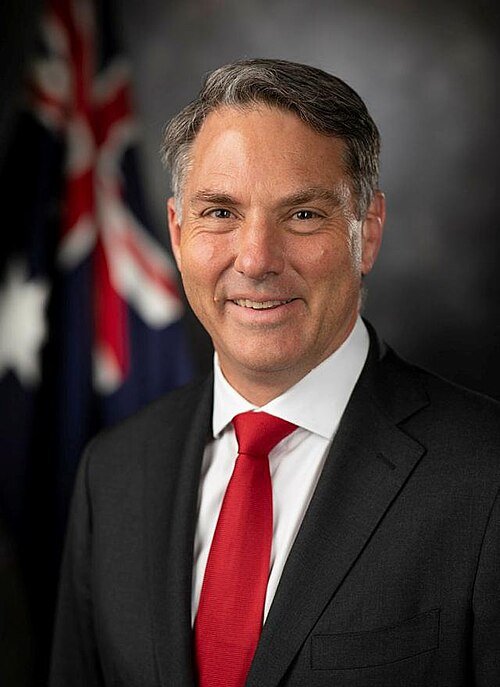
Richard Marles
Australian Labor Party Member for Corio
Currently sitting
Photo: Commonwealth of Australia - Department of Defence, CC BY 4.0, via Wikimedia Commons
Seat and party history (1)
- Australian Labor Party - Corio (House) - 24 Nov 2007 to present
- Seat and party records: OpenAustralia member data.
Contact
Electorate office: (03) 5221 3033
Suite 1, Ground Floor, 92-100 Brougham Street, Geelong VIC 3220
Office details: Parliament of Australia, CC BY-NC-ND 4.0.
Contact details on aph.gov.au Profile on OpenAustraliaNot sure if this is your member? Find your electorate (AEC)
These counts cover what is on this site only. They do not measure electorate work or committee work.
Compared with other members
Richard Marles compared with all 150 sitting House members.
Questions asked in Question Time
Lower than 81% of House members- This member
- 0
- Average
- 11.2
- Median
- 12
Debates spoken in
Lower than 98% of House members- This member
- 4
- Average
- 35.9
- Median
- 30.5
Votes cast
Lower than 91% of House members- This member
- 187
- Average
- 253.0
- Median
- 265
Share of divisions voted in
Lower than 91% of House members- This member
- 56%
- Average
- 79%
- Median
- 81%
Read these with care
- The median is the middle member: half did more, half did less. It is less affected by a few very active members than the average.
- Ministers answer questions rather than ask them, and the presiding officers rarely vote, so their patterns differ.
- Government backbenchers are often given arranged "Dorothy Dixer" questions, which raises their question counts.
- Votes only record ayes and noes, so a missed vote cannot be told apart from a pair (an agreed absence).
- Counts cover only what is on this site, and do not measure electorate or committee work. New members have less history.
Question Time
No questions recorded for this member.
Question from Tania Lawrence
The member asked how the government's investments were improving recruitment and retention figures for the Defence Force.
Background: The government has implemented various measures to improve recruitment and retention within the Australian Defence Force.
Answer from Richard Marles
The minister reported that 8,100 young Australians enlisted in the last financial year, bringing the full-time force to 64,000, its largest size in 25 years. He highlighted that recruitment times had been reduced from over 300 days to 263 days, with further reductions in critical areas. He noted that pay increases, improved housing and education offers, and cultural reforms had contributed to a separation rate of 7.4 per cent, which was significantly lower than the historical mean.
Question from Tom French
The member asked the Deputy Prime Minister how the government was supporting skilled jobs in the defence industry and delivering continuous naval shipbuilding in Western Australia, contrasting this with the previous decade.
Background: The government had recently announced the siting of the Henderson Defence Precinct in Western Australia.
Answer from Richard Marles
The Deputy Prime Minister highlighted the announcement of the Henderson Defence Precinct, which would host the construction of Mogami class frigates and maintenance of nuclear-powered submarines under AUKUS. He stated the precinct would eventually employ almost 6,000 workers and represented a $12 billion commitment, part of a larger $25 billion investment over the decade. He contrasted this with the previous government's record, noting that the current administration had increased defence spending by $117 billion in four years compared to $10 billion in nine years under the Coalition.
Question from Helen Haines
The member asked the Minister representing the Minister for Foreign Affairs what it would take for Australia to join the coalition of countries imposing sanctions, given the government's acknowledgment of the threat to the two-state solution.
Background: Twelve countries had announced sanctions to support the two-state solution, following an ICJ ruling on the illegality of Israel's occupation.
Answer from Richard Marles
The Minister referred to the Prime Minister's earlier answer, reiterating that Israeli settlements breached international law and hindered peace. He stated that Australia had already imposed sanctions and bans on individuals involved in settlements and violence. He confirmed that the government would continue to look at further targeted measures in collaboration with allies to support a two-state solution.
Question from Emma Comer
The member asked how the government was strengthening the alliance with the United States.
Background: The member asked about the status of the alliance with the United States following the 70th anniversary of the ANZUS Treaty.
Answer from Richard Marles
The Deputy Prime Minister noted the recent 75th anniversary of the treaty and his attendance at commemorations in Washington. He traced the alliance's origins to John Curtin's 1941 statement looking to America for support. He emphasised the shared values and history of fighting side-by-side in major conflicts, including the invocation of the treaty after the September 11 attacks. He concluded that the alliance was in the best of order and remained crucial for regional security.
Question from Matt Smith
The member asked how the government was strengthening ties with Pacific nations and the broader region.
Background: A government member asked about cooperation with Pacific neighbors and regional security.
Answer from Richard Marles
The Deputy Prime Minister highlighted the signing of the Vuvale treaty with Fiji, which includes security commitments and economic support. He noted that Fiji is now Australia's fourth alliance partner, alongside Papua New Guinea, New Zealand, and the United States. He listed other recent security agreements with Indonesia, the Solomon Islands, and Vanuatu, as well as enhanced partnerships with France, Tuvalu, Nauru, and the Maldives. He stated that these agreements enhance national security and regional stability.
Question from Nicolette Boele
The member asked when the government would sign the United Nations Treaty on the Prohibition of Nuclear Weapons, citing Pacific concerns.
Background: The member marked anniversaries of nuclear testing in the Pacific and asked about signing the UN Treaty on the Prohibition of Nuclear Weapons.
Answer from Richard Marles
The Minister acknowledged the history of nuclear testing in the Pacific and Australia's support for the Treaty of Rarotonga and the Comprehensive Nuclear-Test-Ban Treaty. He stated that Australia was observing the ban treaty closely but had three concerns: enforcement architecture, interaction with the non-proliferation treaty, and the lack of participation by nuclear weapons states. He affirmed support for a world free of nuclear weapons but noted the need for a regime that changes behaviour.
Question from Sam Lim
The member asked how government investment in defence was delivering well-paid, secure jobs after a decade of perceived waste.
Background: The member asked about government investment in defence and job creation.
Answer from Richard Marles
The Minister highlighted the role of small and medium businesses in the defence industry, citing Australian Safety Engineers as an example. He noted that employment in defence manufacturing had increased by 11 per cent since the government took office. He attributed this to record spending on defence procurement. He contrasted this with the previous government's $42 billion in unfunded defence commitments. He stated that the current government was backing the defence industry to keep Australians safe.
Question from Emma Comer
The member asked how the government's defence investment provides critical capability and creates export opportunities, and why this is better than other approaches.
Background: A government member asked the Deputy Prime Minister about defence investments and export opportunities.
Answer from Richard Marles
The Minister highlighted the Jindalee Operational Radar Network, noting a $2.5 billion deal with Canada to build similar radar systems, the largest defence export in Australian history. He stated this deal supports 1,000 jobs in South Australia and Victoria. He criticized the opposition and One Nation for lacking detailed defence policy, focusing only on GDP percentages without articulating specific platforms. He emphasized that the government's approach builds high-tech industry and national security.
Question from Matt Burnell
The member asked how the historic signing of Australia's largest defence export to Canada would deliver high-paid secure jobs.
Background: Australia signed a defence export agreement with Canada for over-the-horizon radar.
Answer from Richard Marles
The Minister stated that the $2.5 billion deal for over-the-horizon radar was the largest defence export in Australian history, surpassing the $1 billion Boxer sale to Germany. He noted that the Canadian deal would support 1,000 direct and indirect jobs, primarily in South Australia and Victoria. The Minister highlighted that the radar technology, developed since 1986, was the best in the world for long-range surveillance. He emphasized that the deal strengthened the strategic partnership with Canada and supported Australian industry.
Question from David Farley
The member asked if the Department of Defence had provided input into water reviews and food security strategies, and if the minister considered water security a core defence capability.
Background: The member for Farrer asked about the link between water security and national defence.
Answer from Richard Marles
The Minister stated that the Defence Strategic Review emphasized the connection between the civil economy and national security. He noted that water and food security were fundamental to national resilience and defence. He explained that the government was working across departments to integrate these elements into national defence strategy, viewing defence as a whole-of-government effort.
Question from Matt Burnell
The member asked what progress had been made in delivering Australia's future AUKUS submarines.
Background: The government had been in office for some time, and progress on defence capabilities was a key issue.
Answer from Richard Marles
The Minister stated that AUKUS was in full flight, with over 1,000 high-skilled jobs currently active across various sites including Osborne and HMAS Stirling. He noted that 220 submariners were working on Virginia-class submarines in the US and 220 ASC workers were gaining experience at Pearl Harbor. He confirmed the Royal Australian Navy would operate eight nuclear-powered submarines, with one shifting from a new to an in-service Virginia class.
Question from Zali Steggall
The member asked why the government was selling parts of HMAS Penguin against community wishes and whether it would commit to conserving remnant bushland and keeping historic buildings in public hands.
Background: The government was planning to sell parts of HMAS Penguin at Middle Head, contrary to previous statements about keeping Sydney Harbour in public hands.
Answer from Richard Marles
The Minister explained that Defence properties were being audited to determine their role in national capability, with non-essential assets to be transferred to the Department of Finance. He stated that the disposal process would take time, allowing for community engagement on future use. He committed to working with the member and the Assistant Minister for Defence to ensure the best outcome for the community.
Question from Tania Lawrence
The member asked how defence investments were enhancing Australian Defence Force capabilities and requested a comparison with other strategies.
Background: A government member asked the Deputy Prime Minister how record defence investments were delivering capabilities and how this compared to alternative approaches.
Answer from Richard Marles
The Minister stated that the National Defence Strategy provided for a $53 billion increase in defence spending over the decade, including a $4.3 billion increase in the current financial year. He highlighted investments in P-8 aircraft capabilities, counter-drone technology, and airfield upgrades. The Minister criticized the opposition for lacking specific defence policy details and asserted that the government was increasing real capability to keep Australians safe.
Question from Tony Zappia
The member asked the Deputy Prime Minister how the government was securing well-paid jobs in South Australia through defence investments and what uncertainty the industry had previously faced.
Background: A government member asked about defence investments in South Australia.
Answer from Richard Marles
The Minister stated that life-of-type extension work on Collins class submarines would begin later in the month. He criticized the previous government for underfunding the project with only $6 billion, contrasting it with the current $11 billion allocation. He noted that the extension would underpin around 1,400 jobs at the Osborne Naval Shipyard, contributing to 10,000 secure jobs in the facility. He described the previous planning as incompetent and misguided.
Question from Rowan Holzberger
The member asked how the government's record investment in the Defence Force improves capability and how it compares to other approaches.
Background: A government member asked the Deputy Prime Minister how the government's investment in the Defence Force improves capability and how it compares to other approaches.
Answer from Richard Marles
The Minister highlighted the Ghost Bat and Ghost Shark autonomous systems, part of a $12 billion to $15 billion investment in drones and autonomous systems. He contrasted this with the Coalition's decision to cut the SkyGuardian program and their frequent changes in defence ministers. He stated that the Albanese government had increased defence spending by $117 billion over the next 10 years, compared to just $10 billion by the Liberals in nine years.
Question from Claire Clutterham
The member asked how Australia was engaging with other countries regarding the Strait of Hormuz and how the budget improved ADF capability.
Background: A government member asked the Deputy Prime Minister about Australia's engagement regarding the Strait of Hormuz and how the budget improved ADF capability.
Answer from Richard Marles
The Minister stated that Australia had participated in a multinational military mission meeting regarding the Strait of Hormuz and had committed an E-7 Wedgetail. He highlighted a significant increase in defence spending of $141.2 billion across the forward estimates period and $53 billion across the ten-year period. The Minister noted that since coming to government, defence spending had increased by $30 billion over four years, compared to $10 billion over nine years under the previous coalition government. He emphasized that the budget aimed to provide a more capable Defence Force to keep Australians safe.
Question from Matt Burnell
The member inquired how the government was delivering significant investment in the defence force.
Background: The member asked about the government's historic investment in the Australian Defence Force.
Answer from Richard Marles
The Minister stated that the National Defence Strategy 2026 and the updated Integrated Investment Program provided a consistent two-yearly update cycle. He noted that defence spending would increase by $141.2 billion over the forward estimates and $53 billion over the decade. Since taking office, the government had increased defence spending by $30 billion over four years and $117 billion over the decade. The strategy included $12 billion to $15 billion for autonomous systems and drones to enhance capability in a volatile global environment.
Question from Sharon Claydon
The member asked how the government was assisting Australians returning from the Middle East and supporting the region.
Background: A government member asked about assistance for Australians returning from the Middle East and collective efforts in the region.
Answer from Richard Marles
The Deputy Prime Minister noted that the conflict was in its 32nd day and affected 115,000 Australians living in the Middle East. He stated that DFAT had dispatched crisis response teams and facilitated the return of over 10,000 Australians. Travel advisories were in place, including 'no travel' advice for 11 countries. He mentioned that over 100 Defence Force personnel were engaged in seven missions, including an E-7 Wedgetail supplied to the UAE with 85 support crew. Advanced medium-range air-to-air missiles were also supplied to the UAE. The Deputy Prime Minister acknowledged the impact on global oil prices and fuel supply chains. He reiterated support for the strategic objective of denying Iran a nuclear weapon while seeking to reduce hostilities.
Question from Gordon Reid
The member asked what actions the government had taken to secure fuel for the Australian Defence Force.
Background: Concerns were raised about the Australian Defence Force's ability to train due to fuel shortages.
Answer from Richard Marles
The Minister stated that the Australian Defence Force was training normally and that strategic fuel reserves had been tripled since 2022, doubling the total reserves. He confirmed that Exercise Kakadu, a major maritime exercise involving five Navy ships and 700 personnel, was proceeding in full swing. He attributed this readiness to the government's early investment in strategic reserves.
Question from Luke Gosling
The member asked how Australia and Germany were enhancing cooperation between their defence forces and industries and the significance of this relationship.
Background: A government member asked how Australia and Germany were strengthening defence cooperation and why it was important.
Answer from Richard Marles
The Minister highlighted the strategic importance of the relationship with Germany, a major defence player and supporter of the rules-based order. He noted operational cooperation, including the deployment of E-7 aircraft to Ramstein Air Base and German participation in Exercise Talisman Sabre and upcoming Exercise Pitch Black. A letter of intent for space-domain awareness cooperation was signed. On the industry front, Rheinmetall was building combat reconnaissance vehicles in Brisbane, and a cooperation letter with TDW for missile manufacturing was to be signed. The Minister described Germany as a reliable and trusted friend.
Question from Luke Gosling
The member asked how Australia and the EU would strengthen cooperation through this new partnership.
Background: A new security and defence partnership was signed between Australia and the European Union.
Answer from Richard Marles
The minister explained that the partnership enhances cooperation in cybersecurity, space, combating terrorism financing, and information sharing. He highlighted increased collaboration in the defence industry, noting that European companies like Navantia, Thales, and Rheinmetall are key suppliers to the Australian Defence Force. The agreement aims to create a seamless defence industrial base between Australia and Europe, leveraging shared democratic values and trust.
Question from Louise Miller-Frost
The member asked about the delivery of AUKUS projects nationwide, with a focus on South Australia, and requested a comparison with alternative political approaches.
Background: A government member asked the Deputy Prime Minister how the government was delivering AUKUS across the country, particularly in South Australia, and how this compared to other approaches.
Answer from Richard Marles
The Deputy Prime Minister highlighted AUKUS as the largest industrial project in Australia's history, creating 20,000 jobs. He noted $30 billion in investment and a $3.9 billion downpayment announced with the South Australian Premier. He stated that the Osborne Naval Shipyard would sustain Collins class submarines, build Hunter class frigates, and construct future submarines, employing over 7,000 workers at peak. He contrasted this with the Coalition's past failure to deliver on the Attack class program and their attempt to move submarine construction offshore. He praised the Malinauskas government's partnership in delivering these outcomes.
Question from Matt Gregg
The member asked how the government was supporting Gulf countries in their defence against Iranian reprisals.
Background: A government member asked the Deputy Prime Minister about support for Gulf countries against Iranian attacks.
Answer from Richard Marles
The minister confirmed the deployment of an E-7A Wedgetail aircraft and 85 personnel to the Gulf for an initial four-week period to assist the UAE and other nations. He noted the aircraft would be operational by the end of the week and that advanced medium-range air-to-air missiles were also being provided. He emphasized that these were defensive measures to protect Australians and allies in the region.
Question from Anne Stanley
The member asked what advice the government was providing to Australians impacted by travel disruptions in the Middle East.
Background: Travel disruptions in the Middle East affected Australians in the region.
Answer from Richard Marles
The Minister confirmed that over 100 Australian serving personnel in the region were safe and accounted for. He noted that approximately 115,000 Australians were in the Middle East, with 'do not travel' advisories in place for Iran, Israel, Lebanon, the UAE, Qatar, Bahrain, and Kuwait. He encouraged Australians to register on the crisis portal for direct communication and to follow Smartraveller advisories. The 24-hour consular hotline was available for assistance. He stated that airspace was currently blacked out, but commercial flights were expected to resume first as the situation stabilised.
Question from Emma Comer
The member asked how the government was delivering for defence and what alternative approaches existed.
Background: The member sought to highlight government defence investments and contrast them with opposition policies.
Answer from Richard Marles
The minister highlighted the Defence Strategic Review, AUKUS implementation, and the biggest peacetime increase in defence spending. He stated that the Defence Force was growing after previously shrinking. The minister criticized the shadow minister for having no substantive defence policy, noting that he had previously opposed increased defence spending. He referenced a video where the shadow minister praised recent investments, suggesting a lack of independent policy.
Question from Sam Lim
The member asked about the importance of the treaty and how it would strengthen Australia's relationship with Indonesia.
Background: A historic treaty between Australia and Indonesia was signed the previous week.
Answer from Richard Marles
The Deputy Prime Minister explained that the treaty obliges both nations to consult on security challenges, marking the first such commitment since 1995. He noted it includes leader-level consultations and builds on existing defence cooperation agreements. He mentioned ongoing support for training facilities in Indonesia and opportunities for senior Indonesian military leaders to be embedded in the Australian Defence Force.
Question from Tony Zappia
The member asked how the government is reforming the Defence estate and how the response compared to other approaches.
Background: The government announced reforms to the Defence estate to improve efficiency.
Answer from Richard Marles
The Deputy Prime Minister described the reforms as the biggest in history, focusing on utilising sites effectively rather than spending billions on unused assets. He criticised the previous government for inaction and the current shadow minister for lacking analysis or commentary on the reforms. He asserted that the government prioritises national security over political self-interest.
Question from Sophie Scamps
The member asked if the Prime Minister would sanction Israeli institutions linked to settlement expansion and reiterate commitment to a two-state solution.
Background: Israel approved measures to legalise settlement expansion in the West Bank.
Answer from Richard Marles
The Deputy Prime Minister stated that the government supports a two-state solution ensuring Palestinian statehood and Israeli security. He noted that existing sanctions were in place and that the President of Israel was visiting Australia as an honoured guest. He affirmed that the government's position remains consistent with past governments of both parties.
Question from Justine Elliot
The member asked how the government was delivering a future Defence estate for the Australian Defence Force and what alternative approaches existed.
Background: A government member asked the Deputy Prime Minister to outline the government's strategy for reforming the Defence estate and to compare it with alternative approaches.
Answer from Richard Marles
The minister highlighted significant costs incurred by Defence for maintaining vacant properties, such as $1 million at Penrith and $10 million at Maribyrnong. He cited a Defence estate audit stating that Defence holds more property than needed and that past consolidation attempts failed due to a lack of political will. He warned that without reform, governments would spend $2 billion over 25 years on unnecessary properties, arguing that the current government had the political will to act where previous administrations had not.
Question from Rowan Holzberger
The member asked how the government was securing the defence estate's future and what this meant for defence capability.
Background: The government announced a major review of the defence estate to address strategic needs and property inefficiencies.
Answer from Richard Marles
The Minister announced the largest review of the defence estate in history, citing the need to invest in northern and western bases. He referenced an audit by Jan Mason and Jim Miller, which found Defence held excess property. The government agreed in principle to all 20 recommendations, including divesting 64 properties fully and three partially, with proceeds reinvested in defence capability. He cited the cessation of spending on unused sites like Spectacle Island as an example of improved efficiency.
Question from Andrew Wilkie
The member asked for assurance that Anglesea Barracks would remain part of the defence estate and receive funding.
Background: Media reports were silent on the future of Anglesea Barracks in Hobart following the defence estate review.
Answer from Richard Marles
The Minister confirmed that Anglesea Barracks remains a critical part of the defence estate. He explained that the review involves rationalizing properties in Tasmania, including a tri-service cadet facility in Launceston. He announced a $20.8 million investment in Anglesea Barracks to consolidate the defence footprint in Hobart and ensure it can undertake current and future functions.
Question from Josh Burns
The member asked about the government's response to combating antisemitism and why a bipartisan approach was important.
Background: The question addressed the government's response to antisemitism and the importance of bipartisan cooperation.
Answer from Richard Marles
The Deputy Prime Minister recalled a visit to a Jewish school in Melbourne where antisemitic slogans had been spray-painted, highlighting the impact on children. He noted that antisemitism had worsened since 7 October 2023, affecting Jewish students and artists. He stated that the government had criminalised more forms of hate speech, appointed an envoy, and committed to implementing the envoy's report. He emphasised that combating antisemitism required rising above party politics, citing the American Jewish Committee's call for unity and warning against politicising the issue.
Question from Gabriel Ng
The member asked how the government had shown backing for the Iranian people and acted against the regime.
Background: The question addressed the government's support for the Iranian people and actions against the Iranian regime.
Answer from Richard Marles
The Deputy Prime Minister stated that the government stood in solidarity with Iranians demonstrating for human rights and condemned the regime's actions. He noted that more than 200 sanctions were in place against individuals and entities, including members of the Revolutionary Guard Corps. He mentioned that Iran had been removed from a UN committee on discrimination against women and that the Iranian ambassador had been expelled. He advised Australians in Iran to leave quickly, noting that consular assistance was limited due to the suspension of embassy operations.
Question from Sally Sitou
The member asked how the government was continuing to support Ukraine, including through military aid, and why a consistent approach was important.
Background: The government had been providing military and financial support to Ukraine following Russia's invasion.
Answer from Richard Marles
The Minister reported attending an online gathering of supportive nations, which included 35 countries, to discuss peace talks and security guarantees for Ukraine. He emphasized that any peace must respect Ukrainian sovereignty. He announced that the final tranche of 49 Abrams tanks would arrive in Ukraine in the coming weeks. He noted that over 200 Australian personnel had been involved in deploying E-7 Wedgetail aircraft and training Ukrainian forces. He stated that Australia had provided $1.5 billion in support since the conflict began and that a new package of support would be announced shortly.
Question from Meryl Swanson
The member requested an update on the implementation of AUKUS and inquired about other strategies being considered.
Background: A government member asked the Minister for Defence about the progress of AUKUS and alternative approaches.
Answer from Richard Marles
The minister highlighted the maintenance of the USS Vermont at HMAS Stirling, noting that 120 Australian workers were involved and 10 per cent of the crew were Australian submariners. He described this as a key example of AUKUS delivery. He criticized the opposition for lacking detailed defence plans and strategic intent, citing internal divisions within the coalition.
Question from Sussan Ley
The member asked why Australians were paying the price for the government's housing failures, citing the investigation and the resignation.
Background: The Auditor-General launched an investigation into the Housing Australia Future Fund, and the chair of Housing Australia resigned.
Answer from Richard Marles
The minister stated that the opposition should have supported the Housing Australia Future Fund earlier. He noted that 54 homes in Thurgoona, 135 in Penrith, and 213 in Moncrieff were part of the first tranche of projects. He claimed half a million houses had been built since the government took office, including 5,000 social and affordable homes, compared to 313 built by the previous government in nine years.
Question from David Smith
The member asked how these engagements were providing economic growth and opportunities for Australians.
Background: The Prime Minister recently engaged with leaders in the United States, Malaysia, and Korea.
Answer from Richard Marles
The minister reported that the Prime Minister met with leaders from the US, Korea, Canada, New Zealand, Singapore, Thailand, and Vietnam ahead of the APEC summit. He highlighted that these seven countries represent one-quarter of Australia's exports and underpin about a million jobs. He noted a critical minerals framework agreement with the US and emphasized the importance of trade for national prosperity.
Question from Sophie Scamps
The member asked when the government would publish the Briggs report and enact laws for a clear, merit-based appointment system.
Background: An inquiry into public sector board appointments was commissioned in February 2023, with a report promised for mid-2023.
Answer from Richard Marles
The minister stated that the report was currently being considered by cabinet. He confirmed that the report would be released once the cabinet had appropriately considered it, describing this as the normal process for reports submitted to cabinet.
Question from Gordon Reid
The member asked how these investments were helping Australians with the cost of living and healthcare access after a decade of cuts.
Background: The government announced historic investments in Medicare and the PBS.
Answer from Richard Marles
The minister noted that the Bulk Billing Practice Incentive Program would begin soon, aiming to convert around 4,800 GP clinics to full bulk-billing over four years. He stated that from 1 January, PBS scripts would be capped at $25, citing Jardiance as an example of a drug that would become significantly more affordable.
Question from Zaneta Mascarenhas
The member asked the Acting Prime Minister to outline the key outcomes of the Prime Minister's recent discussions with the United States leadership.
Background: The Prime Minister recently held meetings with US President Donald Trump in Washington.
Answer from Richard Marles
The minister described a three-hour meeting focused on defence relations and economic ties, including Australian superannuation investments in the US. He highlighted the signing of an $8.5 billion critical minerals framework agreement, which included immediate investments of $200 million in a gallium recovery project in Western Australia and $100 million in a rare earths project in the Northern Territory. President Trump reaffirmed commitment to AUKUS and committed to providing Virginia-class submarines in the early 2030s. The minister noted the strong personal rapport between the leaders.
Question from Matt Burnell
The member asked how the Prime Minister's recent international engagements were creating economic growth and job opportunities for Australians.
Background: The Prime Minister had recently visited the United States and was attending the ASEAN Summit in Malaysia.
Answer from Richard Marles
The minister emphasised the importance of the Asia-Pacific region, noting ASEAN would become the fourth-largest economy by 2040 and three-quarters of Australia's trade comes from the APEC region. He highlighted the strong economic relationship with the US, including low tariffs and significant investment flows. He criticised the opposition for undermining these relationships and asserted the government was actively managing these ties for national prosperity and security.
Question from Nicolette Boele
The member asked when taxpayers could expect more detail on how the critical minerals deal would benefit them, noting concerns about royalty returns.
Background: Australia and the US signed a critical minerals framework agreement, raising questions about taxpayer benefits.
Answer from Richard Marles
The minister stated the agreement was in Australia's national interest and would create significant downstream processing jobs. He highlighted a $28 billion government investment in the sector since 2022, including the Critical Minerals Production Tax Incentive. He argued that partnering with the US was necessary to support these industries and that the benefits for Australian industry and people were manifest.
Question from Rebekha Sharkie
The member asked when the Minister would reveal the future of Woodside Barracks, given the lack of response to the Defence estate audit and her previous correspondence.
Background: The member had previously asked about the future of Woodside Barracks, noting that the Defence estate audit received in December 2023 had not yet been responded to.
Answer from Richard Marles
The Minister acknowledged the importance of the Defence estate audit, which assesses the fitness of properties for future needs. He explained that the response required more time than initially anticipated due to the complexity of the work and its implications for personnel. He assured the member that the government is working at pace and will respond to the audit in the near future, at which point he will address her specific correspondence regarding Woodside Barracks.
Question from Kara Cook
The member asked how the government was delivering credible climate action and why this was important for the region.
Background: A government member asked the Deputy Prime Minister about the importance of climate action for Australia's regional standing.
Answer from Richard Marles
The minister stated that meaningful climate action is the entry point for engagement with Pacific nations, whose security is threatened by rising sea levels and storm surges. He highlighted the government's bid to host COP31 as an opportunity to amplify the Pacific's climate story. He contrasted this with the previous government's approach, which he claimed involved making jokes at the expense of Pacific nations, and emphasized that climate action is central to Australia's economic prosperity and regional standing.
Question from Luke Gosling
The member asked about the importance of the defence treaty and its impact on the Australian Defence Force.
Background: The Pukpuk treaty had been signed, establishing a mutual defence obligation between Australia and Papua New Guinea.
Answer from Richard Marles
The minister explained that the treaty contains a mutual defence obligation, making Papua New Guinea Australia's third ally, following the United States and New Zealand. He highlighted the historical military cooperation between the two nations, particularly during World War II. Regarding the ADF, he stated the alliance would facilitate integration, including the recruitment of Papua New Guineans, with permanent residents in Australia able to join the Defence Force from 1 January next year.
Question from Tania Lawrence
The member asked how the government was supporting the defence industry and ADF through AUKUS and export reforms, and what barriers had been overcome.
Background: The government was investing in defence industry and AUKUS.
Answer from Richard Marles
The minister reported that defence procurement spending reached $18.2 billion in the last financial year, the highest on record. He highlighted new facilities in Brisbane, Geelong, and Williamtown for manufacturing vehicles and missiles. He noted that AUKUS reforms had reduced barriers, allowing 470 Australian businesses to become licence-exempt, facilitating over $130 million in exports to the US and UK. He contrasted this progress with the previous government's record.
Question from Jodie Belyea
The member asked how the government was delivering on ADF recruitment and retention and what difficulties had been faced.
Background: The member asked about recruitment and retention in the ADF.
Answer from Richard Marles
The minister stated that the ADF separation rate had fallen to 7.7 per cent from 11.2 per cent under the previous government. He noted that 75,000 applications were received in the last 12 months, with over 7,000 enlistments, the highest in 15 years. The full-time force now stands at 61,494, an increase of 2,100. He attributed this to improvements in housing, wages, and retention bonuses.
Question from Angus Taylor
The member asked whether the meeting with Secretary Hegseth was a formal meeting or just a photo opportunity and if there was any outcome beyond the photo.
Background: Conflicting statements were made regarding the nature of a meeting between the Deputy Prime Minister and US Secretary of Defence Hegseth.
Answer from Richard Marles
The Deputy Prime Minister stated that the Pentagon confirmed a meeting took place and was coordinated in advance. He criticised the opposition for suggesting no meeting occurred or that it was happenstance, implying they believed the photos were AI-generated. He emphasised that the Australia-US alliance should be above partisan politics and accused the opposition of hoping the nation fails in its relationship with the United States. He called for the opposition to support the alliance in a bipartisan manner.
Question from Anne Stanley
The member asked about the key outcomes of the AUKMIN meetings and achievements in progressing AUKUS.
Background: A government member asked about the outcomes of recent AUKMIN consultations and progress on AUKUS.
Answer from Richard Marles
The Minister reported that the AUKMIN meetings with UK officials strengthened the bilateral relationship, particularly regarding AUKUS. He noted that the UK had decided to build and operate the same class of submarines as Australia. He mentioned the signing of the Geelong Treaty, which underpins bilateral arrangements under AUKUS. He emphasized the deep trust and strategic importance of the relationship with the United Kingdom.
Question from Allegra Spender
The member asked the Deputy Prime Minister what alternative plan the government had to ensure Australia's submarine capability if the US could not double production in time, and why no such plan existed if that was the case.
Background: The member cited US Navy reports indicating that submarine production was only half the level needed to provide Virginia-class submarines to Australia by 2032.
Answer from Richard Marles
The minister stated that the government was aware of US production challenges when signing the AUKUS agreement. He argued that focusing on alternative plans, as the previous coalition government did with deals involving Japan and France, led to capability gaps. He emphasized that sticking to a long-term plan was essential for acquiring nuclear-powered submarine capability, whereas frequent changes resulted in no capability at all.
Other Parliamentary Activity
-
Muddle, Warrant Officer Class 2 Lachlan
House of Representatives · Tuesday 12 May 2026 · Condolence
Contributed to this debate
-
Bondi Beach Attack Victims
House of Representatives · Monday 19 January 2026 · Condolence
Contributed to this debate
-
Richardson, Hon. Graham Frederick 'Richo', AO
House of Representatives · Wednesday 26 November 2025 · Condolence
Contributed to this debate
-
Treasury Laws Amendment (More Cost of Living Relief) Bill 2025; Second Reading
House of Representatives · Wednesday 26 March 2025 · Second Reading
Contributed to this debate · Position: support
- Votes recorded
- 187
- Aye votes (59.4%)
- 111
- No votes (40.6%)
- 76
Showing the latest 50 votes.
-
Military Rehabilitation and Compensation Amendment (Veterans' Healthcare With...
17 Sep 2026 · Ayes 85, Noes 40 · Passed
VOTED AYE -
Rearrangement
17 Sep 2026 · Ayes 42, Noes 87 · Failed
VOTED NO -
Suspension of Standing and Sessional Orders
17 Sep 2026 · Ayes 42, Noes 89 · Failed
VOTED NO -
Suspension of Standing and Sessional Orders
16 Sep 2026 · Ayes 85, Noes 44 · Passed
VOTED AYE -
Private Health Insurance Amendment (Modernising the Private Health Insurance ...
16 Sep 2026 · Ayes 46, Noes 86 · Failed
VOTED NO -
Rearrangement
16 Sep 2026 · Ayes 84, Noes 13 · Passed
VOTED AYE -
Rearrangement
15 Sep 2026 · Ayes 49, Noes 87 · Failed
VOTED NO -
Consideration of Legislation
14 Sep 2026 · Ayes 43, Noes 87 · Failed
VOTED NO -
Regulatory Reform Omnibus Bill 2026; Consideration of Senate Message
14 Sep 2026 · Ayes 95, Noes 43 · Passed
VOTED AYE -
Regulatory Reform Omnibus Bill 2026; Consideration of Senate Message
14 Sep 2026 · Ayes 95, Noes 42 · Passed
VOTED AYE -
Albanese Government; Attempted Censure
14 Sep 2026 · Ayes 46, Noes 86 · Failed
VOTED NO -
Online Safety Amendment (Strengthening Enforcement for the Social Media Minim...
10 Sep 2026 · Ayes 95, Noes 37 · Passed
VOTED AYE -
Online Safety Amendment (Strengthening Enforcement for the Social Media Minim...
10 Sep 2026 · Ayes 96, Noes 36 · Passed
VOTED AYE -
Carbon Credits (Carbon Farming Initiative-Improved Forest Management in Multi...
10 Sep 2026 · Ayes 38, Noes 92 · Failed
VOTED NO -
Telecommunications Legislation Amendment (Universal Outdoor Mobile Obligation...
9 Sep 2026 · Ayes 52, Noes 86 · Failed
VOTED NO -
Gun Control
9 Sep 2026 · Ayes 88, Noes 47 · Passed
VOTED AYE -
Veterans
7 Sep 2026 · Ayes 88, Noes 49 · Passed
VOTED AYE -
Cash Distribution Framework Bill 2026; Consideration of Senate Message
20 Aug 2026 · Ayes 84, Noes 34 · Passed
VOTED AYE -
Counter-Terrorism Legislation Amendment Bill 2026; Report from Federation Cha...
20 Aug 2026 · Ayes 39, Noes 90 · Failed
VOTED NO -
Combatting Illicit Tobacco Bill 2026; Report from Federation Chamber
19 Aug 2026 · Ayes 41, Noes 84 · Failed
VOTED NO -
Minister for Veterans' Affairs
19 Aug 2026 · Ayes 83, Noes 44 · Passed
VOTED AYE -
News Journalism Payments Bill 2026; Second Reading
19 Aug 2026 · Ayes 40, Noes 83 · Failed
VOTED NO -
Cash Distribution Framework Bill 2026; Reference to Federation Chamber
12 Aug 2026 · Ayes 40, Noes 83 · Failed
VOTED NO -
International Relations: Australia and Japan
12 Aug 2026 · Ayes 88, Noes 41 · Passed
VOTED AYE -
Rearrangement
2 Jul 2026 · Ayes 90, Noes 42 · Passed
VOTED AYE -
Minister for Defence Industry; Attempted Censure
2 Jul 2026 · Ayes 90, Noes 41 · Passed
VOTED AYE -
Foreign Affairs, Defence and Trade Joint Committee; Appointment
2 Jul 2026 · Ayes 38, Noes 101 · Failed
VOTED NO -
National Disability Insurance Scheme Amendment (Securing the NDIS for Future ...
1 Jul 2026 · Ayes 90, Noes 33 · Passed
VOTED AYE -
Health Legislation Amendment (Prescribing of Pharmaceutical Benefits) Bill 20...
1 Jul 2026 · Ayes 90, Noes 43 · Passed
VOTED AYE -
Health Legislation Amendment (Prescribing of Pharmaceutical Benefits) Bill 20...
1 Jul 2026 · Ayes 90, Noes 43 · Passed
VOTED AYE -
Online Safety Amendment (Strengthening Enforcement for the Social Media Minim...
1 Jul 2026 · Ayes 43, Noes 92 · Failed
VOTED NO -
National Anti-Corruption Commission Joint Committee; Consideration of Senate ...
1 Jul 2026 · Ayes 93, Noes 45 · Passed
VOTED AYE -
Member for Groom
30 Jun 2026 · Ayes 102, Noes 33 · Passed
VOTED AYE -
Treasury Laws Amendment (Financial Reporting System Reform) Bill 2026; Consid...
30 Jun 2026 · Ayes 98, Noes 40 · Passed
VOTED AYE -
Treasury Laws Amendment (Financial Reporting System Reform) Bill 2026; Consid...
30 Jun 2026 · Ayes 91, Noes 48 · Passed
VOTED AYE -
Albanese Government
30 Jun 2026 · Ayes 91, Noes 48 · Passed
VOTED AYE -
Workplace Relations Legislation Amendment (Building Cooperative Workplaces No...
30 Jun 2026 · Ayes 97, Noes 42 · Passed
VOTED AYE -
Workplace Relations Legislation Amendment (Building Cooperative Workplaces No...
30 Jun 2026 · Ayes 91, Noes 47 · Passed
VOTED AYE -
Workplace Relations Legislation Amendment (Building Cooperative Workplaces No...
30 Jun 2026 · Ayes 93, Noes 44 · Passed
VOTED AYE -
Prime Minister; Attempted Censure
25 Jun 2026 · Ayes 87, Noes 42 · Passed
VOTED AYE -
Treasury Laws Amendment (Tax Reform No. 1) Bill 2026; Consideration of Senate...
25 Jun 2026 · Ayes 98, Noes 39 · Passed
VOTED AYE -
Treasury Laws Amendment (Tax Reform No. 1) Bill 2026; Consideration of Senate...
25 Jun 2026 · Ayes 90, Noes 47 · Passed
VOTED AYE -
Budget
25 Jun 2026 · Ayes 89, Noes 47 · Passed
VOTED AYE -
Suspension of Standing and Sessional Orders
23 Jun 2026 · Ayes 90, Noes 46 · Passed
VOTED AYE -
Income Tax Rates Amendment (Tax Reform No. 1) Bill 2026; Third Reading
4 Jun 2026 · Ayes 94, Noes 48 · Passed
VOTED AYE -
Income Tax Rates Amendment (Tax Reform No. 1) Bill 2026; Consideration in Det
4 Jun 2026 · Ayes 94, Noes 48 · Passed
VOTED AYE -
Income Tax Rates Amendment (Tax Reform No. 1) Bill 2026; Second Reading
4 Jun 2026 · Ayes 94, Noes 48 · Passed
VOTED AYE -
Income Tax Rates Amendment (Tax Reform No. 1) Bill 2026; Second Reading
4 Jun 2026 · Ayes 41, Noes 94 · Failed
VOTED NO -
Treasury Laws Amendment (Tax Reform No. 1) Bill 2026; Third Reading
4 Jun 2026 · Ayes 94, Noes 49 · Passed
VOTED AYE -
Treasury Laws Amendment (Tax Reform No. 1) Bill 2026; Consideration in Detail
4 Jun 2026 · Ayes 93, Noes 49 · Passed
VOTED AYE
About this page
This page tracks Richard Marles's parliamentary activity: questions asked and answered in Question Time, debates spoken in, and votes in divisions. Summaries are in reported speech, not transcripts; each one links to the official record.