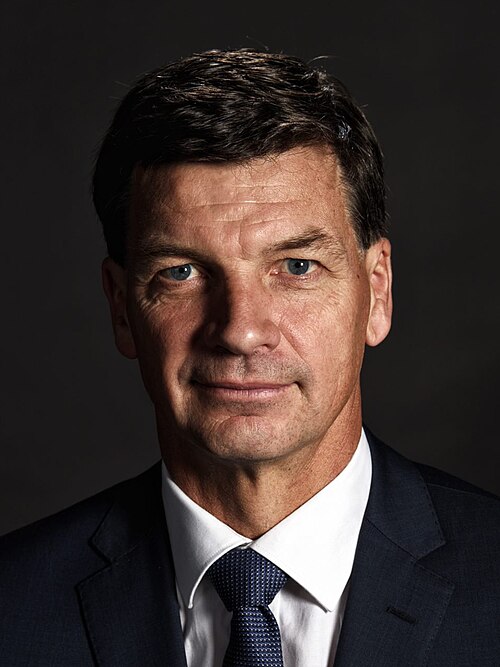
Angus Taylor
Liberal Party Member for Hume
Currently sitting
Photo: Department of Climate Change, Energy, the Environment and Water. 2022. https://www.dcceew.gov.au © Department of Climate Change, Energy, the Environme, CC BY 4.0, via Wikimedia Commons
Seat and party history (1)
- Liberal Party - Hume (House) - 7 Sep 2013 to present
- Seat and party records: OpenAustralia member data.
Contact
Electorate office: (02) 4658 7188
18 Hill Street, Camden NSW 2570
Office details: Parliament of Australia, CC BY-NC-ND 4.0.
Contact details on aph.gov.au Profile on OpenAustraliaNot sure if this is your member? Find your electorate (AEC)
These counts cover what is on this site only. They do not measure electorate work or committee work.
Compared with other members
Angus Taylor compared with all 150 sitting House members.
Questions asked in Question Time
Higher than 99% of House members- This member
- 98
- Average
- 11.2
- Median
- 12
Debates spoken in
Lower than 51% of House members- This member
- 29
- Average
- 35.9
- Median
- 30.5
Votes cast
Lower than 97% of House members- This member
- 112
- Average
- 253.0
- Median
- 265
Share of divisions voted in
Lower than 98% of House members- This member
- 34%
- Average
- 79%
- Median
- 81%
Read these with care
- The median is the middle member: half did more, half did less. It is less affected by a few very active members than the average.
- Ministers answer questions rather than ask them, and the presiding officers rarely vote, so their patterns differ.
- Government backbenchers are often given arranged "Dorothy Dixer" questions, which raises their question counts.
- Votes only record ayes and noes, so a missed vote cannot be told apart from a pair (an agreed absence).
- Counts cover only what is on this site, and do not measure electorate or committee work. New members have less history.
Question Time
Question from Angus Taylor
The member asked why the government had not implemented cuts to immigration levels in the current budget, citing high daily arrival rates.
Background: The Leader of the Opposition highlighted daily migration figures and accused the government of denial regarding immigration levels.
Answer from Tony Burke
The minister stated that excessive cuts to immigration would damage the Australian economy by depriving industries of necessary skills. He noted that sectors such as agriculture, construction, and education rely on overseas workers and international students. While acknowledging the need to temper migration to allow housing supply to catch up, he argued that responsible management requires maintaining sufficient workforce levels for key industries.
Question from Angus Taylor
The member asked whether the Treasurer or cabinet had approved the $7 billion cost associated with reversing the humanitarian intake reduction before the Prime Minister communicated the decision to a journalist. He also inquired about the source of the funding for this reversal.
Background: Parliamentary Budget Office analysis indicated a planned reduction in the humanitarian intake from 20,000 to 13,750, but the Prime Minister reportedly reversed this decision via text message.
Answer from Tony Burke
The minister stated that the government was proud of its generous humanitarian program, noting that the Howard government had also valued such programs. He explained that some budget items are listed as terminating programs but are automatically renewed after four years, arguing that the opposition's suggestion that all terminating programs are intended to be cut was incorrect. He dismissed the premise of the question as a misunderstanding of how budgeting works.
Question from Angus Taylor
The member asked again whether the Treasurer or cabinet had approved the $7 billion increase. He also asked if the Prime Minister ruled out any cuts to the humanitarian immigration intake.
Background: Follow-up to the previous question regarding the $7 billion cost of maintaining the humanitarian intake at 20,000 places.
Answer from Tony Burke
The minister addressed the part of the question regarding ruling out cuts, stating that the decision to maintain the intake at 20,000 places was the specific decision being referred to. He confirmed that the government had boosted the humanitarian program to 20,000 places upon taking office and that it remained at that level.
Question from Angus Taylor
The member asked why the Prime Minister would not admit that the government's policies had intentionally damaged the housing market, citing reports of widespread mortgage stress and negative equity among recent buyers.
Background: Analysis by Aussie Home Loans indicated that 20 per cent of Australians who purchased homes in the previous three years were experiencing negative equity due to falling values and rising interest rates.
Answer from Anthony Albanese
The Prime Minister stated that negative equity affected less than one per cent of mortgage holders, a significant decrease from levels recorded under the previous government. He highlighted that 8,468 investors signed up to build new homes in the June quarter, representing a record high, with $6 billion in loan value borrowed for these builds. He noted that over 660,000 new homes had been constructed since the government took office, with 244,000 more under construction, the highest number since records began in 1984. Construction cost inflation had fallen from 17 per cent to 3.8 per cent. He cited specific examples of first-home buyers successfully purchasing properties in Victoria, Canberra, and his own electorate, often assisted by the government's five per cent deposit scheme.
Question from Angus Taylor
The member asked the Treasurer to quantify how many Australians currently owe more to their banks than their homes are worth, attributing the situation to government tax policies.
Background: Recent data indicated that half of homes purchased in Melbourne and Sydney over the previous year had decreased in value below the purchase price.
Answer from Jim Chalmers
The Treasurer stated that negative equity remains very limited, affecting less than one per cent of borrowers according to the Reserve Bank of Australia. He cited Commonwealth Bank earnings data showing only half a per cent of their book was in negative equity, a figure lower than the same period last year. He contrasted this with April 2019, when the RBA reported that more than two per cent of borrowers had negative equity during the previous government's term. The Treasurer attributed current market conditions to multiple factors, including interest rate increases and global uncertainty, rather than government policy.
Question from Angus Taylor
The member asked whether the Prime Minister would intervene to cancel the Treasurer's proposed tax changes, characterising them as harmful to families.
Background: The opposition leader cited recent tax policy reversals by the Treasurer and alleged the introduction of a new tax on babies.
Answer from Jim Chalmers
The Treasurer dismissed the opposition's credibility on tax matters, citing their own proposals to increase income taxes. He explained that the budget changes regarding trusts were optional and designed to align tax treatment with ordinary workers while reducing restructuring costs. He noted that Treasury analysis indicated families with discretionary trusts paid lower average tax rates than similar non-trust families, with the majority of trust wealth held by the top 10 per cent of households. He stated that over 95 per cent of individual taxpayers would not be affected and confirmed that Treasury was consulting on the legislation in the usual way.
Question from Angus Taylor
The member asked whether the Prime Minister would agree with the New South Wales Premier that the current policy was failing and join the coalition to reduce tobacco taxes and combat organized crime.
Background: The member quoted the New South Wales Premier criticizing the government's illicit tobacco policy and asked if the Prime Minister would join the coalition to crush organized crime.
Answer from Mark Butler
The minister stated that the government would not join the coalition in a price-discounting war with organized crime, arguing that the opposition's policy assumed criminals would not lower prices and failed to consider public health impacts. He cited evidence from Canada where smoking rates among young people increased after tax cuts. He criticized the opposition for not funding enforcement during their time in government and stated that the government's focus was on shutting down illicit stores and taking legal action, rather than lowering taxes.
Question from Angus Taylor
The member asked whether the Prime Minister would release the government's housing modelling to demonstrate the extent of predicted price declines, given claims that new housing supply was falling and first-home buyer activity was decreasing.
Background: The Leader of the Opposition cited comments from the Property Council chief executive regarding the impact of tax changes on housing supply and buyer confidence.
Answer from Anthony Albanese
The Prime Minister stated that the relevant figures were already published in the federal budget. He clarified that existing negative gearing arrangements for properties acquired before the budget were grandfathered, while new investment properties could still utilise negative gearing and the capital gains tax discount. He highlighted that investor borrowing for new dwellings had reached record levels, with 8,468 investors signing up in the June quarter, representing a loan value of $5.99 billion. He noted that developers acknowledged increased demand for new builds due to the tax settings favouring this sector.
Question from Angus Taylor
The member asked when the Prime Minister would admit government failings on illicit tobacco and join the Coalition to combat organised crime gangs.
Background: The member claimed illicit tobacco accounted for 80 per cent of the market and linked it to organised crime violence.
Answer from Tony Burke
The Minister argued that reducing excise would not solve the price differential between legal and illicit cigarettes, as the raw cost of illicit tobacco remains significantly lower. He emphasised that the solution lay in law enforcement through the National Disruption Group, involving the AFP, AUSTRAC, and the Criminal Intelligence Commission. He cited recent operations that seized over 107,000 cigarettes and closed 11 stores, as well as Border Force seizures of over 2 billion illegal cigarettes and 268 tonnes of loose-leaf tobacco. He criticised the opposition for not modelling the impact of their policies on nicotine use.
Question from Angus Taylor
The member asked the Prime Minister to quantify the cost of the national debt to Australians on a per-minute basis, citing a trillion-dollar debt figure.
Background: The Leader of the Opposition cited record debt levels, interest rate rises, and business insolvencies under the current government.
Answer from Anthony Albanese
The Prime Minister stated that the previous government had more than doubled the debt before the pandemic and left a $78 billion deficit with no surplus projected until 2060-61. He noted that the current government had delivered back-to-back surpluses and reduced debt by $173 billion compared to 2022 election forecasts, saving approximately $70 billion in interest costs. He cited positive assessments from S&P Global and Moody's regarding Australia's fiscal performance and low debt ratios. The Prime Minister also claimed the opposition had pledged over $500 billion without funding.
Question from Angus Taylor
The member asked why the Prime Minister would not sack the Minister for Veterans' Affairs, citing incompetence and disrespect.
Background: The member cited multiple alleged failures by the Minister for Veterans' Affairs, including refusing to meet veterans and cutting funding.
Answer from Anthony Albanese
The Prime Minister stated he had every confidence in the Minister for Veterans' Affairs. He emphasized the importance of respecting those who serve in the Defence Force and noted that the minister had inherited a system with issues from previous administrations. He did not address the specific allegations of incompetence directly.
Question from Angus Taylor
The member asked why the government had taken 98 days to reverse its position on the tax measure, attributing the change to pressure from the coalition.
Background: The government had previously faced criticism for delays in addressing concerns about a tax measure affecting widows, which the opposition claimed was a 'widow tax'.
Answer from Anthony Albanese
The Prime Minister stated that draft legislation had been out for consultation for weeks, with the process concluding on Friday. He noted that the government had always intended to introduce legislation to address the issue and that the opposition had previously complained about a lack of consultation. He explained that the decision to pass the legislation quickly was made in response to a request, facilitated by the opposition's support for NDIS sustainability reforms. He argued that the previous government had delayed necessary reforms, costing taxpayers money.
Question from Angus Taylor
The member asked if the Prime Minister would guarantee that rents would not increase by 30 per cent, citing a National Australia Bank confirmation that Labor's taxes would cause such a surge.
Background: The National Australia Bank had issued a statement regarding rental yields, which the opposition interpreted as a forecast of significant rent increases due to government tax changes.
Answer from Anthony Albanese
The Prime Minister stated that the National Australia Bank had clarified that its previous statement was not a forecast of rental yields. He emphasized that the budget made no changes to negative gearing or capital gains tax discounts for existing investment properties, which remained grandfathered. He cited Australian Bureau of Statistics data showing investor lending for new builds rose by 27 per cent and construction loans grew by 20 per cent in the June quarter, arguing that the policy was successfully boosting housing supply.
Question from Angus Taylor
The member asked why the Prime Minister would not take responsibility for his previous comments and stop deflecting questions to other politicians.
Background: The Leader of the Opposition questioned the Prime Minister regarding previous remarks made on a podcast, alleging he had avoided answering questions about them.
Answer from Anthony Albanese
The Prime Minister cited comments from the Japanese ambassador, who described a recent dinner as relaxed and conducive to building trust. He highlighted the strong relationship with Japan and expressed a desire to continue collaborating on economic and security matters in the region.
Question from Angus Taylor
The member expressed pride in Australian firefighters and wished them well.
Background: The Leader of the Opposition associated the coalition with comments praising Australian firefighters deployed overseas.
Answer from The Prime Minister (Anthony Albanese)
The Prime Minister joined in praising the firefighters and wished them a safe return, noting they did the nation proud.
Question from Angus Taylor
The member asked why the Prime Minister would not apologise to the Japanese Prime Minister regarding his podcast comments, characterising the refusal as embarrassing behaviour.
Background: The opposition leader referenced the Prime Minister's appearance on the Bush Deep podcast and alleged a refusal to apologise to the Japanese Prime Minister.
Answer from Anthony Albanese
The Prime Minister stated that his government had spent four years rebuilding regional relationships, prioritising the national interest. He described the Japanese Prime Minister as a friend and noted constructive dealings with three Japanese leaders. He highlighted that the strategic alignment between Australia and Japan was stronger than ever, citing his visits to Japan and the visit of Japanese leaders to Australia.
Question from Angus Taylor
The member asked whether the Prime Minister would admit that changes to capital gains tax and negative gearing had negatively impacted homeowners, causing a severe housing market crash.
Background: The Leader of the Opposition cited an ANZ report predicting a significant fall in Sydney house prices, attributing the downturn to government tax policies.
Answer from Anthony Albanese
The Prime Minister stated that budget measures aimed to assist young Australians entering the property market. He cited commentary from financial commentator Scott Pape, noting that house prices had risen significantly faster than wages due to previous tax settings. The Prime Minister explained that the reforms removed competition from investors using negative gearing, allowing first-home buyers to compete more fairly. He emphasized that the changes were designed to restore access to home ownership for those without family financial support, describing the previous system as broken and requiring repair.
Question from Angus Taylor
The member asked why the government was targeting women undergoing divorce or bereavement to raise revenue through tax changes.
Background: The Leader of the Opposition criticized tax changes affecting widows and divorced women.
Answer from Jim Chalmers
The Treasurer dismissed the question as a political stunt, noting contradictory opposition claims about consultation levels. He explained that draft legislation ensures properties owned on budget night or acquired through inheritance or relationship breakdown retain access to negative gearing. He stated that tax reforms are being legislated in stages, with changes taking effect from 1 July next year, allowing time for detailed implementation and consultation.
Question from Angus Taylor
The member asked the Prime Minister to confirm that new mortgage holders were paying significantly more in interest due to government policies.
Background: The Leader of the Opposition claimed that government policies and interest rate rises had tanked the housing market.
Answer from Anthony Albanese
The Prime Minister acknowledged cost-of-living pressures but highlighted government actions such as wage increases in aged care and child care, and income tax cuts. He challenged the opposition's stance on interest rates, citing past statements from opposition figures arguing for higher rates. He questioned why the Leader of the Opposition had appointed a shadow treasurer who had previously argued that interest rates were too low.
Question from Angus Taylor
The member asked why the government would not support the coalition's bill for human oversight, citing long wait times and the Senate's passage of the bill.
Background: The Senate passed a coalition bill for human oversight of aged care decisions, which the government opposed.
Answer from Anthony Albanese; Sam Rae
The Prime Minister stated that the premise of the question was incorrect as human oversight already exists, and criticized the opposition for hypocrisy given their past record. The Minister for Aged Care clarified that assessments are conducted by qualified humans and that the government shares the intent of the private senator's bill but fears it would lead to inconsistent decisions and longer wait times. The minister announced a new legislated escalation pathway allowing the department secretary to adjust assessments in extenuating circumstances, with consultations planned during the parliamentary break.
Question from Angus Taylor
The member asked how Australians could get ahead when the government was increasing costs for families and small businesses.
Background: The Leader of the Opposition cited rising costs for electricity, gas, rents, health, education, and childcare under the Labor government.
Answer from Anthony Albanese
The Prime Minister stated that the government was delivering real change, including wage increases, tax cuts, expanded paid parental leave to six months with superannuation contributions, and permanent urgent care clinics. He noted that 137 clinics were open and 10 new medicines were added to the PBS. He highlighted that the minimum wage, paid parental leave, and the number of cheaper home batteries installed (450,000 since last July) were all increasing. He also mentioned rising bulk-billing rates and increased first-home buyer activity, contrasting this with the opposition's focus on grievance.
Question from Angus Taylor
The member asked if the Prime Minister would guarantee that house prices would not fall further, citing recent data and forecasts.
Background: The member cited falling house prices in Sydney and Melbourne and predictions of further falls, asking for a guarantee.
Answer from Anthony Albanese
The Prime Minister stated that housing policy aimed to help first-home buyers, citing examples of people buying homes. He noted that first-home buyer confidence was rising and that they were no longer competing as heavily with investors. He emphasized that the goal was providing a secure roof over heads, contrasting this with the opposition's past housing policies.
Question from Angus Taylor
The member asked again if the Prime Minister would guarantee that house prices would not fall further.
Background: The member repeated his question asking for a guarantee that house prices would not fall further.
Answer from Anthony Albanese
The Prime Minister stated that housing policies aimed to give young people a fair chance by removing taxpayer support for investors competing with first-home buyers. He clarified that people could still invest in negatively geared properties, but first-home buyers would not compete against those with tax deductions.
Question from Angus Taylor
The member asked how many first home buyers had entered negative equity since the budget was delivered, citing the Minister's earlier concerns about this specific risk.
Background: The member referenced a previous statement by the Minister regarding the risk of first home buyers falling into negative equity due to low interest rates and large mortgages.
Answer from Clare O'Neil
The Minister stated that legislation passed the previous week delivered tax cuts for 13 million workers and created a level playing field for first home buyers, aiming to help 75,000 renters purchase homes. She noted that Treasury modelling predicted house prices would continue to grow but at a slower rate, approximately two percentage points less than otherwise, a figure supported by the Commonwealth Bank and the Grattan Institute. The Minister emphasized government support for first home buyers through the five per cent deposit program, Help to Buy, and the new tax reforms.
Question from Angus Taylor
The member asked for confirmation that no Commonwealth funds had directly or indirectly been paid to Mick Gatto or his associated companies.
Background: The member asked the Prime Minister to confirm that no taxpayer funds had been paid to convicted criminal Mick Gatto or associated companies.
Answer from Anthony Albanese
The Prime Minister did not directly answer the question about Mick Gatto. Instead, he discussed actions taken after the 2022 election, including expelling John Setka from the Labor Party and excluding the CFMEU from affiliation. He contrasted these actions with the former government's handling of union issues.
Question from Angus Taylor
The member asked whether these specific groups would face increased tax liabilities due to the Treasurer's budget measures. He requested a direct answer on the financial impact on these individuals.
Background: The Leader of the Opposition questioned the Prime Minister regarding the impact of recent tax reforms on vulnerable groups, specifically widows, divorcees, and victims of family violence.
Answer from Anthony Albanese
The Prime Minister stated that none of these groups would be negatively impacted by the tax reforms. He contrasted the government's approach with internal disagreements within the opposition, citing comments from shadow ministers about the need for the Liberal Party to rebrand or dissolve. He maintained that the government was determined to make a positive difference for people through long-called-for tax reform.
Question from Angus Taylor
The member asked when the Prime Minister would intervene to resolve the alleged issues with the Treasurer's budget regarding taxes on widows, divorcees, and victims of family violence.
Background: The Leader of the Opposition followed up on the previous question, alleging that the Treasurer had promised to fix tax impacts on vulnerable groups but had not specified how or when.
Answer from Anthony Albanese
The Prime Minister reiterated that no one in these groups would be negatively impacted, dismissing the premise of the question. He criticised the opposition for internal disarray, noting that shadow ministers were calling for the Liberal Party to be dissolved or rebranded. He pointed out inconsistencies in the opposition's stance on tax cuts, stating they had voted against them, then supported them, and now described them as egregious. He concluded that the opposition needed to get its own act together.
Question from Angus Taylor
The member asked why the Prime Minister sought to impose significant tax increases on Australians through the current budget measures.
Background: The Leader of the Opposition challenged the Prime Minister regarding the government's budget, alleging it imposed $77 billion in new taxes and hindered hardworking Australians.
Answer from Anthony Albanese
The Prime Minister stated that the government was addressing financial pressures by implementing tax cuts for 14 million taxpayers, increasing the minimum wage, expanding paid parental leave to six months, and making 137 Medicare urgent care clinics permanent. He noted that economic growth and business investment were rising while inflation and unemployment fell, attributing resilience to government action despite global uncertainty caused by the war in Iran and fuel price spikes. He contrasted this with the opposition's record, claiming they had previously opposed these measures and failed to address fuel supply issues.
Question from Angus Taylor
The member asked why the Prime Minister allowed a dangerous terrorist sympathiser to enter Australia despite warnings from the ASIO director-general about increasing threats from Islamic State and al-Qaeda affiliates.
Background: The Leader of the Opposition questioned the Prime Minister about issuing an entry permit to an ISIS sympathiser, citing the ASIO annual threat assessment regarding growing terrorist capabilities.
Answer from Anthony Albanese
The Prime Minister quoted the ASIO director-general's call for mutual respect, tolerance, and a 'fair go' to lower the security temperature. He emphasized that the director-general expressed confidence in Australia's ability to meet challenges and praised the resilience of communities and law enforcement agencies. He rejected the suggestion that anyone in parliament supported terrorism, stating that the rule of law distinguished Australia from authoritarian regimes.
Question from Angus Taylor
The member asked why Australians were suffering from economic incompetence, high taxes, and a collapse in living standards under the current administration.
Background: The Opposition Leader challenged the government on economic management, citing inflation and living standards.
Answer from Anthony Albanese
The Prime Minister stated that inflation had dropped to four per cent, a decrease from 4.2 per cent. He highlighted upcoming tax cuts for all workers, including those on the minimum wage, starting on 1 July. He noted the expansion of paid parental leave to 26 weeks with superannuation contributions. He mentioned that 137 urgent care clinics would become permanent parts of Medicare. He also cited the expansion of endometriosis clinics, $25 billion in hospital funding, and the permanent $20,000 instant asset write-off for small businesses. He reported that 450,000 home batteries had been installed under the Cheaper Home Batteries Program. He concluded by noting the upcoming ban on supermarket price gouging.
Question from Angus Taylor
The member asked whether Australians holding self-managed superannuation funds would face increased tax liabilities as a result of the government's agreement with the Greens.
Background: The Leader of the Opposition questioned the Prime Minister regarding recent legislative agreements with the Greens, characterizing them as a dangerous deal involving toxic taxes.
Answer from Anthony Albanese
The Prime Minister stated that existing arrangements are grandfathered under the proposals. He argued that the government could not accept a broken housing system and required Senate engagement to pass reforms, noting the opposition's refusal to debate. He highlighted that the legislation provides tax cuts for all workers and opportunities for homeownership, contrasting this with the opposition's promise to repeal such measures on day one.
Question from Angus Taylor
The member asked when the Prime Minister would stop lying, citing a March statement that he did not negotiate with the Greens.
Background: The Leader of the Opposition questioned the Prime Minister on a previous statement about not negotiating with the Greens.
Answer from Anthony Albanese (Prime Minister)
The Leader of the Opposition withdrew the question before the Prime Minister could respond.
Question from Angus Taylor
The member asked whether any country taxed real capital gains at a higher rate than Australia, citing the government's recent policy adjustments.
Background: The Prime Minister had recently adjusted capital gains tax proposals following the budget release.
Answer from Anthony Albanese
The Prime Minister stated that the government had foreshadowed Treasury's discussion paper and would continue consulting. He noted that all four existing small business capital gains tax concessions were retained and the turnover threshold for the 50 per cent discount was increased from $2 million to $10 million, covering 98 per cent of active businesses. He highlighted $3.8 billion in budget measures supporting small businesses, including permanently allowing the $20,000 instant asset write-off. The Prime Minister asserted that the government was making the tax system fairer and supporting young Australians.
Question from Angus Taylor
The member asked why the government had voted against lower income taxes on 11 occasions, including the Coalition's proposals for annual tax cuts, which he claimed would result in an additional $77 billion in costs for taxpayers.
Background: The Leader of the Opposition challenged the Prime Minister regarding the government's voting record on tax legislation.
Answer from Anthony Albanese
The Prime Minister stated that tax cuts were being delivered on 1 July of the current and following year, measures which the Opposition had voted against. He noted that the Opposition had also rejected the Working Australians Tax Offset of $250 and a $1,000 automatic tax deduction. He argued that the Coalition had campaigned on higher taxes, including increases on resources, motorists, and the housing construction sector, alongside plans to abolish programs such as the Cheaper Home Batteries Program and free TAFE. He concluded by criticizing the Opposition's leadership choices.
Question from Angus Taylor
The member asked what actions the government was taking to strengthen ties with Solomon Islands and support Pacific sovereignty amidst regional instability.
Background: The Prime Minister of Solomon Islands, Matthew Wale, was visiting Canberra for his first overseas trip since taking office.
Answer from Anthony Albanese
The Prime Minister welcomed the visit, noting it reflected deep historical bonds. He announced that negotiations for a new comprehensive treaty based on mutual trust would commence. He highlighted Solomon Islands' participation in the Pacific Policing Initiative and the Prime Minister's upcoming visit to the Pinkenba facility. The Prime Minister emphasized that security must be driven by Pacific nations themselves and mentioned plans to reciprocate the visit in a month.
Question from Angus Taylor
The member asked why the government relied on high migration levels to drive economic growth, citing the arrival of over 1.4 million migrants.
Background: National accounts data indicated GDP per person had declined in the March quarter for the tenth time in fifteen quarters under the current government.
Answer from Anthony Albanese
The Prime Minister stated the economy expanded by 0.3 per cent during the March quarter and 2.5 per cent annually. He attributed economic pressures to global events, specifically referencing the situation on 28 February, and highlighted improved fuel security compared to regional nations. He noted that the migration rate had fallen by 45 per cent and criticized the opposition for ignoring global economic impacts.
Question from Angus Taylor
The member asked when the Prime Minister would admit his economic strategy had failed Australians.
Background: National accounts suggested living standards were declining, with the member claiming the sharpest fall in the developed world.
Answer from Anthony Albanese
The Prime Minister rejected the premise, stating Australia was growing faster than most OECD countries. He highlighted a 4.7 per cent minimum wage increase, lifting it above $1,000 a week, and pointed to strong private sector investment. He criticized the opposition for voting against tax cuts and talking down the economy.
Question from Angus Taylor
The member asked whether the Prime Minister would confirm that Australians would pay $77 billion more in tax than they receive in benefits.
Background: The Treasury secretary recently defended government tax measures by stating revenue needs to be raised. The opposition leader sought confirmation on the net tax burden on Australians.
Answer from Anthony Albanese
The Prime Minister stated that recent legislation supports homeownership for young people, citing examples of first-home buyers in Bexley, Maribyrnong, and Maroubra. He argued that tax changes rebalance the market to assist these buyers. Additionally, he highlighted two tax cut measures: an automatic $1,000 tax deduction and the working Australians tax offset, asserting that the government supports lower income taxes while the opposition supports higher ones.
Question from Angus Taylor
The member asked the Prime Minister to confirm that Australians would pay $77 billion more in tax than they get back.
Background: The opposition leader repeated his previous question regarding the net tax burden on Australians.
Answer from Anthony Albanese
The Prime Minister dismissed the question as nonsensical and criticized the opposition for opposing income tax cuts and real wage increases. He highlighted the 4.75 per cent minimum wage increase and the $12,000 annual increase for minimum wage earners since the government took office. He stated that the government supports higher wages and lower taxes, whereas the opposition consistently votes for higher taxes and lower wages.
Question from Angus Taylor
The member asked why the Prime Minister would not commit to taking the proposed tax changes to the next federal election, alleging that the government had concealed these plans from voters.
Background: The Leader of the Opposition challenged the Prime Minister regarding the government's tax reforms, characterizing them as deceptive measures introduced without public knowledge during the previous election.
Answer from Anthony Albanese
The Prime Minister stated that the legislation introduced by the Treasurer aimed to assist young people in purchasing their first home and to increase housing supply. He explained that the reforms adjusted capital gains tax treatment to ensure income from work was treated more fairly compared to income from assets. The Prime Minister highlighted two additional measures: a $1,000 automatic tax deduction for low- and middle-income earners and further income tax reductions. He noted that the opposition had previously voted against stage 3 tax cuts and other income tax reductions, arguing that their stance contradicted their claims about taxation.
Question from Angus Taylor
The member asserted that Labor premiers and members opposed the tax changes and asked what conditions would lead the Prime Minister to abandon these measures.
Background: The Leader of the Opposition claimed that various Labor politicians and committees opposed the government's tax reforms, asking what would be required to cancel them.
Answer from Anthony Albanese
The Prime Minister rejected the premise of the question as fantasy, citing his recent collaboration with the Western Australian Premier on housing projects under the $47 billion Homes for Australia Plan. He stated that Labor members were proud of the government's commitment to fixing the housing system and delivering income tax cuts funded by these measures. The Prime Minister emphasized the responsibility to deliver real change for future generations, ensuring they could afford to buy homes rather than just inherit them.
Question from Angus Taylor
The member asked whether the Prime Minister would index income tax brackets to prevent bracket creep, noting that the coalition's policy would provide substantial tax relief to typical taxpayers.
Background: The opposition leader cited inflation data to argue that the coalition's tax back guarantee would provide significant relief, asking if the Prime Minister would index income tax brackets.
Answer from Anthony Albanese
The Prime Minister welcomed the opportunity to discuss the opposition's tax policy, noting that the government was introducing tax reductions the following day. He highlighted that the opposition had previously voted against tax cuts and had lost the election as a result. He listed several opposition policies that would increase taxes or costs, including abolishing production tax credits, the EV concession, the Cheaper Home Batteries Program, and free TAFE. He asserted that the government's policy was to lower income taxes for all workers from 1 July, whereas the opposition's policy would result in higher taxes.
Question from Angus Taylor
The member asked whether the government would exempt specific sectors, including hairdressers, builders, and childcare operators, from alleged tax increases and policy failures.
Background: The Leader of the Opposition questioned the Prime Minister regarding the impact of the recent budget on small and family businesses, alleging broken promises and higher taxes.
Answer from Anthony Albanese
The Prime Minister stated that existing concessions for small businesses had not changed. He highlighted $312 billion in new budget measures to lower taxes and encourage investment, including keeping the $20,000 instant asset write-off in place permanently, introducing a permanent two-year loss carry-back, and expanding venture capital incentives. He cited support from the Council of Small Business Organisations, the National Farmers' Federation, and the Australian Chamber of Commerce and Industry, noting these groups welcomed the stability and planning opportunities provided by the reforms.
Question from Angus Taylor
The member asked the Prime Minister to specify which small businesses would be spared from the government's tax policies, accusing the government of dishonesty.
Background: The Leader of the Opposition repeated his previous question, demanding honesty about which small businesses would be exempt from alleged tax increases.
Answer from Anthony Albanese
The Prime Minister reiterated that the budget includes $312 billion in support for small business, including five tax cuts. He listed measures such as the instant asset write-off, loss carry-back, and venture capital incentives, citing support from the Housing Industry Association and Business NSW. He argued that these measures lower taxes and support aspiration for all, contrasting this with the opposition's support for the status quo.
Question from Angus Taylor
The member asked the Prime Minister to specify which small businesses would be carved out from capital gains tax increases.
Background: The Leader of the Opposition asked the Prime Minister which small businesses would be exempt from capital gains tax increases.
Answer from Anthony Albanese
The Prime Minister stated that the budget decreases taxes for small businesses through $312 billion in measures, citing support from various industry groups. He explained that the capital gains tax changes revert to the 1999 system, taxing real gains rather than nominal gains, which produces fairer outcomes. He emphasized that this shift treats income from assets similarly to income from work.
Question from Angus Taylor
The member asked the Prime Minister to specify which small businesses would be exempt from tax increases, accusing the government of failing to be honest.
Background: The Leader of the Opposition asked the Prime Minister for the third time which small businesses would be spared from alleged tax increases, accusing the Prime Minister of dishonesty.
Answer from Anthony Albanese
The Prime Minister reiterated that the budget reduces taxes for small business through $312 billion in measures. He explained that capital gains tax changes replace one discount with another based on real gains. He noted that consultations with the Council of Small Business are ongoing and that legislation would be introduced on Thursday.
Question from Angus Taylor
The member asked the Prime Minister why the government had allegedly misled Australians about plans to increase taxes.
Background: The Leader of the Opposition raised concerns regarding government transparency on tax policy.
Answer from Anthony Albanese
The Prime Minister highlighted recent visits to housing projects, including the Housing Australia Future Fund site in Rosanna, Melbourne, and developments in Hobart and Perth. He noted that 250,000 first-home buyers had purchased properties using a five per cent deposit. He stated that reforms to negative gearing and capital gains tax were designed to improve housing supply and aspiration for younger Australians. He referenced comments from a former Liberal leader regarding young Australians' frustration with the housing market.
Question from Angus Taylor
The member asked whether the Prime Minister would rule out changing his position on taxing the family home, citing claims that Labor had lied about its tax plans.
Background: The Leader of the Opposition questioned the Prime Minister regarding allegations that the Labor government had misled the public about its tax intentions, specifically concerning the family home.
Answer from Anthony Albanese
The Prime Minister stated that the Coalition had campaigned on increasing taxes for all 14 million Australian taxpayers, including higher taxes on resources, motorists, students, and power bills. He noted that the Coalition also proposed abolishing the home batteries program, free TAFE, Build to Rent, Help to Buy, and the Housing Australia Future Fund. He ruled out all the tax increases and policy reversals proposed by the Coalition during the election campaign, asserting that Labor had gone to the election with lower taxes.
Question from Angus Taylor
The member asked when the Prime Minister decided that the truth did not matter, citing claims that Labor had misled the public on housing, investment, and small business taxes.
Background: The Leader of the Opposition questioned the Prime Minister about alleged misrepresentations regarding housing, investment, and small business taxes.
Answer from Anthony Albanese
The Prime Minister criticized the Opposition's leadership instability and past performance, noting that they campaigned on opposing tax cuts and reversing policies. He stated that the Coalition had no policy going forward and sought to divide Australians. He argued that Australians want their children to get ahead, which the budget supports, contrasting this with the Opposition's lack of a coherent plan.
Question from Angus Taylor
The member asked why the government had allegedly lied to Australians about its plan to impose higher taxes.
Background: The Leader of the Opposition challenged the Prime Minister regarding allegations that the government had misled the public about its intentions to increase taxes.
Answer from Anthony Albanese
The Prime Minister stated that the government was changing the tax system to assist young people in purchasing their first home. He described this as a policy change necessary to prevent a generation from missing out on homeownership. He cited a former shadow Treasurer who had previously admitted the opposition was timid in addressing challenges faced by younger Australians. The Prime Minister emphasized that the government was acting to support aspiration and housing supply, distinguishing between investing in new homes, which benefits the nation, and negative gearing on existing homes, which primarily benefits investors.
Other Parliamentary Activity
-
Albanese Government
House of Representatives · Wednesday 16 September 2026 · Matter of Public Importance
Opened this debate
-
Economy
House of Representatives · Thursday 20 August 2026 · Matter of Public Importance
Opened this debate
-
Scolyer, Professor Richard, AO
House of Representatives · Wednesday 1 July 2026 · Condolence
Contributed to this debate
-
Budget
House of Representatives · Thursday 25 June 2026 · Matter of Public Importance
Contributed to this debate
-
Treasury Laws Amendment (Tax Reform No. 1) Bill 2026; Consideration in Detail
House of Representatives · Thursday 4 June 2026 · Consideration in Detail
Opened this debate
-
Taxation
House of Representatives · Wednesday 3 June 2026 · Matter of Public Importance
Contributed to this debate · Position: support
-
Treasury Laws Amendment (Tax Reform No. 1) Bill 2026; Second Reading
House of Representatives · Tuesday 2 June 2026 · Second Reading
Opened this debate
-
Budget
House of Representatives · Thursday 28 May 2026 · General Debate
Opened this debate
-
Budget
House of Representatives · Thursday 28 May 2026 · Matter of Public Importance
Opened this debate
-
Daniher, Mr Neale Francis, AO
House of Representatives · Monday 25 May 2026 · Condolence
Contributed to this debate
-
Appropriation Bill (No. 1) 2026-2027; Second Reading
House of Representatives · Thursday 14 May 2026 · Second Reading
Opened this debate
-
Muddle, Warrant Officer Class 2 Lachlan
House of Representatives · Tuesday 12 May 2026 · Condolence
Contributed to this debate
-
Prime Minister
House of Representatives · Wednesday 1 April 2026 · Matter of Public Importance
Opened this debate
-
Export Finance and Insurance Corporation Amendment (Strategic Reserve) Bill 2026, Appropriation (Fuel Security Response) Bill (No. 1) 2025-2026, Appropriation (Fuel Security Response) Bill (No. 2) 2025-2026; Second Reading
House of Representatives · Monday 30 March 2026 · Second Reading
Contributed to this debate · Position: mixed
-
Labor Government
House of Representatives · Thursday 26 March 2026 · Matter of Public Importance
Opened this debate
-
Cook, Mr Leslie (Les)
House of Representatives · Tuesday 10 March 2026 · Condolence
Contributed to this debate
-
Cometti, Mr Dennis John, AM
House of Representatives · Thursday 5 March 2026 · Condolence
Contributed to this debate
-
Criminalising Re-entry Assistance for Terrorist Sympathisers The Criminal Code Amendment (Keeping Australia Safe) Bill 2026; First Reading
House of Representatives · Tuesday 3 March 2026 · First Reading
Opened this debate
-
Veterans' Affairs Legislation Amendment (Miscellaneous Measures No. 2) Bill 2023; Second Reading
House of Representatives · Tuesday 3 February 2026 · Second Reading
Opened this debate
-
Defence Amendment (Parliamentary Joint Committee on Defence) Bill 2025; Second Reading
House of Representatives · Wednesday 29 October 2025 · Second Reading
Opened this debate
-
Health Legislation Amendment (Miscellaneous Measures No. 1) Bill 2025; Second Reading
House of Representatives · Tuesday 7 October 2025 · Second Reading
Opened this debate
-
Appropriation Bill (No. 1) 2025-2026; Consideration in Detail
House of Representatives · Tuesday 7 October 2025 · Consideration in Detail
Contributed to this debate · Position: oppose
-
Defence Amendment (Defence Honours and Awards Appeals Tribunal) Bill 2025; Second Reading
House of Representatives · Wednesday 3 September 2025 · Second Reading
Responded as shadow minister
-
Defence
House of Representatives · Tuesday 26 August 2025 · Matter of Public Importance
Opened this debate
-
Defence Housing Australia Amendment Bill 2025; Second Reading
House of Representatives · Wednesday 30 July 2025 · Second Reading
Opened this debate
-
Treasury Laws Amendment (More Cost of Living Relief) Bill 2025; Second Reading
House of Representatives · Wednesday 26 March 2025 · Second Reading
Responded as shadow minister
-
Andrews, Hon. Kevin James, AM
House of Representatives · Wednesday 12 February 2025 · Condolence
Contributed to this debate
-
Cost of Living
House of Representatives · Tuesday 11 February 2025 · Matter of Public Importance
Opened this debate
-
Cost of Living
House of Representatives · Tuesday 4 February 2025 · Matter of Public Importance
Opened this debate
- Votes recorded
- 112
- Aye votes (37.5%)
- 42
- No votes (62.5%)
- 70
Showing the latest 50 votes.
-
Military Rehabilitation and Compensation Amendment (Veterans' Healthcare With...
17 Sep 2026 · Ayes 85, Noes 40 · Passed
VOTED NO -
Suspension of Standing and Sessional Orders
17 Sep 2026 · Ayes 42, Noes 89 · Failed
VOTED AYE -
Consideration of Legislation
14 Sep 2026 · Ayes 43, Noes 87 · Failed
VOTED AYE -
Online Safety Amendment (Strengthening Enforcement for the Social Media Minim...
10 Sep 2026 · Ayes 95, Noes 37 · Passed
VOTED NO -
Online Safety Amendment (Strengthening Enforcement for the Social Media Minim...
10 Sep 2026 · Ayes 96, Noes 36 · Passed
VOTED NO -
Carbon Credits (Carbon Farming Initiative-Improved Forest Management in Multi...
10 Sep 2026 · Ayes 38, Noes 92 · Failed
VOTED AYE -
Telecommunications Legislation Amendment (Universal Outdoor Mobile Obligation...
9 Sep 2026 · Ayes 52, Noes 86 · Failed
VOTED AYE -
Gun Control
9 Sep 2026 · Ayes 88, Noes 47 · Passed
VOTED NO -
Veterans
7 Sep 2026 · Ayes 88, Noes 49 · Passed
VOTED NO -
Minister for Veterans' Affairs
19 Aug 2026 · Ayes 83, Noes 44 · Passed
VOTED NO -
Royal Commission on Antisemitism and Social Cohesion
18 Aug 2026 · Ayes 87, Noes 48 · Passed
VOTED NO -
Minister for Veterans' Affairs and Defence Personnel; Attempted Censure
17 Aug 2026 · Ayes 86, Noes 43 · Passed
VOTED NO -
International Relations: Australia and Japan
12 Aug 2026 · Ayes 88, Noes 41 · Passed
VOTED NO -
Rearrangement
11 Aug 2026 · Ayes 86, Noes 47 · Passed
VOTED NO -
Rearrangement
2 Jul 2026 · Ayes 90, Noes 42 · Passed
VOTED NO -
Minister for Defence Industry; Attempted Censure
2 Jul 2026 · Ayes 90, Noes 41 · Passed
VOTED NO -
National Anti-Corruption Commission Joint Committee; Consideration of Senate ...
1 Jul 2026 · Ayes 93, Noes 45 · Passed
VOTED NO -
Member for Groom
30 Jun 2026 · Ayes 102, Noes 33 · Passed
VOTED NO -
Treasury Laws Amendment (Financial Reporting System Reform) Bill 2026; Consid...
30 Jun 2026 · Ayes 98, Noes 40 · Passed
VOTED NO -
Treasury Laws Amendment (Financial Reporting System Reform) Bill 2026; Consid...
30 Jun 2026 · Ayes 91, Noes 48 · Passed
VOTED NO -
Albanese Government
30 Jun 2026 · Ayes 91, Noes 48 · Passed
VOTED NO -
Workplace Relations Legislation Amendment (Building Cooperative Workplaces No...
30 Jun 2026 · Ayes 97, Noes 42 · Passed
VOTED NO -
Workplace Relations Legislation Amendment (Building Cooperative Workplaces No...
30 Jun 2026 · Ayes 91, Noes 47 · Passed
VOTED NO -
Workplace Relations Legislation Amendment (Building Cooperative Workplaces No...
30 Jun 2026 · Ayes 93, Noes 44 · Passed
VOTED NO -
Aviation Consumer Protection Bill 2026, Aviation Consumer Protection (Consequ...
29 Jun 2026 · Ayes 47, Noes 86 · Failed
VOTED AYE -
Prime Minister; Attempted Censure
25 Jun 2026 · Ayes 87, Noes 42 · Passed
VOTED NO -
Treasury Laws Amendment (Tax Reform No. 1) Bill 2026; Consideration of Senate...
25 Jun 2026 · Ayes 98, Noes 39 · Passed
VOTED NO -
Treasury Laws Amendment (Tax Reform No. 1) Bill 2026; Consideration of Senate...
25 Jun 2026 · Ayes 90, Noes 47 · Passed
VOTED NO -
Budget
25 Jun 2026 · Ayes 89, Noes 47 · Passed
VOTED NO -
Workplace Relations Legislation Amendment (Building Cooperative Workplaces No...
24 Jun 2026 · Ayes 88, Noes 45 · Passed
VOTED NO -
Income Tax Rates Amendment (Tax Reform No. 1) Bill 2026; Third Reading
4 Jun 2026 · Ayes 94, Noes 48 · Passed
VOTED NO -
Income Tax Rates Amendment (Tax Reform No. 1) Bill 2026; Second Reading
4 Jun 2026 · Ayes 94, Noes 48 · Passed
VOTED NO -
Income Tax Rates Amendment (Tax Reform No. 1) Bill 2026; Second Reading
4 Jun 2026 · Ayes 41, Noes 94 · Failed
VOTED AYE -
Treasury Laws Amendment (Tax Reform No. 1) Bill 2026; Third Reading
4 Jun 2026 · Ayes 94, Noes 49 · Passed
VOTED NO -
Treasury Laws Amendment (Tax Reform No. 1) Bill 2026; Consideration in Detail
4 Jun 2026 · Ayes 93, Noes 49 · Passed
VOTED NO -
Treasury Laws Amendment (Tax Reform No. 1) Bill 2026; Consideration in Detail
4 Jun 2026 · Ayes 43, Noes 93 · Failed
VOTED AYE -
Consideration of Legislation
4 Jun 2026 · Ayes 90, Noes 51 · Passed
VOTED NO -
Consideration of Legislation
4 Jun 2026 · Ayes 90, Noes 51 · Passed
VOTED NO -
Treasury Laws Amendment (Tax Reform No. 1) Bill 2026, Income Tax Rates Amendm...
4 Jun 2026 · Ayes 92, Noes 48 · Passed
VOTED NO -
Treasury Laws Amendment (Tax Reform No. 1) Bill 2026, Income Tax Rates Amendm...
4 Jun 2026 · Ayes 96, Noes 46 · Passed
VOTED NO -
Treasury Laws Amendment (Tax Reform No. 1) Bill 2026, Income Tax Rates Amendm...
4 Jun 2026 · Ayes 43, Noes 92 · Failed
VOTED AYE -
Treasury Laws Amendment (Tax Reform No. 1) Bill 2026, Income Tax Rates Amendm...
4 Jun 2026 · Ayes 9, Noes 126 · Failed
VOTED NO -
Treasury Laws Amendment (Tax Reform No. 1) Bill 2026, Income Tax Rates Amendm...
4 Jun 2026 · Ayes 89, Noes 49 · Passed
VOTED NO -
Treasury Laws Amendment (Tax Reform No. 1) Bill 2026, Income Tax Rates Amendm...
28 May 2026 · Ayes 91, Noes 48 · Passed
VOTED NO -
Competition and Consumer Amendment (Responding to Exceptional Circumstances) ...
25 May 2026 · Ayes 45, Noes 97 · Failed
VOTED AYE -
Veterans
25 May 2026 · Ayes 105, Noes 39 · Passed
VOTED NO -
Consideration of Legislation
1 Apr 2026 · Ayes 41, Noes 88 · Failed
VOTED AYE -
Treasury Laws Amendment (Doubling Penalties for ACCC Enforcement) Bill 2026, ...
26 Mar 2026 · Ayes 43, Noes 93 · Failed
VOTED AYE -
Consideration of Legislation
26 Mar 2026 · Ayes 94, Noes 46 · Passed
VOTED NO -
Consideration of Legislation
26 Mar 2026 · Ayes 94, Noes 46 · Passed
VOTED NO
About this page
This page tracks Angus Taylor's parliamentary activity: questions asked and answered in Question Time, debates spoken in, and votes in divisions. Summaries are in reported speech, not transcripts; each one links to the official record.