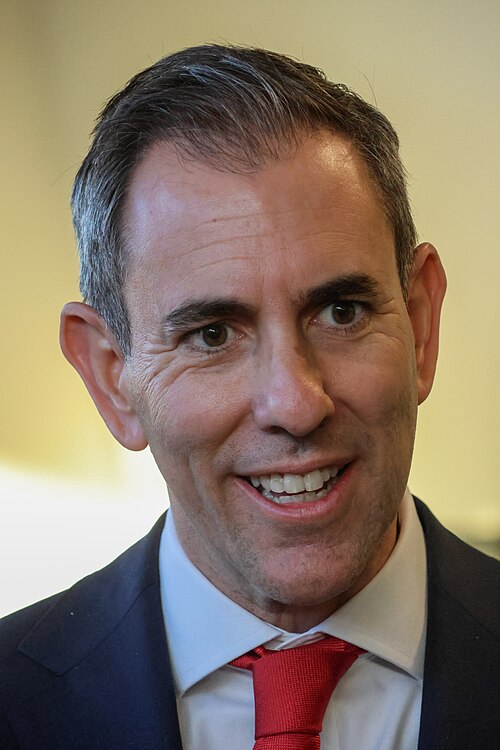
Jim Chalmers
Australian Labor Party Member for Rankin
Currently sitting
Photo: Yu Chu Chin, CC BY-SA 4.0, via Wikimedia Commons
Seat and party history (1)
- Australian Labor Party - Rankin (House) - 7 Sep 2013 to present
- Seat and party records: OpenAustralia member data.
Contact
Electorate office: (07) 3299 5910
Unit 2A, Logan Central Plaza, 38-74 Wembley Road, Logan Central QLD 4114
Office details: Parliament of Australia, CC BY-NC-ND 4.0.
Contact details on aph.gov.au Profile on OpenAustraliaNot sure if this is your member? Find your electorate (AEC)
These counts cover what is on this site only. They do not measure electorate work or committee work.
Compared with other members
Jim Chalmers compared with all 150 sitting House members.
Questions asked in Question Time
Lower than 81% of House members- This member
- 0
- Average
- 11.2
- Median
- 12
Debates spoken in
Lower than 64% of House members- This member
- 22
- Average
- 35.9
- Median
- 30.5
Votes cast
Lower than 72% of House members- This member
- 224
- Average
- 253.0
- Median
- 265
Share of divisions voted in
Lower than 77% of House members- This member
- 68%
- Average
- 79%
- Median
- 81%
Read these with care
- The median is the middle member: half did more, half did less. It is less affected by a few very active members than the average.
- Ministers answer questions rather than ask them, and the presiding officers rarely vote, so their patterns differ.
- Government backbenchers are often given arranged "Dorothy Dixer" questions, which raises their question counts.
- Votes only record ayes and noes, so a missed vote cannot be told apart from a pair (an agreed absence).
- Counts cover only what is on this site, and do not measure electorate or committee work. New members have less history.
Question Time
No questions recorded for this member.
Question from Kevin Hogan
The member asked how Australians could trust the government's statements on migration and budget impacts, given the lack of immigration cuts and alleged fiscal mismanagement.
Background: The Deputy Leader of the Nationals questioned the Treasurer on migration cuts and alleged budget deficits caused by the Prime Minister.
Answer from Jim Chalmers
The Treasurer stated that net overseas migration had nearly halved from its peak and was falling ahead of schedule. He attributed previous surges in migration to the prior government's tenure, which coincided with falling housing market indicators. He affirmed that current policies were designed to manage migration responsibly in the national economic interest, contrasting this with the opposition's approach.
Question from Tim Wilson
The member asked how many more chances the Prime Minister would give the Treasurer, alleging that productivity assumptions were changed to inflate budget numbers.
Background: The Liberal member accused the Treasurer of manipulating productivity figures and questioned the Prime Minister's support for the Treasurer.
Answer from Jim Chalmers
The Treasurer defended the productivity assumption of 1.2 per cent, stating it was based on Treasury advice and consistent with international forecasts from the UK, US, and New Zealand. He argued that the previous government had kept assumptions artificially high at 1.5 per cent despite weak growth. He highlighted the budget's broad productivity agenda, including faster approvals and foreign investment reform, as measures to address long-term structural challenges.
Question from Basem Abdo
The member asked what actions the government was taking to improve the budget and how this compared to international approaches.
Background: A government member asked the Treasurer about budget improvements and comparisons with other countries.
Answer from Jim Chalmers
The Treasurer highlighted the upcoming Intergenerational Report, which projected an improvement in the cash balance by 1.2 percentage points of GDP and a decline in gross debt from 33.1 per cent to 22.2 per cent of GDP by 2062-63. He noted that all three major ratings agencies still gave Australia a stable AAA credit rating. He attributed these improvements to responsible economic management, debt reduction, and structural reforms.
Question from Tim Wilson
The member asked the Treasurer to respond to reports that Labor MPs were mocking his inflation explanations and expressing doubts about cabinet's appreciation of how markets functioned.
Background: Media reports suggested Labor backbenchers were mocking the Treasurer's inflation excuses and doubting cabinet's understanding of markets.
Answer from Jim Chalmers
The Treasurer stated that he took his colleagues and economic challenges seriously, noting that the specific matters raised had not come up in a recent briefing on the Intergenerational report. He highlighted the government's focus on inflation, productivity, and global volatility, citing the impact of the war in Iran on borrowing costs. He pointed to the government's productivity package, tax reform, and responsible budget management as evidence of serious engagement with economic risks.
Question from Cassandra Fernando
The member asked what the government was doing to improve the budget and make the economy more resilient in the face of global uncertainty. She also asked about alternative approaches.
Background: Global economic uncertainty was increasing, with rising oil prices and interest rates.
Answer from Jim Chalmers
The Treasurer highlighted rising global interest rates and inflation due to the war in Iran, noting that Brent oil prices had risen 55 per cent. He stated that Australia had lower gross debt to GDP than other major advanced economies and one of the strongest budgets in the G20. He cited Australia's AAA sovereign credit rating and positive assessments from S&P and Moody's. He contrasted this with the opposition's unfunded commitments, arguing that responsible economic management shielded Australians from global volatility.
Question from Anne Stanley
The member asked how the government was managing the economy and budget responsibly in the face of global uncertainty.
Background: Global economic uncertainty was rising due to conflicts in the Middle East and inflationary pressures.
Answer from Jim Chalmers
The Treasurer stated that the government's responsible budget management had resulted in lower gross debt to GDP than any major advanced economy. He noted that the bottom line was more than $250 billion better than when the government took office, with gross debt around $200 billion lower. He contrasted this with the opposition's unfunded commitments, which he argued would push up inflation and deficits.
Question from David Farley
The member asked if the Treasurer accepted that debt has an unsustainable limit and what debt-to-GDP ratio would trigger concern.
Background: The member questioned whether there was a point at which Commonwealth debt becomes unsustainable.
Answer from Jim Chalmers
The Treasurer stated that Australia's debt position was much stronger than its peers, with gross debt to GDP less than half that of the US, UK, and Canada. He noted that almost two-thirds of the current debt was inherited from the previous government. He emphasized that Australia was not approaching unsustainable levels, unlike some other countries, and that responsible management was ongoing.
Question from David Moncrieff
The member asked what the government was doing to strengthen universal superannuation and the budget, and how this compared to other approaches.
Background: The government was implementing measures to strengthen superannuation.
Answer from Jim Chalmers
The Treasurer highlighted measures including super on paid parental leave, payday super, and boosting the low-income super tax offset. He noted the rise in the superannuation guarantee rate from 9% to 12%. He stated that the upcoming Intergenerational Report would show superannuation helping meet intergenerational obligations, with median retirement balances projected to rise to $450,000. He contrasted this with opposition policies that would reduce the guarantee to nine per cent, potentially leaving a 25-year-old worker $770,000 worse off at retirement.
Question from Angus Taylor
The member asked the Treasurer to quantify how many Australians currently owe more to their banks than their homes are worth, attributing the situation to government tax policies.
Background: Recent data indicated that half of homes purchased in Melbourne and Sydney over the previous year had decreased in value below the purchase price.
Answer from Jim Chalmers
The Treasurer stated that negative equity remains very limited, affecting less than one per cent of borrowers according to the Reserve Bank of Australia. He cited Commonwealth Bank earnings data showing only half a per cent of their book was in negative equity, a figure lower than the same period last year. He contrasted this with April 2019, when the RBA reported that more than two per cent of borrowers had negative equity during the previous government's term. The Treasurer attributed current market conditions to multiple factors, including interest rate increases and global uncertainty, rather than government policy.
Question from Tim Wilson
The member asked the Treasurer to concede whether the government's strategy of higher debt and spending was driving up interest rates, given that the interest bill was becoming the fastest-growing budget line.
Background: Government debt costs had risen from a budget assumption of 4.8 per cent to approximately 5.2 per cent for 10-year bonds, with predictions of further interest rate hikes.
Answer from Jim Chalmers
The Treasurer argued that the current debt trajectory was $200 billion lower than inherited levels, with over 60 per cent of existing debt accumulated during the previous nine years of Coalition government. He attributed the rise in global bond yields to the escalation of conflict in Iran and broader global economic uncertainty, noting that markets in all major advanced economies were pricing in rate increases. He stated that the government's fiscal management had resulted in surpluses and revenue upward revisions, contrasting this with the opposition's unfunded commitments.
Question from Ali France
The member asked the Treasurer how the government's economic management was boosting retirement incomes and strengthening the budget, and how this compared to alternative approaches.
Background: The government was promoting its economic management record and superannuation policies.
Answer from Jim Chalmers
The Treasurer stated that superannuation provided security for workers and reduced budget pressure, citing upcoming Intergenerational Report findings. He noted that international ratings agencies had reaffirmed Australia's AAA credit rating due to sound fiscal performance. He contrasted this with the Queensland government's fiscal deterioration and highlighted global economic uncertainty driven by Middle East conflict and rising inflation. He emphasized that the government's approach involved backing superannuation, delivering tax cuts, and restraining spending.
Question from Angus Taylor
The member asked whether the Prime Minister would intervene to cancel the Treasurer's proposed tax changes, characterising them as harmful to families.
Background: The opposition leader cited recent tax policy reversals by the Treasurer and alleged the introduction of a new tax on babies.
Answer from Jim Chalmers
The Treasurer dismissed the opposition's credibility on tax matters, citing their own proposals to increase income taxes. He explained that the budget changes regarding trusts were optional and designed to align tax treatment with ordinary workers while reducing restructuring costs. He noted that Treasury analysis indicated families with discretionary trusts paid lower average tax rates than similar non-trust families, with the majority of trust wealth held by the top 10 per cent of households. He stated that over 95 per cent of individual taxpayers would not be affected and confirmed that Treasury was consulting on the legislation in the usual way.
Question from Shayne Neumann
The member asked how the government's superannuation approach supported dignified retirements and how it differed from alternative proposals.
Background: The member asked how the government's approach to universal superannuation was helping deliver dignified retirements and how it compared to other policies.
Answer from Jim Chalmers
The Treasurer argued that the superannuation system relied on universality, preservation, and compounding returns, which were at risk under opposition policies. He stated that early withdrawals would cost individuals significantly at retirement and increase budget deficits. He cited Intergenerational Report projections showing pension spending would fall from 2.3 per cent to 1.8 per cent of the economy as superannuation improved retirement incomes. He criticised the Coalition and One Nation for proposing policies that would undermine superannuation and increase income taxes.
Question from Nicolette Boele
The member asked whether the government would support a nationally consistent definition of affordable housing to ensure public funds deliver housing for essential workers.
Background: The member referred to a petition calling for a uniform national definition of affordable housing and an incident involving a developer who violated planning conditions.
Answer from Jim Chalmers
The Treasurer acknowledged the importance of consistent definitions and noted that the Housing Australia Future Fund required rents to be at a 25 per cent discount to market rates. He stated that the Minister for Housing had asked Treasury to examine different definitions and frameworks across Australia to identify options for greater consistency. He confirmed that this work was ongoing with state housing ministers and that he would keep the member informed of progress.
Question from Carina Garland
The member asked what the government was doing to help Australian workers increase their earnings and retirement savings, and how this compared to other approaches.
Background: The member asked about government measures to help workers earn more, keep more, and retire with more.
Answer from Jim Chalmers
The Treasurer outlined policies including five income tax cuts, raising the super guarantee to 12 per cent, and introducing payday super. He criticized the opposition and One Nation for proposing policies that would raid superannuation balances, arguing this would cost workers $3 for every $1 withdrawn and increase taxes. He stated that the government's approach protected retirement savings and supported wages, contrasting it with opposition policies that he claimed would lower wages and increase taxes.
Question from Bob Katter
The member asked whether the Treasurer agreed that income splitting and a $75,000 birthing payment would make taxation fairer and help arrest declining birthrates.
Background: The member highlighted household debt and cost-of-living pressures, proposing income splitting and a birthing payment.
Answer from Jim Chalmers
The Treasurer stated that income splitting would cost the budget substantially, citing a Parliamentary Budget Office estimate of over $12 billion over forward estimates and nearly $70 billion over the medium term. He noted that such policies primarily benefit higher-income couples and could reduce incentives for women's workforce participation. He outlined alternative government measures to assist families, including tax cuts, cheaper medicines, minimum wage increases, and boosted paid parental leave. He concluded that the government had chosen a different path for cost-of-living relief.
Question from Steve Georganas
The member asked what the government was doing to strengthen the superannuation system and how this compared to other approaches.
Background: The member asked about government actions to strengthen superannuation and help Australians get ahead.
Answer from Jim Chalmers
The Treasurer listed several government initiatives, including raising the super guarantee to 12 per cent, boosting the low-income super tax offset, paying super on paid parental leave, and implementing payday super. He criticised the Coalition and One Nation for opposing compulsory superannuation, claiming they would cut super and reduce economic security for retirees. He also referenced past comments by the Shadow Treasurer acknowledging the need to slow housing price growth to address intergenerational inequity.
Question from Llew O'Brien
The member asked whether the Prime Minister would rule out any reduction in the tobacco excise.
Background: The member asked for a definitive answer on whether the government would reduce tobacco excise.
Answer from Jim Chalmers
The Treasurer stated that the government's priority was addressing illicit tobacco as an enforcement and compliance issue, backed by over $350 million in additional resourcing. He noted that the vast bulk of excise increases had occurred under the previous government and that coalition figures had previously supported higher excise to reduce consumption. He affirmed that the government would rely on expert advice rather than political pressure from One Nation when considering next steps on enforcement and compliance.
Question from Tim Wilson
The member asked why the government would not support a future generations fund to pay down debt using resource revenue windfalls, citing high interest costs.
Background: The member claimed the government had spent over $400 billion in windfall revenue since 2022 and cited high interest costs on national debt.
Answer from Jim Chalmers
The Treasurer stated that Australia's debt ratios were low compared to peer nations, citing reaffirmations of the AAA credit rating by Moody's and S&P Global. He argued that most of the current gross debt was accumulated between 2013 and 2022 by the previous government. He noted that gross debt was $200 billion lower than the inherited trajectory, resulting in $7 billion less interest paid this year compared to the previous budget. The Treasurer claimed the opposition's policies would have led to higher debt and deficits.
Question from David Farley
The member asked if the government intended to crash house prices and drive up rents, or if it had failed to understand the impact of its budget policies.
Background: The member claimed the May budget assumptions were wrong regarding rents, house prices, and startups.
Answer from Jim Chalmers
The Treasurer argued that One Nation, the Liberals, and the Nationals did not support first home buyers or wage increases. He stated that budget assumptions cover multi-year periods, not just initial months. He cautioned against using recent rent figures selectively and noted that house price fluctuations had occurred multiple times in the previous decade. The Treasurer attributed market softening to various factors present before the budget was released.
Question from Cassandra Fernando
The member asked about the progress being made in the economy and how it compared to alternative approaches.
Background: The member asked about economic progress and comparisons to other approaches.
Answer from Jim Chalmers
The Treasurer cited wage growth above three per cent, low unemployment, a record-low gender pay gap, and a decrease in insolvency rates. He noted that Moody's had reaffirmed Australia's AAA credit rating due to low debt ratios and conservative budgeting. He claimed that gross debt was $200 billion lower than the inherited trajectory, resulting in $70 billion less in interest payments. The Treasurer argued that the opposition's policies would have increased debt and deficits.
Question from Sarah Witty
The member asked for an update on wage growth, superannuation reforms, and budget management, and what threatened these outcomes.
Background: The member asked about progress on wages, super, and the budget, and the risks to this progress.
Answer from Jim Chalmers
The Treasurer highlighted real wage growth in the June quarter and nominal growth above three per cent for four years. He noted the strengthening of the superannuation system, including raising the rate to 12 per cent. He cited Moody's reaffirmation of Australia's AAA credit rating as evidence of responsible budget management, with gross debt reduced by $200 billion. He contrasted this with the opposition's $110 billion in forward estimates commitments, arguing they posed a risk to wages and super.
Question from Allegra Spender
The member asked whether the government would act to reset regulatory incentives, such as establishing a regulatory review committee or setting hard targets for deregulation.
Background: The member noted that real wages had fallen by five per cent since March 2021 and asked if the government would implement stronger deregulation measures.
Answer from Jim Chalmers
The Treasurer identified Katy Gallagher as the Minister for Better Regulation and highlighted the government's broader economic reform agenda. He stated that the budget aimed to cut compliance costs by more than $10 billion a year through various measures, including regulatory reform bills and streamlined approvals. He acknowledged that ongoing work was needed to improve productivity but emphasized the progress made since the Economic Reform Roundtable.
Question from Zhi Soon
The member asked why and how the government was strengthening universal superannuation and how this compared to other approaches.
Background: The government was promoting its record on strengthening the superannuation system.
Answer from Jim Chalmers
The Treasurer stated that the government had boosted the super guarantee to 12 per cent, introduced super on paid parental leave, and increased the Low Income Super Tax Offset for 1.3 million workers. He argued that the opposition did not support universal superannuation, citing historical comments from Liberal Party figures. He framed the upcoming election as a referendum on whether workers would retain universal superannuation or see it undermined.
Question from Lisa Chesters
The member asked the Treasurer what actions the government was taking to strengthen the superannuation system and what risks had emerged.
Background: The member asked about government measures to strengthen superannuation and emerging risks.
Answer from Jim Chalmers
The Treasurer stated that the government had increased the superannuation guarantee to 12 per cent, implemented payday super, and paid superannuation on paid parental leave. He noted that superannuation represented about a quarter of household wealth and was the fourth-largest pool of retirement savings globally. He identified the opposition parties as the primary risk, citing their history of opposing universal superannuation and recent comments characterizing it as a policy failure.
Question from Zali Steggall
The member asked the Treasurer what modelling Treasury had done on the economic damage from cuts to skilled migration and which sectors would need to scale back due to worker shortages.
Background: The member cited that migrants filled critical workforce shortages, accounting for 30 per cent or more of the workforce in some sectors.
Answer from Jim Chalmers
The Treasurer stated that analysis from the Treasury, Productivity Commission, OECD, and Reserve Bank consistently showed that migrants contributed significantly to the economy and innovation. He noted that the government was reducing net overseas migration by 45 per cent below its peak while recognizing the important role of migrants. He rejected the approach of those seeking to divide the community over migration issues.
Question from Matt Burnell
The member asked what the data indicated about wages and whether there were risks to retirement incomes.
Background: A government member asked about the implications of recent earnings data for Australian incomes and retirement security.
Answer from Jim Chalmers
The Treasurer reported that average weekly full-time earnings had risen by more than $300 since the government was elected, and the gender pay gap had fallen to 11.3 per cent. He stated real wages growth was expected to return as inflation subsided. He criticised the opposition for wanting to end compulsory superannuation, citing comments from Senator Bragg and the shadow Treasurer.
Question from Alicia Payne
The member asked what the government was doing to help with cost of living and improve the budget, and how this compared to alternative approaches.
Background: A government member asked about cost-of-living measures and budget management compared to other approaches.
Answer from Jim Chalmers
The Treasurer reported that inflation had fallen for three months, leading the RBA to hold rates steady. He highlighted tax cuts, wage boosts, expanded parental leave, and Medicare strengthening. He claimed the budget was managed responsibly with two surpluses and $200 billion less debt than the inherited trajectory, citing S&P Global's reaffirmation of the AAA rating. He contrasted this with opposition commitments totalling $110 billion in deficits and $530 billion in debt over ten years, arguing these would worsen inflation and interest rates.
Question from Angie Bell
The member asked if the Prime Minister accepted that his tax policies would increase the difficulty for young Australians to save for a house deposit.
Background: The member cited comments from the member for Sturt regarding changes to taxes affecting young people's ability to save for deposits.
Answer from Jim Chalmers
The Treasurer stated that the government takes caucus views seriously and that the member for Sturt was an effective local representative. He highlighted that 93,000 taxpayers in Sturt were receiving tax cuts and 80,000 would benefit from the Working Australians Tax Offset. He argued that the government was addressing housing market distortions that locked out young people, contrasting this with the opposition's approach which he claimed would maintain the status quo.
Question from Angus Taylor
The member asked why the government was targeting women undergoing divorce or bereavement to raise revenue through tax changes.
Background: The Leader of the Opposition criticized tax changes affecting widows and divorced women.
Answer from Jim Chalmers
The Treasurer dismissed the question as a political stunt, noting contradictory opposition claims about consultation levels. He explained that draft legislation ensures properties owned on budget night or acquired through inheritance or relationship breakdown retain access to negative gearing. He stated that tax reforms are being legislated in stages, with changes taking effect from 1 July next year, allowing time for detailed implementation and consultation.
Question from Fiona Phillips
The member asked what recent economic developments meant for Australians, specifically regarding the Reserve Bank's interest rate decision.
Background: A government member asked about recent economic developments and the Reserve Bank's interest rate decision.
Answer from Jim Chalmers
The Treasurer reported that the Reserve Bank kept interest rates unchanged at 4.35 per cent, providing relief to mortgage holders. He noted that inflation forecasts had been downgraded while growth forecasts were upgraded, with inflation moderating for three consecutive months. He attributed persistent price pressures partly to the war in the Middle East. He highlighted that Australia retained its AAA credit rating and had lower gross debt than other major advanced economies, attributing this to responsible economic management.
Question from Kevin Hogan
The member asked which factors were to blame for rising rents: immigration, tax policies, interest rates, or all of the above.
Background: The member cited a 10 per cent increase in rents since the budget and listed potential causes.
Answer from Jim Chalmers
The Treasurer stated that multiple factors were affecting the housing market, including interest rate movements and global uncertainty. He noted that housing market softening had occurred before the budget. He explained that budget measures aimed to help first-home buyers over the medium term. He highlighted that net overseas migration had decreased by 45 per cent from its peak and that the government was investing $50 billion in housing supply to address shortages and put downward pressure on rents.
Question from Tim Watts
The member asked how the government is easing pressure on Australians and helping first home buyers, and how this compares to other approaches.
Background: The budget session concluded with various cost-of-living measures.
Answer from Jim Chalmers
The Treasurer listed measures including tax cuts, pay rises, fuel assistance, paid parental leave, super on payday, and an instant asset write-off for small businesses. He highlighted that the government has delivered smaller deficits and the lowest average unemployment in half a century. He criticized the opposition for voting against measures that would help Australians, arguing their agenda exacerbates economic pressures.
Question from Susan Templeman
The member asked what measures the government was taking to assist Australians with living costs, including tax cuts, and how these compared to other approaches.
Background: The member asked about government actions to assist with the cost of living, specifically regarding tax cuts.
Answer from Jim Chalmers
The Treasurer confirmed that tax cuts were being delivered, providing an average worker with approximately $2,800 extra. He listed measures including minimum wage increases, extended paid parental leave, small business instant asset write-offs, payday superannuation, and fuel excise relief. He noted that the budget deficit was smaller than anticipated and debt was $200 billion less than the inherited trajectory. He argued that the opposition would have resulted in larger deficits, no tax cuts, and no cost-of-living assistance.
Question from Rob Mitchell
The member asked what measures the government was implementing to assist Australians with living expenses and progress, and how these efforts compared to other political approaches.
Background: The member asked about the government's actions to assist Australians with the cost of living and how these compared to alternative approaches.
Answer from Jim Chalmers
The Treasurer stated that from 1 July, the government would deliver income tax cuts, wage boosts, extended paid parental leave, superannuation paid with wages, extended petrol price relief, and a permanent small business instant asset write-off. He cited specific weekly wage increases for aged care workers: $59 for personal care workers, $86 for registered nurses, and $67 for enrolled nurses. The Treasurer noted that national debt was $200 billion lower than when inherited and that the deficit would be smaller, contrasting this with the opposition's stance against these relief measures.
Question from Zoe McKenzie
The member asked the Treasurer to explain why it was fair for him to have benefited from negative gearing in the past while removing that opportunity for other Australians through budget changes.
Background: The member referenced a previous admission by the Treasurer that he had negatively geared properties in the past.
Answer from Jim Chalmers
The Treasurer stated that the budget changes aimed to make the housing market fairer for first home buyers and young Australians who had been locked out for a quarter of a century. He argued that the opposition sought to preserve the status quo, which he characterized as a policy mistake that distorted the market. The Treasurer emphasized that the government was taking action to address the challenge of housing affordability, contrasting this with the opposition's inaction.
Question from Zaneta Mascarenhas
The member asked how the government was helping Australians with the cost of living and getting ahead, and how this compared to alternative approaches.
Background: A government member asked the Treasurer about the government's cost-of-living assistance measures and how they compared to other approaches.
Answer from Jim Chalmers
The Treasurer outlined measures taking effect on 1 July, including tax cuts for all workers, a six per cent pay rise for minimum wage earners, and a 4.34 per cent rise for award-wage workers. He noted that superannuation would be paid with wages, fuel excise relief would continue, and paid parental leave would increase to 26 weeks. He also mentioned the ban on excessive grocery pricing and indexing of various payments. He contrasted these measures with the opposition's stance, accusing them of opposing tax cuts and reforms.
Question from Jo Briskey
The member asked how the government's tax reforms would assist Australians and what alternative policies existed.
Background: A government member asked the Treasurer how tax reforms would help Australians and how they compared to alternative approaches.
Answer from Jim Chalmers
The Treasurer reported that inflation and unemployment had decreased, with over 1.25 million jobs created since the government took office. He stated that the government was passing tax cuts for workers, supporting first-home buyers, and making the tax system fairer, while the opposition voted against these measures. He outlined upcoming benefits including tax cuts for 14 million taxpayers, minimum wage increases, expanded paid parental leave to 26 weeks, superannuation paid with wages, and a ban on excessive grocery pricing.
Question from Alison Penfold
The member asked how many more reversals would occur before the Treasurer admitted the budget was a failure, citing changes to tax rules for widows and divorcees.
Background: The member for Lyne asked the Treasurer about the government's reversal on capital gains tax and negative gearing rules affecting widows and divorcees.
Answer from Jim Chalmers
The Treasurer stated that the arrangements were consistent with existing tax system treatments and that the government was addressing issues through subsequent legislation. He explained that large tax reform packages often require multiple pieces of legislation, citing historical examples. He accused the opposition of trying to distract from their intent to vote against tax cuts and support for first-home buyers when the bills returned to the House.
Question from Tim Wilson
The member asked if the Treasurer's previous statement that inflation had turned the corner was a broken promise, given that core inflation had risen and mortgage costs had increased significantly.
Background: The Shadow Treasurer questioned the Treasurer on rising core inflation and interest rates.
Answer from Jim Chalmers
The Treasurer stated that inflation had fallen for the second consecutive month. He noted that the Shadow Treasurer had acknowledged on social media that the war in the Middle East was worsening inflationary pressures. He argued that the Shadow Treasurer inadvertently credited the budget settings for the substantial drop in inflation. He warned that the opposition's $110 billion in unfunded commitments would lead to higher inflation and interest rates. He criticized the Opposition Leader for trying to outdo One Nation on policy.
Question from Sophie Scamps
The member asked if the government would consider restoring financial assistance grants to one per cent of federal taxation to address the funding crisis affecting local governments.
Background: Local councils had written to parliamentarians warning of a funding crisis and requesting restored financial assistance grants.
Answer from Jim Chalmers
The Treasurer acknowledged the funding request from local governments. He stated that the government had already provided $2.9 billion in financial assistance grants for roads and services. He mentioned the $2 billion Local Infrastructure Fund for housing projects. He cited a further $780 million allocated to the Thriving Suburbs and Growing Regions programs, which brought total investment to over $1.7 billion. He noted the Stronger Communities Program and Active Transport Fund provided another $500 million. He also referenced the Roads to Recovery Program funding of $1 billion annually.
Question from Carina Garland
The member asked what the inflation figures indicated about cost-of-living pressures and what actions the government was taking to help people.
Background: New inflation data had been released showing a decrease in headline inflation.
Answer from Jim Chalmers
The Treasurer stated that headline inflation had fallen in both monthly and annual terms for the second consecutive month. He noted that more than 14 million Australians would receive tax cuts from 1 July. He mentioned a six per cent increase in the national minimum wage and a 434 per cent increase in modern award wages. He highlighted the expansion of paid parental leave to 26 weeks and the payment of superannuation on pay day. He also cited the ban on excessive grocery pricing and tax reforms including the working Australians tax offset.
Question from Alice Jordan-Baird
The member asked how the government's tax reforms and cost-of-living assistance assist Australians to progress and how these policies compare to other approaches.
Background: A government member asked the Treasurer to outline how the government's tax reform and cost-of-living measures assist Australians, and to compare these approaches with alternatives.
Answer from Jim Chalmers
The Treasurer described the reforms as necessary progress for a fairer tax system, benefiting first home buyers and workers. He noted that small businesses now have access to concessions and that super fund borrowing rules are being strengthened consistent with the Murray review. He criticized the opposition for opposing tax cuts and repealing legislation, which would reduce the small-business concessional threshold from $10 million to $2 million. He added that the government is lowering fuel costs and increasing wages while making housing more accessible.
Question from Tim Wilson
The member asked how the public could trust the Treasurer's statements given the change in position regarding restrictions on self-managed superannuation funds investing in property.
Background: The Shadow Treasurer questioned the Treasurer's credibility, citing a previous statement that the government had no intention of restricting self-managed superannuation fund property investments.
Answer from Jim Chalmers
The Treasurer explained that the amendment reduces risk to retirement savings and secures passage of fairer tax reforms. He cited the Murray inquiry, which found direct borrowing by super funds inconsistent with retirement savings objectives. He clarified that the change extends the ban on borrowing but grandfathers existing arrangements with a 45-day transition period. Regarding trust, he pointed to falling petrol prices across major cities since March, contradicting the Shadow Treasurer's claims that prices were not falling.
Question from Bob Katter
The member asked how the government would handle the financial situation arising from increasing temporary visa numbers, noting that 92 per cent reside in Sydney and Melbourne where he claimed there are no jobs.
Background: The member for Kennedy questioned the Treasurer on the financial impact of high numbers of temporary visa holders, particularly student visas, concentrating in Sydney and Melbourne.
Answer from Jim Chalmers
The Treasurer stated that net overseas migration has decreased by 45 per cent from its peak and is at its lowest level in years. He highlighted that the government has achieved the lowest average unemployment in 50 years. He criticized the opposition for aligning with One Nation's rhetoric on monoculturalism and argued that the government's policies support workers, young people, and first home buyers, reflecting core Australian values.
Question from Basem Abdo
The member asked how the government was helping Australians with the cost of living and how this compared to other political approaches.
Background: The member asked about government actions to assist with the cost of living.
Answer from Jim Chalmers
The Treasurer announced an extension of fuel excise relief for one month, saving Australians approximately $11 per tank. He highlighted five tax cuts for 13.3 million workers and a six per cent increase in the national minimum wage, effective the following week. He noted that tax cuts for over 14 million Australians would begin rolling out. The Treasurer contrasted these measures with the opposition's voting record, claiming they opposed higher wages and lower taxes.
Question from Tim Wilson
The member asked the Prime Minister to confirm whether enterprises of every scale would forfeit the current 50 per cent capital gains tax rebate for all holdings.
Background: The member asked if businesses would lose the 50 per cent capital gains tax discount.
Answer from Jim Chalmers
The Treasurer clarified that a discount for capital gains would remain, reflecting real gains rather than an arbitrary figure. He stated that 98 per cent of all active businesses would access concessions and carve-outs, with 100 per cent of active small businesses accessing the higher turnover threshold. He criticized the shadow treasurer for running a scare campaign against changes he had previously called for. The Treasurer asserted that the opposition voted against measures to help first home buyers and workers.
Question from Llew O'Brien
The member asked whether a bricklayer, farmer, or hairdresser with innovative ideas would be eligible for the innovative business capital gains tax concession.
Background: The member asked about eligibility for the innovative business CGT concession for specific trades and professions.
Answer from Jim Chalmers
The Treasurer stated that most such businesses would be included in the new higher threshold for small-business turnover. He noted that 99 per cent of agricultural businesses would qualify for the revised 50 per cent active asset reduction. He mentioned that a consultation paper on startups had been released to address questions about defining innovation and holding periods. The Treasurer emphasized that 98 per cent of all active businesses would access concessions and carve-outs.
Question from Helen Haines
The member asked the Treasurer to commit to tabling a response to the bank closures report before any further branch closures occurred.
Background: A report on bank closures in regional Australia was tabled in May 2024, noting 596 towns with no banks.
Answer from Jim Chalmers
The Treasurer stated that the government had taken substantial action since the report, including negotiating a moratorium on branch closures for major banks until 27 July. He noted that 700 regional branches closed between 2017 and 2022, but the rate of closures had plummeted under the current government. He mentioned increased investment in Bank@Post, the cash acceptance mandate, and draft legislation on cash distribution. The Treasurer acknowledged that more work was needed and that discussions with banks and regulators were ongoing.
Question from Trish Cook
The member asked how the government's tax cuts would assist workers and how tax reforms would help first-home buyers, and how these measures compared to other approaches.
Background: A government member asked the Treasurer to detail the benefits of recent tax legislation for workers and home buyers.
Answer from Jim Chalmers
The Treasurer stated that the legislation would cut taxes for more than 13 million workers and simplify tax time. He described the reforms as the most significant in over 25 years, helping tens of thousands of Australians into homes who would otherwise be locked out. He highlighted the Working Australians Tax Offset as a permanent increase to the effective tax-free threshold. He noted that the average worker would gain up to $2,816 annually, funded by reforms to make the tax system fairer. He criticized the Opposition for voting against these measures.
Other Parliamentary Activity
-
Treasury Laws Amendment (Tax Reform No. 2) Bill 2026; Second Reading
House of Representatives · Thursday 25 June 2026 · Second Reading
Opened this debate
-
Treasury Laws Amendment (Fuel Excise Relief No. 2) Bill 2026; Second Reading
House of Representatives · Monday 22 June 2026 · Second Reading
Opened this debate
-
Treasury Laws Amendment (Tax Reform No. 1) Bill 2026; Third Reading
House of Representatives · Thursday 4 June 2026 · Third Reading
Contributed to this debate
-
Treasury Laws Amendment (Tax Reform No. 1) Bill 2026; Consideration in Detail
House of Representatives · Thursday 4 June 2026 · Consideration in Detail
Responded as minister
-
Income Tax Rates Amendment (Tax Reform No. 1) Bill 2026; Third Reading
House of Representatives · Thursday 4 June 2026 · Third Reading
Contributed to this debate
-
Treasury Laws Amendment (Tax Reform No. 1) Bill 2026; Second Reading
House of Representatives · Thursday 28 May 2026 · Second Reading
Opened this debate
-
Income Tax Rates Amendment (Tax Reform No. 1) Bill 2026; Second Reading
House of Representatives · Thursday 28 May 2026 · Second Reading
Contributed to this debate
-
Appropriation Bill (No. 1) 2026-2027; Second Reading
House of Representatives · Tuesday 12 May 2026 · Second Reading
Opened this debate
-
Treasury Laws Amendment (Fuel Excise Relief) Bill 2026; Second Reading
House of Representatives · Tuesday 31 March 2026 · Second Reading
Opened this debate
-
Appropriation (Fuel Security Response) Bill (No. 2) 2025-2026; Second Reading
House of Representatives · Monday 30 March 2026 · Second Reading
Contributed to this debate
-
Appropriation (Fuel Security Response) Bill (No. 1) 2025-2026; Second Reading
House of Representatives · Monday 30 March 2026 · Second Reading
Opened this debate
-
Treasury Laws Amendment (Doubling Penalties for ACCC Enforcement) Bill 2026; Second Reading
House of Representatives · Wednesday 25 March 2026 · Second Reading
Opened this debate
-
Treasury Laws Amendment (Building a Stronger and Fairer Super System) Bill 2026; Second Reading
House of Representatives · Wednesday 11 February 2026 · Second Reading
Opened this debate
-
Superannuation (Building a Stronger and Fairer Super System) Imposition Bill 2026; Second Reading
House of Representatives · Wednesday 11 February 2026 · Second Reading
Contributed to this debate
-
Bondi Beach Attack Victims
House of Representatives · Monday 19 January 2026 · Condolence
Contributed to this debate
-
Treasury Laws Amendment (Payday Superannuation) Bill 2025; Second Reading
House of Representatives · Thursday 9 October 2025 · Second Reading
Opened this debate
-
Superannuation Guarantee Charge Amendment Bill 2025; Second Reading
House of Representatives · Thursday 9 October 2025 · Second Reading
Contributed to this debate
-
Regulatory Reform Omnibus Bill 2025; Second Reading
House of Representatives · Wednesday 8 October 2025 · Second Reading
Opened this debate
-
Treasury Laws Amendment (More Cost of Living Relief) Bill 2025; Third Reading
House of Representatives · Wednesday 26 March 2025 · Third Reading
Contributed to this debate
-
Treasury Laws Amendment (More Cost of Living Relief) Bill 2025; Second Reading
House of Representatives · Wednesday 26 March 2025 · Second Reading
Opened this debate
-
Appropriation Bill (No. 1) 2025-2026; Second Reading
House of Representatives · Tuesday 25 March 2025 · Second Reading
Opened this debate
-
Pacific Banking Guarantee Bill 2025; Second Reading
House of Representatives · Wednesday 12 February 2025 · Second Reading
Opened this debate
- Votes recorded
- 224
- Aye votes (58.0%)
- 130
- No votes (42.0%)
- 94
Showing the latest 50 votes.
-
Military Rehabilitation and Compensation Amendment (Veterans' Healthcare With...
17 Sep 2026 · Ayes 85, Noes 40 · Passed
VOTED AYE -
Rearrangement
17 Sep 2026 · Ayes 42, Noes 87 · Failed
VOTED NO -
Suspension of Standing and Sessional Orders
17 Sep 2026 · Ayes 42, Noes 89 · Failed
VOTED NO -
Suspension of Standing and Sessional Orders
16 Sep 2026 · Ayes 85, Noes 44 · Passed
VOTED AYE -
Private Health Insurance Amendment (Modernising the Private Health Insurance ...
16 Sep 2026 · Ayes 88, Noes 48 · Passed
VOTED AYE -
Private Health Insurance Amendment (Modernising the Private Health Insurance ...
16 Sep 2026 · Ayes 87, Noes 48 · Passed
VOTED AYE -
Private Health Insurance Amendment (Modernising the Private Health Insurance ...
16 Sep 2026 · Ayes 86, Noes 47 · Passed
VOTED AYE -
Private Health Insurance Amendment (Modernising the Private Health Insurance ...
16 Sep 2026 · Ayes 45, Noes 87 · Failed
VOTED NO -
Private Health Insurance Amendment (Modernising the Private Health Insurance ...
16 Sep 2026 · Ayes 46, Noes 86 · Failed
VOTED NO -
Rearrangement
15 Sep 2026 · Ayes 49, Noes 87 · Failed
VOTED NO -
Consideration of Legislation
14 Sep 2026 · Ayes 43, Noes 87 · Failed
VOTED NO -
Regulatory Reform Omnibus Bill 2026; Consideration of Senate Message
14 Sep 2026 · Ayes 95, Noes 43 · Passed
VOTED AYE -
Regulatory Reform Omnibus Bill 2026; Consideration of Senate Message
14 Sep 2026 · Ayes 95, Noes 42 · Passed
VOTED AYE -
Albanese Government; Attempted Censure
14 Sep 2026 · Ayes 46, Noes 86 · Failed
VOTED NO -
Statute Update Bill 2026; Consideration of Senate Message
14 Sep 2026 · Ayes 84, Noes 48 · Passed
VOTED AYE -
Online Safety Amendment (Strengthening Enforcement for the Social Media Minim...
10 Sep 2026 · Ayes 95, Noes 37 · Passed
VOTED AYE -
Online Safety Amendment (Strengthening Enforcement for the Social Media Minim...
10 Sep 2026 · Ayes 96, Noes 36 · Passed
VOTED AYE -
Carbon Credits (Carbon Farming Initiative-Improved Forest Management in Multi...
10 Sep 2026 · Ayes 38, Noes 92 · Failed
VOTED NO -
Telecommunications Legislation Amendment (Universal Outdoor Mobile Obligation...
9 Sep 2026 · Ayes 52, Noes 86 · Failed
VOTED NO -
Gun Control
9 Sep 2026 · Ayes 88, Noes 47 · Passed
VOTED AYE -
Veterans
7 Sep 2026 · Ayes 88, Noes 49 · Passed
VOTED AYE -
Cash Distribution Framework Bill 2026; Consideration of Senate Message
20 Aug 2026 · Ayes 84, Noes 34 · Passed
VOTED AYE -
Economy
20 Aug 2026 · Ayes 41, Noes 85 · Failed
VOTED NO -
Universities Accord (Opening the Doors of Opportunity) Bill 2026; Considerati...
20 Aug 2026 · Ayes 90, Noes 36 · Passed
VOTED AYE -
Counter-Terrorism Legislation Amendment Bill 2026; Report from Federation Cha...
20 Aug 2026 · Ayes 39, Noes 90 · Failed
VOTED NO -
Australia's Foreign Relations (State and Territory Arrangements) Amendment Bi...
19 Aug 2026 · Ayes 38, Noes 80 · Failed
VOTED NO -
Combatting Illicit Tobacco Bill 2026; Report from Federation Chamber
19 Aug 2026 · Ayes 41, Noes 84 · Failed
VOTED NO -
Minister for Veterans' Affairs
19 Aug 2026 · Ayes 83, Noes 44 · Passed
VOTED AYE -
News Journalism Payments Bill 2026; Second Reading
19 Aug 2026 · Ayes 40, Noes 83 · Failed
VOTED NO -
Interactive Gambling Amendment (Gambling Reform) Bill 2026; Consideration in ...
18 Aug 2026 · Ayes 33, Noes 95 · Failed
VOTED NO -
Interactive Gambling Amendment (Gambling Reform) Bill 2026; Second Reading
18 Aug 2026 · Ayes 12, Noes 86 · Failed
VOTED NO -
Interactive Gambling Amendment (Gambling Reform) Bill 2026; Second Reading
18 Aug 2026 · Ayes 12, Noes 85 · Failed
VOTED NO -
Royal Commission on Antisemitism and Social Cohesion
18 Aug 2026 · Ayes 87, Noes 48 · Passed
VOTED AYE -
Minister for Veterans' Affairs and Defence Personnel; Attempted Censure
17 Aug 2026 · Ayes 86, Noes 43 · Passed
VOTED AYE -
Cash Distribution Framework Bill 2026; Reference to Federation Chamber
12 Aug 2026 · Ayes 40, Noes 83 · Failed
VOTED NO -
International Relations: Australia and Japan
12 Aug 2026 · Ayes 88, Noes 41 · Passed
VOTED AYE -
Aged Care Amendment (Restoring Human Override for Aged Care Needs Assessments...
11 Aug 2026 · Ayes 42, Noes 87 · Failed
VOTED NO -
Rearrangement
2 Jul 2026 · Ayes 90, Noes 42 · Passed
VOTED AYE -
Minister for Defence Industry; Attempted Censure
2 Jul 2026 · Ayes 90, Noes 41 · Passed
VOTED AYE -
Health Insurance Amendment (Incentive Payments and Other Measures) Bill 2026;...
2 Jul 2026 · Ayes 39, Noes 92 · Failed
VOTED NO -
Social Policy and Legal Affairs Committee; Reference
2 Jul 2026 · Ayes 13, Noes 78 · Failed
VOTED NO -
Foreign Affairs, Defence and Trade Joint Committee; Appointment
2 Jul 2026 · Ayes 38, Noes 101 · Failed
VOTED NO -
National Disability Insurance Scheme Amendment (Securing the NDIS for Future ...
1 Jul 2026 · Ayes 90, Noes 33 · Passed
VOTED AYE -
Health Legislation Amendment (Prescribing of Pharmaceutical Benefits) Bill 20...
1 Jul 2026 · Ayes 90, Noes 43 · Passed
VOTED AYE -
Health Legislation Amendment (Prescribing of Pharmaceutical Benefits) Bill 20...
1 Jul 2026 · Ayes 90, Noes 43 · Passed
VOTED AYE -
Online Safety Amendment (Strengthening Enforcement for the Social Media Minim...
1 Jul 2026 · Ayes 43, Noes 92 · Failed
VOTED NO -
National Anti-Corruption Commission Joint Committee; Consideration of Senate ...
1 Jul 2026 · Ayes 93, Noes 45 · Passed
VOTED AYE -
Member for Groom
30 Jun 2026 · Ayes 102, Noes 33 · Passed
VOTED AYE -
Treasury Laws Amendment (Financial Reporting System Reform) Bill 2026; Consid...
30 Jun 2026 · Ayes 98, Noes 40 · Passed
VOTED AYE -
Treasury Laws Amendment (Financial Reporting System Reform) Bill 2026; Consid...
30 Jun 2026 · Ayes 91, Noes 48 · Passed
VOTED AYE
About this page
This page tracks Jim Chalmers's parliamentary activity: questions asked and answered in Question Time, debates spoken in, and votes in divisions. Summaries are in reported speech, not transcripts; each one links to the official record.