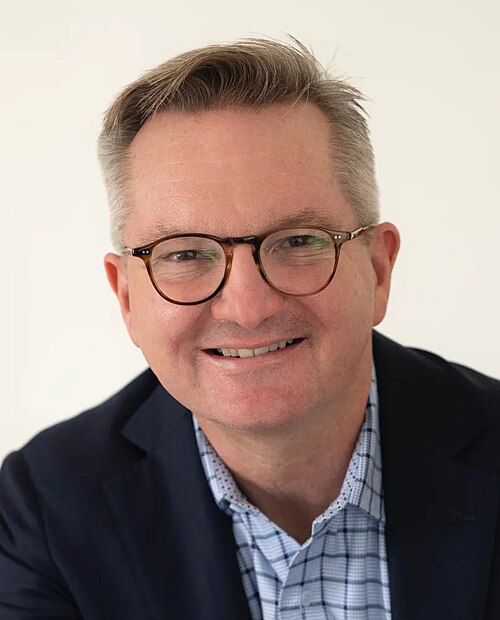
Chris Bowen
Australian Labor Party Member for McMahon
Currently sitting
Photo: © Department of Climate Change, Energy, the Environment and Water 2022, CC BY 4.0, via Wikimedia Commons
Seat and party history (2)
- Australian Labor Party - McMahon (House) - 21 Aug 2010 to present
- Australian Labor Party - Prospect (House) - 9 Oct 2004 to 21 Aug 2010
- Seat and party records: OpenAustralia member data.
Contact
Electorate office: (02) 9604 0710
Shops 3 & 4, 398 Hamilton Road, Fairfield NSW 2165
Office details: Parliament of Australia, CC BY-NC-ND 4.0.
Contact details on aph.gov.au Profile on OpenAustraliaNot sure if this is your member? Find your electorate (AEC)
These counts cover what is on this site only. They do not measure electorate work or committee work.
Compared with other members
Chris Bowen compared with all 150 sitting House members.
Questions asked in Question Time
Lower than 74% of House members- This member
- 2
- Average
- 11.2
- Median
- 12
Debates spoken in
Lower than 93% of House members- This member
- 8
- Average
- 35.9
- Median
- 30.5
Votes cast
Lower than 55% of House members- This member
- 245
- Average
- 253.0
- Median
- 265
Share of divisions voted in
Lower than 56% of House members- This member
- 74%
- Average
- 79%
- Median
- 81%
Read these with care
- The median is the middle member: half did more, half did less. It is less affected by a few very active members than the average.
- Ministers answer questions rather than ask them, and the presiding officers rarely vote, so their patterns differ.
- Government backbenchers are often given arranged "Dorothy Dixer" questions, which raises their question counts.
- Votes only record ayes and noes, so a missed vote cannot be told apart from a pair (an agreed absence).
- Counts cover only what is on this site, and do not measure electorate or committee work. New members have less history.
Question Time
Question from Chris Bowen
The member stated that Australia enters the crisis with 36 days of petrol, 29 days of aviation fuel, and 32 days of diesel, exceeding previous ministerial guarantees of 24 days. He argued that supplies are secure and urged against panic buying.
Background: Current fuel stock levels compared to previous government standards.
Answer from Chris Bowen (Minister for Climate Change and Energy)
The member noted that current fuel stocks exceed the minimum levels previously deemed necessary by the former energy minister. He emphasized that fuel supplies are arriving and stocks are strong, urging responsible members to reassure the public that there is no need for panic buying despite real challenges. He contrasted the government's leadership with the opposition's political maneuvering.
Question from Chris Bowen
The member elaborated on the job losses and criticised the opposition's stance on extending the life of coal-fired power stations.
Background: This was a follow-up to the previous question regarding the Gladstone Power Station.
Answer from Chris Bowen (Minister for Industry and Science)
The minister reiterated that the closure was a decision by the owners. He argued that unplanned outages at coal plants, such as Callide, posed the biggest threat to energy reliability and prices. He stated that modernising the energy system was essential for industrial jobs, contrasting this with the opposition's focus on keeping ageing assets operational.
Question from Barnaby Joyce
The member asked how much the government had spent on green hydrogen projects to date.
Background: The One Nation member asked the Climate Change Minister about expenditure on green hydrogen projects.
Answer from Chris Bowen
The minister stated that no payments had been made under the Hydrogen Headstart or production tax credit policies because green hydrogen had not yet been produced. He noted that some hydrogen hubs announced by the previous government had not proceeded. He offered to provide further details on specific hub expenditures and affirmed that green hydrogen had a role in future industrial decarbonisation.
Question from Zali Steggall
The member asked how Australians and Pacific nations could trust the government's climate commitment given the simultaneous support for fossil fuel expansion. She referenced the presence of Tuvalu's climate minister and a Canadian senator advocating for stronger global action.
Background: Australia signed the Belem declaration for a just transition away from fossil fuels, while the Prime Minister pledged climate action in Palau and the resources minister celebrated fossil fuel expansion in the Beetaloo basin.
Answer from Chris Bowen
The minister affirmed close cooperation with Pacific nations, citing the Palau declaration which identified climate change as the biggest threat to livelihoods. He highlighted domestic progress, noting that renewable energy had exceeded 50 per cent of the mix in the last quarter of the previous year. He argued that building new renewable energy is the pathway for transition, replacing old energy sources gradually. He committed to continuing international work with Pacific leaders to elevate climate issues on the global stage.
Question from Dan Tehan
The member asked if the minister recalled his previous positive statements about green hydrogen and why he now appeared skeptical.
Background: The member cited a previous statement by the Minister for Climate Change and Energy praising the potential of green hydrogen.
Answer from Chris Bowen
The minister clarified that his recent comments referred to the hype around green hydrogen for home heating and transport, noting that electric vehicles had overtaken petrol cars and only one hydrogen car was sold last year. He stated that green hydrogen would still play a role in industrial decarbonization. He pointed out that the shadow minister had also made similar positive statements about green hydrogen in the past.
Question from Jodie Belyea
The member asked how the government was helping families embrace technology to save money on power bills and what obstacles existed.
Background: The government was promoting cheaper home batteries to reduce energy bills.
Answer from Chris Bowen
The minister stated that 540,211 households had installed cheaper home batteries, including 2,326 in Dunkley. He noted the program had doubled the number of battery installers to 8,846, creating jobs in Western Sydney. He highlighted high uptake rates in several Western Sydney electorates. He contrasted the government's support for the program with the opposition's intention to abolish it.
Question from Alison Penfold
The member asked for the date the minister first became aware of fraud allegations related to the home battery program.
Background: The member asked when the minister was first made aware of fraud allegations impacting the Cheaper Home Batteries Program.
Answer from Chris Bowen
The Minister stated that he had received regular progress reports from the Clean Energy Regulator since the program's implementation on 1 July 2025. He noted that these reports showed the number of complaints per installation had halved since the program began. He denied claims of systemic fraud, stating that 535,833 households had installed batteries and that the opposition's allegations were untrue.
Question from Fiona Phillips
The member asked how the government was supporting families to reduce energy bills and what policies might hinder this effort.
Background: The member asked how the government was helping families lower energy bills and what policies could stop this progress.
Answer from Chris Bowen
The Minister reported that 535,833 households had installed cheaper home batteries, with more than 10 per cent of households in seven electorates participating. He highlighted that the electorate of Mitchell had the highest participation rate at 12.5 per cent. He stated that total installed capacity had reached 15 gigawatt hours, exceeding the entire US home battery capacity. He argued that the opposition's desire to abolish the program was the only thing that could stop this progress, citing high public support for the policy.
Question from Llew O'Brien
The member asked the Minister for Climate Change and Energy to disclose the amount of taxpayer money provided to foreign companies under the Capacity Investment Scheme.
Background: The member cited reports that CIS-backed companies had spent nearly $40 billion on social licence commitments.
Answer from Chris Bowen
The minister stated that auction results for the scheme were commercial in confidence, consistent with longstanding practice for government auctions. He noted that 65 projects had pledged $35.5 billion in domestic inputs, with $1.1 billion allocated to Australian steel. He highlighted that some projects, such as the one in Wellington, had negotiated five per cent equity ownership for local First Nations people.
Question from Garth Hamilton
The member asked the Minister for Climate Change and Energy to disclose the cost to taxpayers of the Capacity Investment Scheme.
Background: The member asked for the taxpayer cost of the Capacity Investment Scheme.
Answer from Chris Bowen
The minister stated that the scheme was treated as commercial in confidence in the budget, similar to previous government programs like the Underwriting New Generation Investments program. He noted that the projects aimed to provide cheaper energy and cited a press release from the shadow minister acknowledging that the net zero agenda was delivering affordable energy.
Question from Susan Templeman
The member asked how the government was delivering change in energy and what policies would obstruct this.
Background: A government member asked about energy policy and what would stop positive change.
Answer from Chris Bowen
The Minister reported that 504,470 Australians had installed cheaper home batteries in the last 12 months, totaling 14.1 gigawatt hours, surpassing the US total. He linked this to a 47 per cent reduction in wholesale prices. He highlighted high adoption rates in several electorates, including Macquarie. He stated that the opposition would abolish the battery policy and replace it with an uncosted nuclear plan, which he argued would increase bills and delay action.
Question from Dai Le
The member asked if the government could guarantee that energy bills would not increase, questioning the 'solar sharer' scheme.
Background: The member questioned the effectiveness of three hours of free power and asked for a guarantee that bills would not rise.
Answer from Chris Bowen
The Minister confirmed that free power was a legal requirement for energy companies. He stated that the default market offer had reduced prices by 3.4 per cent in the Endeavour Energy network. He highlighted that 2,720 households in Fowler had installed cheaper home batteries, reducing bills significantly. He argued that the policy was effective and popular in the electorate.
Question from Libby Coker
The member asked how the government was helping households lower bills through renewable energy and what policies would stop this progress.
Background: The member asked how the government was helping households lower bills using renewable energy.
Answer from Chris Bowen
The Minister stated that 457,439 households had installed cheaper home batteries in the last year, with Australia now having more household batteries than California. He noted that solar sharer was available in NSW, South-East Queensland, and South Australia, offering three hours of free electricity. He mentioned rule changes limiting price rises to once a year and banning excessive fees. He warned that the opposition would abolish these policies.
Question from Justine Elliot
The member asked for details on government policies reducing fuel and energy costs and a comparison with policies that would increase costs.
Background: The member asked what policies were helping to lower fuel and energy costs and what policies would see Australians paying more.
Answer from Chris Bowen
The Minister stated that the cheaper home battery policy, introduced on 1 July last year, had been adopted by 456,320 households, equating to 13 gigawatt-hours of storage. He noted that this capacity was 100 times that of the Hornsdale battery. The Minister highlighted that over 10 per cent of households in several electorates, including Hume, had installed batteries. He criticized the opposition for opposing cheaper home batteries, EV tax cuts, and the new vehicle efficiency standard, claiming they wanted to keep bills high.
Question from Sally Sitou
The member asked how the government was assisting with energy and fuel costs and which policies would lead to higher prices.
Background: A government member asked the Minister for Climate Change and Energy how the government was helping with fuel and energy prices and what policies would increase costs.
Answer from Chris Bowen
The Minister highlighted the cheaper home battery scheme, which had increased uptake from one in 60 to one in 17 households, and the growth in electric vehicle sales due to new efficiency standards. He stated that abolishing these policies, as proposed by the Liberal Party, would increase costs and taxes, citing a Parliamentary Budget Office estimate of $600 million in additional petrol tax revenue if standards were removed.
Question from Carol Berry
The member asked how the government is helping Australians with fuel and energy costs and what policies would increase costs.
Background: A government member asked the Minister for Climate Change and Energy about government assistance with fuel and energy costs.
Answer from Chris Bowen
The Minister announced an extension of fuel excise relief for another month. He reported that 448,342 households have taken up cheaper home batteries, with over 10 per cent uptake in electorates like Greenway, Mitchell, Mayo, and Wright. He highlighted support for electric vehicles through the new vehicle efficiency standard and tax cuts. He warned that the opposition would abolish these measures, thereby increasing costs for Australians.
Question from Kate Thwaites
The member asked how the government had acted to bolster fuel security and protect Australians from the effects of the Middle East conflict.
Background: The member asked about government actions to strengthen fuel security amid Middle East conflicts.
Answer from Chris Bowen
The Minister stated that Australia held greater fuel reserves than at any point since the minimum stock obligation began, with 44 days of petrol, 39 days of diesel, and 32 days of jet fuel. He noted that 51 ships were en route with fuel and 3.9 billion litres were contracted for delivery over the next four weeks. The Minister criticized opposition members for predicting shortages and rationing, asserting that the government's calm approach had ensured supply security. He thanked the private sector and trading partners for their cooperation.
Question from Nicolette Boele
The member asked why BHP, which had after-tax profits over $1.512 trillion, received $622 million in diesel tax credits, particularly given the fuel crisis affecting regular Australians.
Background: An independent member questioned the provision of diesel tax credits to a profitable mining company during a fuel crisis.
Answer from Chris Bowen
The Minister stated that the government's focus was on securing fuel supply during an international crisis. He highlighted reforms to the Safeguard Mechanism, which had led to 5.8 million tonnes of emissions being avoided over two years. He projected that 17 billion litres of diesel use would be avoided between now and 2035 through settings designed to encourage large emitters to reduce fuel use.
Question from Matt Gregg
The member asked how the government had helped ensure fuel security, what policies would maintain this security, and which policies would leave Australia vulnerable.
Background: A government member asked about the government's role in ensuring fuel security.
Answer from Chris Bowen
The Minister stated that Australia had 48 days' worth of petrol, an increase of 12 days since the bombing of Iran. He noted supplies of diesel and jet fuel had also increased, with total fuel stocks at 6.2 billion litres. He criticized the Opposition for raising unfounded concerns about shortages. He highlighted the government's plan to build a strategic fuel reserve and promote electric vehicles, noting that in May, 30 per cent of new car sales were for electric or plug-in hybrid models. He stated that abolishing the New Vehicle Efficiency Standard and EV tax cuts would undermine fuel security.
Question from Sarah Witty
The member asked how the government's energy plan is delivering for households and businesses, and what policies would make energy more expensive.
Background: The member sought to highlight the government's progress on cheaper and cleaner energy.
Answer from Chris Bowen
The Minister stated that the default market offer indicated energy bill cuts of as much as 10.7 per cent for homes and 20.9 per cent for small businesses. He observed that electricity emissions dropped by four per cent in 2025. He pointed out that 423,717 batteries had been fitted since 1 July, contributing 12 gigawatt hours of storage. He condemned the opposition for rejecting the Cheaper Home Batteries policy and backing the unsuccessful UNGI scheme.
Question from Barnaby Joyce
The member asked for a specific cost estimate for the Capacity Investment Scheme, proposing several financial ranges.
Background: A One Nation member asked the Treasurer for an estimate of the cost of the Capacity Investment Scheme, suggesting various ranges.
Answer from Chris Bowen
The Minister stated that the costings were commercial-in-confidence due to the auction nature of the scheme. He noted that the recent auction was expected to generate $17 billion of private capital and result in approximately 19,000 roles in the building sector. The Minister argued that keeping the costs confidential was appropriate to protect taxpayers' interests, citing the member's previous support for commercial confidentiality.
Question from Renee Coffey
The member asked what the default market offer determination means for power prices, which policies are reducing costs, and which would increase them.
Background: A government member asked the Minister for Climate Change and Energy about the impact of the default market offer on power prices and the policies driving these changes.
Answer from Chris Bowen
The Minister announced price reductions in all jurisdictions, including a 10.7 per cent drop for residences in Energex and up to 20.9 per cent for small businesses in Essential Energy. He attributed these reductions to increased renewable energy penetration, battery storage displacing expensive gas and hydro generation, and reforms to the default market offer. He contrasted this with opposition policies, such as extending coal life and nuclear energy, which he argued would not help reduce prices.
Question from Andrew Gee
The member asked what actions would be taken to hold accountable those responsible for destroying a Wiradjuri cultural site and where accountability lies.
Background: The member for Calare asked the Prime Minister about the destruction of a Wiradjuri cultural site during transmission line construction for the Central West-Orana Renewable Energy Zone.
Answer from Chris Bowen
The Minister agreed that the destruction of First Nations culture was unacceptable. He stated he would discuss the matter with the Minister for Indigenous Australians and the New South Wales government and keep the member advised of progress in the investigation.
Question from David Moncrieff
The member asked the Minister for Climate Change and Energy how the budget strengthened Australia's fuel security and how this compared to previous policies.
Background: A government member asked about the budget's impact on fuel security.
Answer from Chris Bowen
The Minister reported that diesel holdings were at 38 days, the highest since the minimum stock obligation began in 2023, with 43 days of diesel and 31 days of jet fuel available. He stated that one billion litres of extra stock had been added in seven weeks, underwritten by Export Finance Australia. He highlighted the budget's investment in a sovereign strategic reserve, contrasting this with the previous government's reliance on reserves held in Texas. He argued that a government-owned reserve was necessary for future security.
Question from Basem Abdo
The member asked how the budget enhances fuel security and protects families from global energy shocks, and what policies would leave Australians more exposed.
Background: A government member asked the Minister for Climate Change and Energy how the budget strengthens fuel security and protects families from energy shocks.
Answer from Chris Bowen
The Minister stated that the budget builds a sovereign fuel stock and supports households in diversifying energy choices, such as buying electric vehicles and installing home batteries. He noted that 398,123 households had installed cheaper home batteries, with 400,000 expected soon. He criticized the Opposition for opposing these measures and for suggesting they should be paused or means-tested. He highlighted high take-up rates in regional areas like Mallee, contradicting claims of low regional uptake.
Question from Lisa Chesters
The member asked how the budget strengthened fuel security and resilience, and which policies would weaken resilience.
Background: A government member asked the Minister for Climate Change and Energy how the budget strengthened fuel security and resilience, and what policies would weaken it.
Answer from Chris Bowen
The Minister stated that the budget included a $14.8 billion package for fuel security, including a $1.1 billion fund for cleaner fuels like biofuels. He highlighted a $3.2 billion commitment for a government-owned strategic fuel reserve, which had been welcomed by rural and regional groups. The Minister criticized the opposition for opposing the government-owned reserve and noted that their proposal to increase private sector stock obligations to 60 days was mathematically incorrect, as a billion litres only equated to 37 days of supply.
Question from Kara Cook
The member inquired about steps taken to secure fuel supplies and what budget initiatives would improve Australia's position for future fuel security challenges.
Background: The member asked about government actions to secure additional fuel for Australia and what budget measures would ensure resilience against future uncertainty.
Answer from Chris Bowen
The Minister stated that Australia currently holds more fuel than on 28 February, with 42 days of petrol, 35 days of diesel, and 29 days of jet fuel. He attributed this to government-industry cooperation and diplomatic efforts with South-East Asian partners. The government had adjusted diesel standards and released strategic reserves. The budget would establish a government-owned strategic reserve of one billion litres to address regional shortages, aligning Australia with 22 of the 32 International Energy Agency governments that hold such reserves.
Question from Carina Garland
The member asked how the government had acted to strengthen Australia's fuel security.
Background: Global supply chains were disrupted by the war in the Middle East.
Answer from Chris Bowen
The Minister stated that securing fuel supply had been the focus since 28 February. He listed actions including changing fuel quality standards, releasing 20 per cent of the strategic reserve, and changing diesel standards. He noted that legislation enabling Export Finance Australia to support fuel imports had passed both houses and would be law. He mentioned ongoing conversations with 10 companies and engagement with international partners like Singapore and Brunei to ensure fuel flows.
Question from Nicolette Boele
The member asked if the government would maintain its commitment to the domestic gas reservation scheme to ensure resources worked for Australians.
Background: The east coast gas reservation was due to start next year, with some producers concerned about supply impacts.
Answer from Chris Bowen
The Minister confirmed the government was determined to introduce the gas reservation policy starting 1 January 2027. He noted that submissions had been received and detailed design was underway in consultation with industry and gas users. He stated that cabinet would decide the parameters based on recommendations to ensure gas under Australian soil and waters benefited heavy industry and the energy system.
Question from Kevin Hogan
The member asked who would be classified as a critical user under the plan.
Background: The National Fuel Security Plan had been agreed upon.
Answer from Chris Bowen
The Minister said priority would go to essential users like emergency services, utilities, and life-supporting services. He cited examples from the Liquid Fuel Emergency Act determination, including police, fire, rescue, ambulance, corrective, public transport, state emergency, and taxi services. He noted the Minister for Energy made this determination.
Question from Dan Tehan
The member asked how many service stations in Australia were currently out of fuel.
Background: The Shadow Minister for Energy asked for specific data on service stations without fuel.
Answer from Chris Bowen
The Minister provided detailed figures for each state and territory. In New South Wales, 247 stations lacked diesel and 61 had total stockouts out of 2,400. In Queensland, 77 lacked diesel and 39 lacked unleaded petrol out of 1,800. In Victoria, 82 lacked diesel and 40 lacked petrol out of 1,627. In South Australia, 20 lacked diesel and 13 lacked unleaded petrol out of 700. In Western Australia, 18 lacked diesel and 14 lacked unleaded petrol out of 771. In Tasmania, eight lacked diesel and 15 had unavailable grades out of 294. In the Northern Territory, five lacked diesel and four lacked unleaded petrol out of 180, with some shortages due to road closures. In the ACT, five lacked diesel and two lacked unleaded petrol, with shortages typically resolved within the same day.
Question from Libby Coker
The member asked how the government had acted to protect Australians from fuel and energy market impacts.
Background: A government member asked about government actions to protect Australians from fuel market impacts due to the Middle East war.
Answer from Chris Bowen
The Minister stated that the government had focused on ensuring energy supply since 28 February. Actions included freeing up 20 per cent of the minimum stock obligation, altering sulphur and diesel rules, and confirming that cancelled ships were replaced. He noted that over 55 ships were en route to Australia with fuel, and 3.7 billion litres were contracted for April. Legislation was introduced to allow Export Finance Australia to finance risky spot cargoes. The Minister also highlighted progress in electricity, noting that over 300,000 home batteries had been installed since 1 July, including 1,508 in Corangamite, helping to store renewable energy and reduce gas use.
Question from Alison Penfold
The member asked how many oil tankers had left the Middle East for Asian refineries since 28 February.
Background: The National Party member asked about the number of oil tankers leaving the Middle East for Asian refineries since 28 February.
Answer from Chris Bowen
The Minister stated that over 53 ships were en route to Australia from various refineries, with 3.7 billion litres contracted for April. He acknowledged risks in the supply chain due to the Strait of Hormuz closure and highlighted government actions like releasing minimum stock obligations and introducing legislation to finance spot cargoes. He noted that Asian refineries supply both Australia and Asia, and that the government was in constant contact with international counterparts.
Question from Jamie Chaffey
The member asked how many ships the Minister expected to arrive in Australia in May, citing previous figures of 53 and 81 ships.
Background: The National Party member questioned the consistency of ship arrival figures provided by the Minister.
Answer from Chris Bowen
The Minister clarified that over 53 ships were currently en route, with some imminent and others just leaving refineries. He stated that the historical average of 81 ships per month was expected to continue into May. He confirmed 3.7 billion litres were on the water. Regarding Middle East exports, he noted that around 46 ships had left the Middle East through the Strait of Hormuz since the conflict began, which was below pre-conflict levels. He mentioned Saudi Arabia increasing exports from Yanbu to bypass the Strait and highlighted ongoing engagement with international counterparts.
Question from David Batt
The member asked how the government allowed the fuel crisis to threaten essential transport for vulnerable Australians.
Background: The opposition member asked about diesel supplies for wheelchair-accessible taxis in his electorate.
Answer from Chris Bowen
The Minister thanked taxi operators and stated that fuel supply to Australia continued at expected rates. He acknowledged regional shortages and highlighted increased sales at terminals in Gladstone and Mackay. The release of the minimum stockholding obligation had led to increased allocations to wholesalers and regional distributors, including for mining, rail, and Indigenous communities. The Minister offered to assist specific constituents by contacting fuel companies to address shortages. He expressed appreciation for the work of taxi operators supporting elderly and disabled Australians.
Question from Susan Templeman
The member asked how the government was taking further action to strengthen Australia's fuel security amidst global supply chain disruptions.
Background: Global supply chains were impacted by the war in the Middle East.
Answer from Chris Bowen
The Minister reported that Australia held 39 days' worth of petrol, 30 days of diesel, and 30 days of jet fuel. He noted that deliveries to regional Australia were 55 per cent higher than normal. To address difficulties in purchasing spot cargoes, the government announced that Export Finance Australia would finance and insure fuel imports. Legislation was introduced to allow this support for fuel and other goods like fertiliser, aiming to secure available global supplies for Australian consumers.
Question from Anne Stanley
The member asked how the government was ensuring fuel was distributed to where it was required.
Background: A government member asked the Minister for Climate Change and Energy how the government was acting to distribute fuel where needed.
Answer from Chris Bowen
The Minister stated that supply remained strong, with all six cancelled ships replaced and additional spot cargo confirmed. He noted that the two domestic refineries were operating at full capacity for Australian use. He explained that suppliers were prioritizing contract holders, leading to shortages in the spot market, but emphasized that government and industry personnel were working long hours to address regional shortages. He reported that Ampol's supplies to independent distributors in regional areas had increased significantly year-on-year, ranging from 19 per cent in Victoria to 66 per cent in South Australia.
Question from Dan Tehan
The member asked for the number of service stations currently out of fuel and whether the minister would commit to releasing daily updates on individual stations that had run out.
Background: The Shadow Minister for Energy asked how many service stations were out of fuel and if the minister would commit to daily updates on individual stations.
Answer from Chris Bowen
The Minister provided state-by-state figures for service stations without diesel or unleaded fuel, noting declines in some areas like Victoria. He stated he would continue providing updates as appropriate, similar to state premiers. He explained that data was collected primarily by states and shared regularly with the Commonwealth, and that premiers were providing daily updates.
Question from Melissa McIntosh
The member asked when the government would ensure fuel availability to prevent Australians from choosing between eating and driving, and why the minister would not commit to daily updates on individual service stations.
Background: The Shadow Minister for Women cited a constituent's financial stress due to fuel costs and asked when the government would ensure fuel availability and commit to daily updates.
Answer from Chris Bowen
The Minister stated the government had been taking action since 28 February to ensure supply and distribution. He noted that international oil prices were the primary driver of petrol costs, a factor beyond government control. Regarding updates, he confirmed he had been providing daily updates in the House and pointed out that every state had apps or websites with service station information. He mentioned that a national system had been tried before and opposed by the Liberal Party.
Question from Michelle Landry
The member asked if the minister could guarantee fuel availability for Australians traveling to regional areas for Easter and why he would not commit to daily updates on individual service stations.
Background: A National Party member asked if the minister could guarantee fuel availability for Easter travel and why he would not commit to daily updates on individual stations.
Answer from Chris Bowen
The Minister reiterated that Ampol's distribution to regional Queensland had increased substantially year-on-year, indicating industry efforts to catch up with demand. He stated that the government was working hard to ensure fuel access for Easter and beyond. He criticized misleading claims about fuel exports and net zero links. Regarding updates, he confirmed he would continue providing daily updates in the House and noted that state premiers and state websites were also providing useful information.
Question from Tony Pasin
The member asked why a fourth-generation farmer from Eudunda had to wait four weeks for fuel needed for farming operations, despite being categorized as critical.
Background: The Shadow Minister for Fisheries cited a farmer waiting four weeks for fuel and asked why she had to wait.
Answer from Chris Bowen
The Minister offered to take up the specific case with suppliers. He reported that Ampol's supply to regional South Australia was up 44 per cent year-on-year and provided figures for Viva, showing increases in supply to regional areas across states. He stated that combined supplies from Ampol and Viva were significantly higher than a year ago, reflecting progress in catching up with demand spikes. He praised the National Farmers' Federation for its constructive approach and emphasized the need for collaboration during this difficult international circumstance.
Question from Angus Taylor
The member asked how many service stations in the country were currently experiencing fuel stockouts.
Background: The Leader of the Opposition queried the Prime Minister regarding the current state of fuel availability at service stations across Australia.
Answer from Chris Bowen
The minister provided a state-by-state breakdown of fuel shortages. In New South Wales, 187 stations lacked diesel and 32 had no stock, a decrease of 19 from the previous day, out of 2,417 total stations. Queensland reported 55 stations without diesel and 35 without regular unleaded. Victoria had 134 stations lacking one or more grades, down 28 from the last report. South Australia had 49 shortages out of 700 stations. Western Australia had six total stockouts and four without diesel out of 771 stations. Tasmania had one station without diesel and six without unleaded. The Northern Territory had no shortages due to fuel supply issues, though natural disaster impacts affected access. The Australian Capital Territory had one station without diesel, with rectification expected within hours.
Question from Dan Tehan
The member asked how many service stations needed to run out of fuel before the minister would use powers to require mandated reporting and immediate domestic redistribution of stock.
Background: The Shadow Minister for Energy questioned the Minister for Climate Change and Energy about the use of powers to mandate reporting and redistribution of fuel stocks, referencing a previous statement that fuel levels were unchanged since the start of the conflict.
Answer from Chris Bowen
The minister confirmed that fuel levels were accurate and that ships continued to arrive and refineries operated fully. He acknowledged real shortages in rural areas due to doubled demand but stated that using information-gathering powers would require legislation that the opposition had previously voted against. He compared this to the opposition's stance on hate speech legislation, noting they voted against it and then demanded its use.
Question from Gordon Reid
The member asked how the government was acting to get more fuel flowing to where it was needed and why representatives should act in the national interest.
Background: A government member asked the Minister for Climate Change and Energy how the government was ensuring fuel reached areas of need and why national interest action was required.
Answer from Chris Bowen
The minister reported that 20 per cent of the minimum stock obligation had been released on the condition that it flowed to rural and regional Australia, with agreements struck with impacted companies. He stated that 757 million litres were now flowing to regional areas due to these releases. He noted that six cancelled ship arrivals in April had been replaced with alternative spot market orders, and three additional cargo deliveries had been secured for April and May. He criticized the opposition for not making constructive suggestions and for misleading statements regarding exports and Pacific leaders.
Question from Angie Bell
The member asked when the minister would take action to ensure fuel gets to where it is needed, referencing the Queensland Premier's statement about the need for a national plan.
Background: The Shadow Minister for Youth asked the Minister for Climate Change and Energy when he would take action to ensure fuel gets to where it is needed, citing the Queensland Premier's call for a national plan.
Answer from Chris Bowen
The minister said the government had freed 757 million litres from the minimum stock obligation, provided it went to designated regions. He outlined distributions for Toowoomba, the Darling Downs, the Atherton Tablelands, Mareeba, Indigenous communities, Cape York, and farming areas near Cairns and Townsville. He highlighted that priority went to key fuel stops for long-distance transport and extra bulk supplies for Queensland households. He specifically noted sending fuel to Texas, Queensland, contrasting this with the opposition's previous plans.
Question from Mary Aldred
The member asked when the minister would take action to ensure fuel gets to where it is needed, referencing the New South Wales Premier's statement about national coordination.
Background: A Liberal member asked the Minister for Climate Change and Energy when he would take action to ensure fuel gets to where it is needed, citing the New South Wales Premier's call for national-level demand management.
Answer from Chris Bowen
The minister stated that the government was coordinating action through National Cabinet and meetings with energy ministers, which was exactly what the New South Wales Premier had advocated for. He criticized the opposition for partisanship and lack of constructive suggestions, noting that the member had accurately quoted the Premier unlike a previous misrepresentation.
Question from Dan Tehan
The member asked when the legislation to increase ACCC penalties for fuel misconduct would be introduced, noting that fuel prices had doubled in three weeks.
Background: The Minister for Climate Change and Energy had previously stated that penalties for fuel misconduct would be increased.
Answer from Chris Bowen
The minister stated that the legislation would be introduced the following day.
Question from Rick Wilson
The member asked for the number of service stations in each state and territory that were currently out of fuel.
Background: The minister had previously stated that there was enough diesel for foreseeable needs.
Answer from Chris Bowen
The minister provided figures for service stations without fuel: 164 without diesel and 289 without at least one fuel type in New South Wales; 55 without diesel and 35 without regular unleaded in Queensland; 162 with one or more grades unavailable in Victoria; 46 in South Australia; six in Western Australia; one without diesel and six without unleaded in Tasmania. He noted no shortages in the Northern Territory or ACT, though flooding affected access in the NT.
Question from Michael McCormack
The member asked what the government's plan was to get fuel to these stations.
Background: More than 400 service stations were reported to have no fuel.
Answer from Chris Bowen
The minister stated that the government released 20 per cent of the minimum stock obligation, conditional on fuel flowing to regional areas. He also announced a temporary relaxation of sulphur rules for petrol, adding 100 million litres to the system monthly. The government was working with refiners and suppliers to ensure fuel reached areas with real shortages, denying claims that exports were being stopped.
Question from Basem Abdo
The member asked for an update on fuel supply and how the government had acted to strengthen it.
Background: Concerns persisted regarding fuel supply security and government response.
Answer from Chris Bowen
The minister announced changes to fuel security services payments to keep two existing refineries operating. He also announced a change to diesel standards, allowing a lower flashpoint of 60.5 degrees to increase import flexibility. He reiterated that 20 per cent of the minimum stock obligation had been released to boost supply, emphasizing that these were practical measures taken in response to international uncertainty.
Question from Tom Venning
The member asked whether any state or territory energy ministers had requested a federal fuel-rationing plan.
Background: A newspaper article claimed states warned the government of fuel ration confusion.
Answer from Chris Bowen
The minister referred to a communique from energy ministers agreeing to work together on fuel security and contingency planning. He stated that the government was working with states under the National Liquid Fuel Emergency Response Plan, which had existed for 20 years, and denied that rationing was being requested or implemented.
Question from Andrew Wilkie
The member asked whether the minister would use the Liquid Fuel Emergency Act to prioritize bunker fuel, given its importance to trade.
Background: The Minimum Stockholding Obligation did not apply to bunker fuel, which is critical for shipping.
Answer from Chris Bowen
The minister confirmed that bunker fuel was not part of the Minimum Stockholding Obligation but stated that conditions on the release of stocks prioritized maritime oil supply for cargo and passenger vessels. He noted that fuel oil accounted for one per cent of refined product use in 2025. He stated that invoking the Liquid Fuel Emergency Act was not envisaged as the threshold for its use was high and had never been met in 40 years.
Other Parliamentary Activity
-
Export Finance and Insurance Corporation Amendment) Strategic Reserve) Bill 2026; Second Reading
House of Representatives · Monday 30 March 2026 · Second Reading
Opened this debate
-
Bondi Beach Attack Victims
House of Representatives · Monday 19 January 2026 · Condolence
Contributed to this debate
-
Annual Climate Change Statement; Reference to Federation Chamber
House of Representatives · Thursday 27 November 2025 · Ministerial Statement
Contributed to this debate
-
Home Affairs Legislation Amendment (2025 Measures No. 2) Bill 2025; Third Reading
House of Representatives · Thursday 30 October 2025 · Third Reading
Contributed to this debate
-
Education Legislation Amendment (Integrity and Other Measures) Bill 2025; Third Reading
House of Representatives · Thursday 30 October 2025 · Third Reading
Contributed to this debate
-
Electricity Infrastructure Legislation Amendment Bill 2025; Third Reading
House of Representatives · Wednesday 12 February 2025 · Third Reading
Contributed to this debate
-
Electricity Infrastructure Legislation Amendment Bill 2025; Second Reading
House of Representatives · Tuesday 11 February 2025 · Second Reading
Responded as minister
-
Electricity Infrastructure Legislation Amendment Bill 2025; Second Reading
House of Representatives · Wednesday 5 February 2025 · Second Reading
Opened this debate
- Votes recorded
- 245
- Aye votes (57.1%)
- 140
- No votes (42.9%)
- 105
Showing the latest 50 votes.
-
Military Rehabilitation and Compensation Amendment (Veterans' Healthcare With...
17 Sep 2026 · Ayes 85, Noes 40 · Passed
VOTED AYE -
Rearrangement
17 Sep 2026 · Ayes 42, Noes 87 · Failed
VOTED NO -
Suspension of Standing and Sessional Orders
17 Sep 2026 · Ayes 42, Noes 89 · Failed
VOTED NO -
Suspension of Standing and Sessional Orders
16 Sep 2026 · Ayes 85, Noes 44 · Passed
VOTED AYE -
Private Health Insurance Amendment (Modernising the Private Health Insurance ...
16 Sep 2026 · Ayes 88, Noes 48 · Passed
VOTED AYE -
Private Health Insurance Amendment (Modernising the Private Health Insurance ...
16 Sep 2026 · Ayes 87, Noes 48 · Passed
VOTED AYE -
Private Health Insurance Amendment (Modernising the Private Health Insurance ...
16 Sep 2026 · Ayes 9, Noes 85 · Failed
VOTED NO -
Private Health Insurance Amendment (Modernising the Private Health Insurance ...
16 Sep 2026 · Ayes 86, Noes 47 · Passed
VOTED AYE -
Private Health Insurance Amendment (Modernising the Private Health Insurance ...
16 Sep 2026 · Ayes 45, Noes 87 · Failed
VOTED NO -
Private Health Insurance Amendment (Modernising the Private Health Insurance ...
16 Sep 2026 · Ayes 46, Noes 86 · Failed
VOTED NO -
Rearrangement
16 Sep 2026 · Ayes 84, Noes 13 · Passed
VOTED AYE -
Rearrangement
15 Sep 2026 · Ayes 49, Noes 87 · Failed
VOTED NO -
Consideration of Legislation
14 Sep 2026 · Ayes 43, Noes 87 · Failed
VOTED NO -
Regulatory Reform Omnibus Bill 2026; Consideration of Senate Message
14 Sep 2026 · Ayes 95, Noes 43 · Passed
VOTED AYE -
Regulatory Reform Omnibus Bill 2026; Consideration of Senate Message
14 Sep 2026 · Ayes 95, Noes 42 · Passed
VOTED AYE -
Albanese Government; Attempted Censure
14 Sep 2026 · Ayes 46, Noes 86 · Failed
VOTED NO -
Statute Update Bill 2026; Consideration of Senate Message
14 Sep 2026 · Ayes 84, Noes 48 · Passed
VOTED AYE -
Online Safety Amendment (Strengthening Enforcement for the Social Media Minim...
10 Sep 2026 · Ayes 95, Noes 37 · Passed
VOTED AYE -
Online Safety Amendment (Strengthening Enforcement for the Social Media Minim...
10 Sep 2026 · Ayes 96, Noes 36 · Passed
VOTED AYE -
Carbon Credits (Carbon Farming Initiative-Improved Forest Management in Multi...
10 Sep 2026 · Ayes 38, Noes 92 · Failed
VOTED NO -
Telecommunications Legislation Amendment (Universal Outdoor Mobile Obligation...
9 Sep 2026 · Ayes 52, Noes 86 · Failed
VOTED NO -
Gun Control
9 Sep 2026 · Ayes 88, Noes 47 · Passed
VOTED AYE -
Veterans
7 Sep 2026 · Ayes 88, Noes 49 · Passed
VOTED AYE -
Cash Distribution Framework Bill 2026; Consideration of Senate Message
20 Aug 2026 · Ayes 84, Noes 34 · Passed
VOTED AYE -
Economy
20 Aug 2026 · Ayes 41, Noes 85 · Failed
VOTED NO -
Universities Accord (Opening the Doors of Opportunity) Bill 2026; Considerati...
20 Aug 2026 · Ayes 90, Noes 36 · Passed
VOTED AYE -
Counter-Terrorism Legislation Amendment Bill 2026; Report from Federation Cha...
20 Aug 2026 · Ayes 39, Noes 90 · Failed
VOTED NO -
Australia's Foreign Relations (State and Territory Arrangements) Amendment Bi...
19 Aug 2026 · Ayes 38, Noes 80 · Failed
VOTED NO -
Combatting Illicit Tobacco Bill 2026; Report from Federation Chamber
19 Aug 2026 · Ayes 41, Noes 84 · Failed
VOTED NO -
Minister for Veterans' Affairs
19 Aug 2026 · Ayes 83, Noes 44 · Passed
VOTED AYE -
News Journalism Payments Bill 2026; Consideration in Detail
19 Aug 2026 · Ayes 11, Noes 69 · Failed
VOTED NO -
News Journalism Payments Bill 2026; Second Reading
19 Aug 2026 · Ayes 40, Noes 83 · Failed
VOTED NO -
Interactive Gambling Amendment (Gambling Reform) Bill 2026; Second Reading
18 Aug 2026 · Ayes 12, Noes 86 · Failed
VOTED NO -
Interactive Gambling Amendment (Gambling Reform) Bill 2026; Second Reading
18 Aug 2026 · Ayes 12, Noes 85 · Failed
VOTED NO -
Royal Commission on Antisemitism and Social Cohesion
18 Aug 2026 · Ayes 87, Noes 48 · Passed
VOTED AYE -
Minister for Veterans' Affairs and Defence Personnel; Attempted Censure
17 Aug 2026 · Ayes 86, Noes 43 · Passed
VOTED AYE -
Cash Distribution Framework Bill 2026; Reference to Federation Chamber
12 Aug 2026 · Ayes 40, Noes 83 · Failed
VOTED NO -
International Relations: Australia and Japan
12 Aug 2026 · Ayes 88, Noes 41 · Passed
VOTED AYE -
Aged Care Amendment (Restoring Human Override for Aged Care Needs Assessments...
11 Aug 2026 · Ayes 42, Noes 87 · Failed
VOTED NO -
Rearrangement
11 Aug 2026 · Ayes 86, Noes 47 · Passed
VOTED AYE -
Rearrangement
2 Jul 2026 · Ayes 90, Noes 42 · Passed
VOTED AYE -
Minister for Defence Industry; Attempted Censure
2 Jul 2026 · Ayes 90, Noes 41 · Passed
VOTED AYE -
Health Insurance Amendment (Incentive Payments and Other Measures) Bill 2026;...
2 Jul 2026 · Ayes 39, Noes 92 · Failed
VOTED NO -
Social Policy and Legal Affairs Committee; Reference
2 Jul 2026 · Ayes 72, Noes 12 · Passed
VOTED AYE -
Foreign Affairs, Defence and Trade Joint Committee; Appointment
2 Jul 2026 · Ayes 38, Noes 101 · Failed
VOTED NO -
National Disability Insurance Scheme Amendment (Securing the NDIS for Future ...
1 Jul 2026 · Ayes 90, Noes 33 · Passed
VOTED AYE -
Health Legislation Amendment (Prescribing of Pharmaceutical Benefits) Bill 20...
1 Jul 2026 · Ayes 90, Noes 43 · Passed
VOTED AYE -
Health Legislation Amendment (Prescribing of Pharmaceutical Benefits) Bill 20...
1 Jul 2026 · Ayes 90, Noes 43 · Passed
VOTED AYE -
Online Safety Amendment (Strengthening Enforcement for the Social Media Minim...
1 Jul 2026 · Ayes 43, Noes 92 · Failed
VOTED NO -
National Anti-Corruption Commission Joint Committee; Consideration of Senate ...
1 Jul 2026 · Ayes 93, Noes 45 · Passed
VOTED AYE
About this page
This page tracks Chris Bowen's parliamentary activity: questions asked and answered in Question Time, debates spoken in, and votes in divisions. Summaries are in reported speech, not transcripts; each one links to the official record.