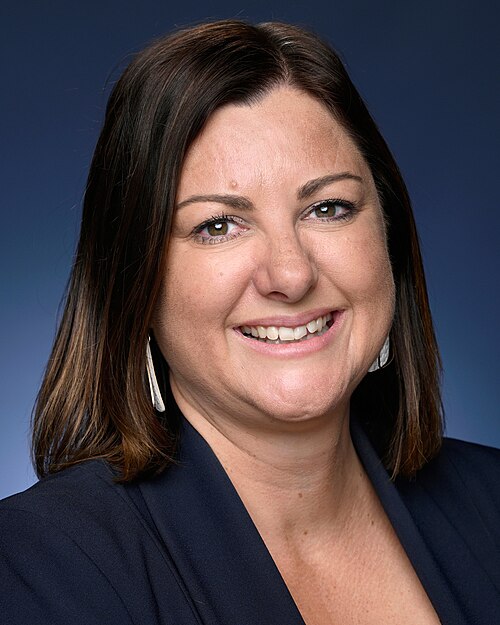
Kristy McBain
Australian Labor Party Member for Eden-Monaro
Currently sitting
Photo: Penny Bradfield, CC BY 3.0 au, via Wikimedia Commons
Seat and party history (1)
- Australian Labor Party - Eden-Monaro (House) - 4 Jul 2020 to present
- Seat and party records: OpenAustralia member data.
Contact
Electorate office: (02) 6284 2442
1/21-25 Monaro Street, Queanbeyan NSW 2620
Office details: Parliament of Australia, CC BY-NC-ND 4.0.
Contact details on aph.gov.au Profile on OpenAustraliaNot sure if this is your member? Find your electorate (AEC)
These counts cover what is on this site only. They do not measure electorate work or committee work.
Compared with other members
Kristy McBain compared with all 150 sitting House members.
Questions asked in Question Time
Lower than 81% of House members- This member
- 0
- Average
- 11.2
- Median
- 12
Debates spoken in
Lower than 79% of House members- This member
- 16
- Average
- 35.9
- Median
- 30.5
Votes cast
Lower than 53% of House members- This member
- 251
- Average
- 253.0
- Median
- 265
Share of divisions voted in
Lower than 54% of House members- This member
- 76%
- Average
- 79%
- Median
- 81%
Read these with care
- The median is the middle member: half did more, half did less. It is less affected by a few very active members than the average.
- Ministers answer questions rather than ask them, and the presiding officers rarely vote, so their patterns differ.
- Government backbenchers are often given arranged "Dorothy Dixer" questions, which raises their question counts.
- Votes only record ayes and noes, so a missed vote cannot be told apart from a pair (an agreed absence).
- Counts cover only what is on this site, and do not measure electorate or committee work. New members have less history.
Question Time
No questions recorded for this member.
Question from Fiona Phillips
The member asked how the government was delivering real change for regional communities and how this compared to other approaches.
Background: A government member asked the Regional Development Minister about delivering change for regional communities.
Answer from Kristy McBain
The minister reported $361 million in housing support, $2 billion in the Local Infrastructure Fund, and $750 million for Growing Regions and Thriving Suburbs. She highlighted specific projects like the Cannonvale Community Hub and Langhorne Creek Discovery Trail. She contrasted this with the previous government's use of regional grants for urban projects like the North Sydney pool.
Question from Sharon Claydon
The member asked how the government was delivering real change through infrastructure investment across Australia.
Background: The government had recently opened the M1 Raymond Terrace project.
Answer from Kristy McBain
The minister highlighted the opening of the M1 Raymond Terrace project, which removed traffic lights between Melbourne and Coffs Harbour. She listed other major projects including the Torrens to Darlington project in South Australia, the North East Link in Victoria, Bruce Highway upgrades in Queensland, the Fremantle Traffic Bridge in WA, and road sealing in the Northern Territory. She emphasised that these investments were providing safer and faster journeys.
Question from Jess Teesdale
The member asked how the government was serving those residing and employed in regional areas and how this compared to other approaches.
Background: The government had announced funding for regional projects and road safety upgrades.
Answer from Kristy McBain
The minister highlighted funding for over 110 projects through the Growing Regions Program and 64 projects through the Regional Precincts program. She noted doubling the Roads to Recovery Program to $1 billion annually and increasing blackspot funding to $150 million annually. She also mentioned a 5 per cent increase in financial assistance grants to local councils in 2026-27, contrasting this with the opposition's previous freeze on such grants.
Question from Sam Lim
The member asked how the AusAlert trial performed and what other investments were being made ahead of the higher risk weather season.
Background: A government member asked about the performance of the AusAlert trial and further investments in emergency management.
Answer from Kristy McBain; Anthony Albanese
The Minister reported that the AusAlert test on 27 July was successful, with over 94 per cent of cell towers broadcasting the alert. She noted the system would be ready in October. She highlighted investments in the National Emergency Management Agency, the Disaster Ready Fund with 449 projects, and $100 million for aerial firefighting. She also mentioned Australian firefighters deployed to Canada, the US, and France to assist with wildfires.
Question from Marion Scrymgour
The member asked for details on government support for disaster preparedness and response, and a comparison with alternative political approaches.
Background: The member asked how the government was supporting communities to prepare for and respond to natural disasters, and how this compared to other approaches.
Answer from Kristy McBain
The Minister noted that 60 severe weather events had impacted over 190 local government areas in the last high-risk season. She listed government investments including the establishment of the National Emergency Management Agency, a $1 billion Disaster Ready Fund, a National Emergency Management Stockpile, the AusAlert warning system, and over $100 million in aerial firefighting capability. The Minister criticized the opposition for ignoring warnings and playing politics with recovery support, referencing comments by the Leader of the Opposition regarding firefighters.
Question from Ash Ambihaipahar
The member asked how the government was delivering for local governments and what approaches would leave them worse off.
Background: The member asked about government support for local governments and alternative approaches.
Answer from Kristy McBain
The Minister stated that over $3.6 billion had been committed through financial assistance grants, an increase of over five per cent. She noted that the previous government had frozen indexation, removing $1 billion from the sector. She mentioned the $2 billion Local Infrastructure Fund and $1.5 billion from the Housing Support Program. She cited the doubling of Roads to Recovery to $1 billion a year. She also referenced $200 million for safer local roads and $150 million for road black-spot funding.
Question from David Farley
The member asked if Australia's irrigated water capacity is sufficient to secure food supply during the next prolonged drought and if water allocations have been negotiated for food production.
Background: The member for Farrer questioned the Minister for Emergency Management on water capacity and allocations during droughts.
Answer from Kristy McBain; Tony Burke
The Minister for Emergency Management stated that drought events fall outside her portfolio and handed the question to the Minister for Water. The Minister for Home Affairs, answering on water matters, explained that water security varies by region, affecting crop choices. He noted that the Murray-Darling Basin Plan addresses water allocations during droughts, with high-security areas supporting permanent plantings and low-security areas suited for opportunity crops like rice.
Question from Fiona Phillips
The member asked how the government was delivering outcomes for regional Australia and what other approaches were being considered.
Background: The government was delivering infrastructure projects in regional areas.
Answer from Kristy McBain
The Minister highlighted $600 million in Growing Regions Fund funding, citing specific projects in Mission Beach and Wynyard. She announced $750 million for future rounds and $400 million for the Regional Precincts and Partnerships Program. She contrasted the government's merit-based grants with the previous government's allocation of funds to coalition-held seats.
Question from Matt Smith
The member asked how the budget facilitated thriving regional communities and requested a comparison with other policy options.
Background: A government member asked the Minister for Regional Development how the budget supported living in regional areas and how it compared to alternative approaches.
Answer from Kristy McBain
The Minister highlighted the $47 billion Homes for Australia plan, noting that programs like the five per cent deposit scheme had helped 83,000 people buy homes in regions. She mentioned investments in social and affordable housing through the Housing Australia Future Fund and $2 billion for enabling infrastructure, including $500 million for regional areas. The Minister contrasted this with the previous government's spending, which she claimed was significantly lower and focused on urban amenities rather than regional needs.
Question from Lisa Chesters
The member asked how the government was supporting local government to help regions thrive and how this compared with other approaches.
Background: A government member asked the Minister for Regional Development how the government was working with local government to help regions thrive.
Answer from Kristy McBain
The Minister stated that the budget allocated more than $3.6 billion to local councils via the Financial Assistance Grant, representing a five per cent rise on the prior year. She highlighted extra money for Roads to Recovery, Safer Local Roads, road black spots, and the Growing Regions Program. She criticized the opposition for halting indexation on financial assistance grants and for using regional funds to build a pool in North Sydney, arguing that this was not a regional project and lacked proper guidelines or tender processes.
Question from Meryl Swanson
The member asked how the budget would deliver for regional Australia and how this compared to alternative approaches.
Background: A government member asked the Minister for Regional Development how the budget would deliver for regional Australia and how this compared to other approaches.
Answer from Kristy McBain
The Minister highlighted a $14.8 billion plan to secure fuel and strengthen supply chains. She noted a nearly $580 million investment to keep Medicare urgent care clinics open, with 47 clinics in regional, rural, and remote areas. The Minister mentioned a $25 million investment for six new bulk-billing clinics in the Hunter region. She stated that $500 million was dedicated to local enabling infrastructure for housing in regional Australia. Additionally, an extra $750 million was committed to the Growing Regions Program and Thriving Suburbs Program, bringing total investment since 2022 to $1.7 billion.
Question from Trish Cook
The member asked how the higher risk weather season had impacted communities and how the government responded.
Background: A government member asked about the impact of the higher risk weather season and government response.
Answer from Kristy McBain
The Minister detailed impacts from Tropical Cyclone Fina, bushfires in NSW and Tasmania, monsoons in Queensland, heatwaves, and flooding. She noted disaster recovery funding was activated in affected areas. The government announced 96 projects in the $200 million Disaster Ready Fund, including levee upgrades and bushfire warning systems. A national emergency stockpile was established, and funding for the National Aerial Firefighting Fleet was increased. The Minister thanked members and communities for their support and resilience.
Question from Tom French
The member asked how the government was delivering support to communities impacted by Ex-Tropical Cyclone Narelle.
Background: Ex-Tropical Cyclone Narelle had impacted communities in Queensland, the Northern Territory, and Western Australia.
Answer from Kristy McBain
The Minister confirmed that disaster recovery funding arrangements had been activated with Queensland, the Northern Territory, and Western Australia. Personal hardship payments were available in Queensland and the NT. In Western Australia, the shires of Exmouth, Carnarvon, and Shark Bay were eligible for recovery assistance, including emergency aid for household items and minor repairs. The Australian Defence Force was supporting operations in Western Australia.
Question from Marion Scrymgour
The member asked how the government was supporting communities affected by Severe Tropical Cyclone Narelle and requested an update on the current situation.
Background: A government member asked how the government was supporting communities impacted by Severe Tropical Cyclone Narelle and requested an update on the situation.
Answer from Kristy McBain
The Minister reported that NEMA had activated the Crisis Coordination Team and embedded officials in Queensland, the Northern Territory, and Western Australia. In the Northern Territory, support was activated in 20 local government areas, with disaster recovery payments in Katherine, Daly River, and Palumpa. ADF personnel were assisting with clean-up and evacuations, and an AUSMAT field hospital was set up in East Katherine. In Queensland, disaster recovery funding was activated in 61 local government areas, with over $107 million in additional support packages. The Minister warned that Cyclone Narelle was travelling along the WA coast as a severe category 3 cyclone with gusts up to 185 km/h and urged vigilance.
Question from Dan Repacholi
The member asked how the government was improving connectivity for people in regional, rural, and remote Australia and what other approaches were being considered.
Background: The member asked about government efforts to improve telecommunications in regional, rural, and remote areas.
Answer from Kristy McBain
The Minister pointed to the Better Connectivity Plan, which put $1.1 billion into rural areas, and a $3 billion boost to improve the fibre-to-the-node network. She mentioned the launch of AusAlert for emergency alerts and the universal outdoor mobile obligation. She faulted the former government’s management of the NBN and inland rail, stating that the current government was providing key infrastructure and retaining public control of the NBN.
Question from Fiona Phillips
The member asked how the government was delivering for regional Australians and how this compared to alternative approaches.
Background: A government member asked about delivery for regional Australians and comparisons with other approaches.
Answer from Kristy McBain
The minister highlighted investments in roads, health, and education, including doubling the Roads to Recovery Program to $1 billion annually. She noted the opening of 126 Medicare urgent care clinics, 40 in regional areas. She criticized the opposition for lacking a regional strategy, citing their election review which omitted regional issues.
Question from Ash Ambihaipahar
The member asked how the government was supporting communities through local councils.
Background: The member asked about the government's work with local councils.
Answer from Kristy McBain
The minister cited $3.4 billion in direct investment in local government through financial assistance grants. She noted the doubling of the Roads to Recovery Program to $1 billion annually, increased road black spot funding to $150 million, and a new $200 million Safer Local Roads and Infrastructure Program. She also highlighted transparent grant programs like Growing Regions and Thriving Suburbs.
Question from Anne Urquhart
The member asked how the government was improving health care access in regional Australia and how increasing bulk-billing rates improved outcomes.
Background: The member sought to highlight improvements in health care access for regional Australians.
Answer from Kristy McBain
The minister stated that over 3,400 Medicare bulk-billing clinics were now accessible, with the national bulk-billing rate jumping to 81.4 per cent. She noted increases in bulk-billing rates in regional and rural areas and highlighted the opening of 123 urgent care clinics, 40 of which were in regional areas. The minister also mentioned that 2,100 junior doctors were starting training as GPs or rural generalists, an increase of 500 over previous intakes.
Question from Meryl Swanson
The member asked what the government was doing to enhance regional community roads and infrastructure, and how this compared to other approaches.
Background: The government was investing in local roads and infrastructure in regional communities.
Answer from Kristy McBain
The Minister announced $4.4 billion over five years for the Roads to Recovery program, an increase of $1.8 billion. She highlighted the Growing Regions program delivering $600 million for projects, and increased Black Spot funding to $150 million annually. She noted the launch of a $200 million Safer Local Roads and Infrastructure program and restored highway maintenance funding from $350 million to $460 million. She contrasted this with the previous government's freeze on funding.
Question from Helen Haines
The member asked what additional support communities in her electorate could expect from the Commonwealth, given the severe impact of the bushfires on her region.
Background: The member for Indi noted that over 75 per cent of homes lost in the Victorian bushfires were in her electorate and asked for further Commonwealth support beyond what had already been announced.
Answer from Kristy McBain
The minister acknowledged the impact on over 415,000 hectares and mentioned meetings with local communities regarding needs such as rebuilding the Ruffy community centre and improving infrastructure resilience. She noted that $158 million had been announced for supports including power outage assistance, clean-up, temporary accommodation, and mental health services, on top of over $330 million already enacted under Disaster Recovery Funding Arrangements. She stated that the government would continue to work with state and local governments to identify and provide further assistance as needed.
Question from Marion Scrymgour
The member asked what the government was doing for regional Australians and why unity was important for delivering outcomes.
Background: A government member asked the Minister for Regional Development about the government's delivery for regional Australians and the importance of unity.
Answer from Kristy McBain
The minister highlighted investments in regional health, housing, and education, including the Regional and Remote Airport Support Program and $10,000 payments for housing apprentices. She noted that PBS medicines were now $25 or less, saving over $200 million annually, and that 122 urgent care clinics had opened, with 39 in regional areas. She also mentioned increasing Roads to Recovery funding to $1 billion a year, with 85 per cent going to regional councils.
Question from Lisa Chesters
The member asked what support measures had been activated for Victorian communities hit by bushfires and what the outlook was for the remainder of the high-risk weather season.
Background: Communities in Victoria were affected by recent bushfires, including the Carlisle River blaze.
Answer from Kristy McBain
The Minister reported that over $330 million had been committed for disaster recovery, including $158 million announced recently. Funding covered clean-up, business support, rebuilding infrastructure like the Harcourt cool store, and mental health support. Disaster recovery payments were available in 57 locations, and income support was available in 23 local government areas. She warned that conditions could change quickly and urged residents to follow emergency advice.
Question from Lisa Chesters
The member asked how the government was supporting communities in Victoria and Queensland affected by natural disasters.
Background: Communities in Victoria and Queensland had been affected by recent bushfires and floods.
Answer from Kristy McBain
The Minister stated that more than $77 million had been committed under Disaster Recovery Funding Arrangements for Victoria, including support for primary producers and disaster recovery payments in 47 locations. For Queensland, more than $66 million had been activated, with emergency fodder drops, grants, and $1112 million for airport repairs announced. She noted that 1,300 structures had been damaged or destroyed in Victoria, and stock losses in Queensland could exceed 50,000. The government continued to work with state governments to provide further assistance.
Question from Luke Gosling
The member asked what actions the government was taking to assist NT communities following the cyclone and how it was preparing the nation for similar high-risk weather events.
Background: The member asked about government support for Northern Territory communities affected by Tropical Cyclone Fina and preparations for the upcoming weather season.
Answer from Kristy McBain
The minister reported that disaster recovery funding had been activated in several local government areas to provide immediate relief and support infrastructure repairs. She highlighted collaboration with the NT government, emergency services, and the National Emergency Management Agency. She noted that over $600 million from the $1 billion Disaster Ready Fund had been committed to 446 projects, including cyclone shelters and emergency coordination facilities, to reduce disaster risk.
Question from Justine Elliot
The member asked what the government was doing to prepare regional communities for more intense natural disasters and what alternative approaches had been considered.
Background: A government member asked about government preparations for more intense natural disasters due to climate change.
Answer from Kristy McBain
The minister cited the National Climate Risk Assessment, noting that 70 natural disasters were declared in 2024-25. She highlighted the creation of the National Emergency Management Agency, the $1 billion Disaster Ready Fund, increased aerial capability, and a national emergency stockpile. She also mentioned funding for Disaster Relief Australia and emphasized that the government was taking decisive action while the opposition debated climate science.
Question from Carol Berry
The member asked how the government was improving the lives and health of people in regional and rural Australia.
Background: The member asked about improving lives in regional and rural Australia.
Answer from Kristy McBain
The minister highlighted the establishment of 90 Medicare urgent care clinics, including 31 in regional areas, and the reduction of PBS co-payments to $25. She noted investments in mental health centres and bulk-billing incentives. She also listed infrastructure projects such as the Kwinana aquatics centre, Port Fairy skate park, and funding for the Hunter Park youth precinct in Gilgandra.
Question from Zali Steggall
The member asked if the government would re-evaluate funding priorities to increase investment in disaster resilience.
Background: The independent member cited CSIRO estimates that disaster preparation saves recovery costs, noting low spending on resilience.
Answer from Anthony Albanese; Kristy McBain
The Prime Minister acknowledged the impact of climate change on weather events and mentioned recent changes to the RIC program to support resilience. The Minister for Emergency Management highlighted the $1 billion Disaster Ready Fund, with projects including levees and culvert upgrades. She emphasized the importance of both hard infrastructure and soft infrastructure, such as preparedness programs in local communities.
Question from Alison Penfold
The member asked the Minister for Emergency Management why Category D funding was still unavailable for flood-impacted small businesses, despite being available for primary producers.
Background: The member noted that Category D funding was available for primary producers but not for small businesses affected by the May floods in NSW.
Answer from Kristy McBain
The minister stated that the government had expended over $212 million on income supports and $300 million on various supports across 19 local government areas. She noted that $25,000 grants were available for small businesses and that the recovery coordinator was gathering data to determine if additional supports were needed. She emphasized ongoing collaboration with the NSW government and local communities.
Question from Dan Repacholi
The member asked the minister how the government was delivering cost-of-living relief to people in regional areas and what threats existed to these measures.
Background: The member asked the Minister for Regional Development about cost-of-living relief for regional Australians.
Answer from Kristy McBain
The minister highlighted tax cuts, cheaper medicines, bulk-billing investments, and 31 urgent care clinics in regional areas. She noted that over 30,000 people had accessed the regional home buyers guarantee and that a $10,000 incentive was being delivered to construction apprentices. She emphasized that the government was protecting penalty rates and cutting student debt.
Other Parliamentary Activity
-
Budget
House of Representatives · Thursday 4 June 2026 · Matter of Public Importance
Responded as minister
-
Treasury Laws Amendment (The Survivors Law) Bill 2026; Second Reading
House of Representatives · Wednesday 13 May 2026 · Second Reading
Contributed to this debate · Position: support
-
Regional Ministerial Budget Statement; Reference to Federation Chamber
House of Representatives · Wednesday 13 May 2026 · Ministerial Statement
Contributed to this debate
-
Albanese Government
House of Representatives · Tuesday 12 May 2026 · Matter of Public Importance
Responded as minister
-
Telecommunications Legislation Amendment (Universal Outdoor Mobile Obligation) Bill 2025; Second Reading
House of Representatives · Monday 2 March 2026 · Second Reading
Responded as minister
-
Jonceski, Mr Ljupco (Luch)
House of Representatives · Thursday 5 February 2026 · Condolence
Contributed to this debate
-
Cost of Living
House of Representatives · Wednesday 4 February 2026 · Matter of Public Importance
Responded as minister
-
Bondi Beach Attack Victims
House of Representatives · Monday 19 January 2026 · Condolence
Contributed to this debate
-
Excise Tariff Amendment (Draught Beer) Bill 2025, Customs Tariff Amendment (Draught Beer) Bill 2025; Second Reading
House of Representatives · Tuesday 25 November 2025 · Second Reading
Responded as minister
-
Regional Australia
House of Representatives · Wednesday 5 November 2025 · Matter of Public Importance
Responded as minister
-
National Health Amendment (Cheaper Medicines) Bill 2025; Second Reading
House of Representatives · Wednesday 27 August 2025 · Second Reading
Contributed to this debate
-
Regional Australia
House of Representatives · Thursday 27 March 2025 · Matter of Public Importance
Responded as minister
-
Telecommunications Amendment (Enhancing Consumer Safeguards) Bill 2025; Second Reading
House of Representatives · Wednesday 26 March 2025 · Second Reading
Responded as minister
-
Regional Budget Statement
House of Representatives · Wednesday 26 March 2025 · Ministerial Statement
Opened this debate
-
Regional Australia
House of Representatives · Wednesday 5 February 2025 · Matter of Public Importance
Responded as minister
-
Free TAFE Bill 2024; Second Reading
House of Representatives · Tuesday 4 February 2025 · Second Reading
Responded as minister
- Votes recorded
- 251
- Aye votes (57.8%)
- 145
- No votes (42.2%)
- 106
Showing the latest 50 votes.
-
Military Rehabilitation and Compensation Amendment (Veterans' Healthcare With...
17 Sep 2026 · Ayes 85, Noes 40 · Passed
VOTED AYE -
Rearrangement
17 Sep 2026 · Ayes 42, Noes 87 · Failed
VOTED NO -
Suspension of Standing and Sessional Orders
17 Sep 2026 · Ayes 42, Noes 89 · Failed
VOTED NO -
Suspension of Standing and Sessional Orders
16 Sep 2026 · Ayes 85, Noes 44 · Passed
VOTED AYE -
Private Health Insurance Amendment (Modernising the Private Health Insurance ...
16 Sep 2026 · Ayes 88, Noes 48 · Passed
VOTED AYE -
Private Health Insurance Amendment (Modernising the Private Health Insurance ...
16 Sep 2026 · Ayes 87, Noes 48 · Passed
VOTED AYE -
Private Health Insurance Amendment (Modernising the Private Health Insurance ...
16 Sep 2026 · Ayes 9, Noes 85 · Failed
VOTED NO -
Private Health Insurance Amendment (Modernising the Private Health Insurance ...
16 Sep 2026 · Ayes 86, Noes 47 · Passed
VOTED AYE -
Private Health Insurance Amendment (Modernising the Private Health Insurance ...
16 Sep 2026 · Ayes 45, Noes 87 · Failed
VOTED NO -
Rearrangement
16 Sep 2026 · Ayes 84, Noes 13 · Passed
VOTED AYE -
Rearrangement
15 Sep 2026 · Ayes 49, Noes 87 · Failed
VOTED NO -
Consideration of Legislation
14 Sep 2026 · Ayes 43, Noes 87 · Failed
VOTED NO -
Regulatory Reform Omnibus Bill 2026; Consideration of Senate Message
14 Sep 2026 · Ayes 95, Noes 43 · Passed
VOTED AYE -
Regulatory Reform Omnibus Bill 2026; Consideration of Senate Message
14 Sep 2026 · Ayes 95, Noes 42 · Passed
VOTED AYE -
Albanese Government; Attempted Censure
14 Sep 2026 · Ayes 46, Noes 86 · Failed
VOTED NO -
Statute Update Bill 2026; Consideration of Senate Message
14 Sep 2026 · Ayes 84, Noes 48 · Passed
VOTED AYE -
Online Safety Amendment (Strengthening Enforcement for the Social Media Minim...
10 Sep 2026 · Ayes 95, Noes 37 · Passed
VOTED AYE -
Online Safety Amendment (Strengthening Enforcement for the Social Media Minim...
10 Sep 2026 · Ayes 96, Noes 36 · Passed
VOTED AYE -
Telecommunications Legislation Amendment (Universal Outdoor Mobile Obligation...
9 Sep 2026 · Ayes 52, Noes 86 · Failed
VOTED NO -
Gun Control
9 Sep 2026 · Ayes 88, Noes 47 · Passed
VOTED AYE -
Veterans
7 Sep 2026 · Ayes 88, Noes 49 · Passed
VOTED AYE -
Cash Distribution Framework Bill 2026; Consideration of Senate Message
20 Aug 2026 · Ayes 84, Noes 34 · Passed
VOTED AYE -
Economy
20 Aug 2026 · Ayes 41, Noes 85 · Failed
VOTED NO -
Universities Accord (Opening the Doors of Opportunity) Bill 2026; Considerati...
20 Aug 2026 · Ayes 90, Noes 36 · Passed
VOTED AYE -
Counter-Terrorism Legislation Amendment Bill 2026; Report from Federation Cha...
20 Aug 2026 · Ayes 39, Noes 90 · Failed
VOTED NO -
Australia's Foreign Relations (State and Territory Arrangements) Amendment Bi...
19 Aug 2026 · Ayes 38, Noes 80 · Failed
VOTED NO -
Combatting Illicit Tobacco Bill 2026; Report from Federation Chamber
19 Aug 2026 · Ayes 41, Noes 84 · Failed
VOTED NO -
Minister for Veterans' Affairs
19 Aug 2026 · Ayes 83, Noes 44 · Passed
VOTED AYE -
News Journalism Payments Bill 2026; Consideration in Detail
19 Aug 2026 · Ayes 11, Noes 69 · Failed
VOTED NO -
News Journalism Payments Bill 2026; Second Reading
19 Aug 2026 · Ayes 40, Noes 83 · Failed
VOTED NO -
Interactive Gambling Amendment (Gambling Reform) Bill 2026; Third Reading
18 Aug 2026 · Ayes 103, Noes 14 · Passed
VOTED AYE -
Interactive Gambling Amendment (Gambling Reform) Bill 2026; Consideration in ...
18 Aug 2026 · Ayes 102, Noes 14 · Passed
VOTED AYE -
Interactive Gambling Amendment (Gambling Reform) Bill 2026; Consideration in ...
18 Aug 2026 · Ayes 33, Noes 95 · Failed
VOTED NO -
Interactive Gambling Amendment (Gambling Reform) Bill 2026; Consideration in ...
18 Aug 2026 · Ayes 96, Noes 9 · Passed
VOTED AYE -
Interactive Gambling Amendment (Gambling Reform) Bill 2026; Second Reading
18 Aug 2026 · Ayes 12, Noes 86 · Failed
VOTED NO -
Interactive Gambling Amendment (Gambling Reform) Bill 2026; Second Reading
18 Aug 2026 · Ayes 12, Noes 85 · Failed
VOTED NO -
Royal Commission on Antisemitism and Social Cohesion
18 Aug 2026 · Ayes 87, Noes 48 · Passed
VOTED AYE -
Minister for Veterans' Affairs and Defence Personnel; Attempted Censure
17 Aug 2026 · Ayes 86, Noes 43 · Passed
VOTED AYE -
Cash Distribution Framework Bill 2026; Reference to Federation Chamber
12 Aug 2026 · Ayes 40, Noes 83 · Failed
VOTED NO -
International Relations: Australia and Japan
12 Aug 2026 · Ayes 88, Noes 41 · Passed
VOTED AYE -
Aged Care Amendment (Restoring Human Override for Aged Care Needs Assessments...
11 Aug 2026 · Ayes 42, Noes 87 · Failed
VOTED NO -
Rearrangement
11 Aug 2026 · Ayes 86, Noes 47 · Passed
VOTED AYE -
Rearrangement
2 Jul 2026 · Ayes 90, Noes 42 · Passed
VOTED AYE -
Minister for Defence Industry; Attempted Censure
2 Jul 2026 · Ayes 90, Noes 41 · Passed
VOTED AYE -
Health Insurance Amendment (Incentive Payments and Other Measures) Bill 2026;...
2 Jul 2026 · Ayes 39, Noes 92 · Failed
VOTED NO -
Foreign Affairs, Defence and Trade Joint Committee; Appointment
2 Jul 2026 · Ayes 38, Noes 101 · Failed
VOTED NO -
National Disability Insurance Scheme Amendment (Securing the NDIS for Future ...
1 Jul 2026 · Ayes 90, Noes 33 · Passed
VOTED AYE -
National Disability Insurance Scheme Amendment (Securing the NDIS for Future ...
1 Jul 2026 · Ayes 100, Noes 9 · Passed
VOTED AYE -
National Disability Insurance Scheme Amendment (Securing the NDIS for Future ...
1 Jul 2026 · Ayes 10, Noes 68 · Failed
VOTED NO -
Regulatory Reform Omnibus Bill 2026; Report from Federation Chamber
1 Jul 2026 · Ayes 9, Noes 68 · Failed
VOTED NO
About this page
This page tracks Kristy McBain's parliamentary activity: questions asked and answered in Question Time, debates spoken in, and votes in divisions. Summaries are in reported speech, not transcripts; each one links to the official record.