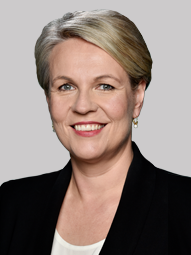
Tanya Plibersek
Australian Labor Party Member for Sydney
Currently sitting
Photo: Department of Climate Change, Energy, the Environment and Water, CC BY 4.0, via Wikimedia Commons
Seat and party history (1)
- Australian Labor Party - Sydney (House) - 3 Oct 1998 to present
- Seat and party records: OpenAustralia member data.
Contact
Electorate office: (02) 9379 0700
1a Great Buckingham Street (cnr. Cleveland Street), Redfern, Sydney NSW 2016
Office details: Parliament of Australia, CC BY-NC-ND 4.0.
Contact details on aph.gov.au Profile on OpenAustraliaNot sure if this is your member? Find your electorate (AEC)
These counts cover what is on this site only. They do not measure electorate work or committee work.
Compared with other members
Tanya Plibersek compared with all 150 sitting House members.
Questions asked in Question Time
Lower than 81% of House members- This member
- 0
- Average
- 11.2
- Median
- 12
Debates spoken in
Lower than 59% of House members- This member
- 25
- Average
- 35.9
- Median
- 30.5
Votes cast
Lower than 68% of House members- This member
- 229
- Average
- 253.0
- Median
- 265
Share of divisions voted in
Lower than 72% of House members- This member
- 69%
- Average
- 79%
- Median
- 81%
Read these with care
- The median is the middle member: half did more, half did less. It is less affected by a few very active members than the average.
- Ministers answer questions rather than ask them, and the presiding officers rarely vote, so their patterns differ.
- Government backbenchers are often given arranged "Dorothy Dixer" questions, which raises their question counts.
- Votes only record ayes and noes, so a missed vote cannot be told apart from a pair (an agreed absence).
- Counts cover only what is on this site, and do not measure electorate or committee work. New members have less history.
Question Time
No questions recorded for this member.
Question from Madonna Jarrett
The member asked how the government was ensuring children received owed support and addressing financial abuse within the child support system.
Background: A government member asked the Social Services Minister about closing loopholes in the child support system.
Answer from Tanya Plibersek
The minister announced a $183 million package to reform the child support system, including new legislation to fix processes weaponised against former partners. She noted that $2 billion in unpaid child support debt existed, with some parents owing over $150,000. Future measures would include automatic travel bans for those with debts over $10,000 who travel overseas and increased use of employer withholding to ensure payments are made automatically.
Question from Alison Byrnes
The member asked how the proposed digital duty of care would help tackle gender-based violence and better protect children.
Background: The government proposed a digital duty of care to address online harms linked to real-world violence.
Answer from Tanya Plibersek
The minister cited a 70 per cent increase in sexual violence rates, particularly among young people, and noted that almost 60 per cent of young Australians had experienced sexual strangulation. She argued that online content feeds real-world harm, with misogynistic content appearing within 23 minutes of account creation. The government had already introduced age verification for pornography and restrictions on social media for under-16s. The digital duty of care would obligate platforms to keep users safe, addressing the algorithmic promotion of harmful content.
Question from Renee Coffey
The member asked how the government was responding to the Robodebt scheme and how it compared to other approaches.
Background: The government is implementing recommendations from the Royal Commission into the Robodebt scheme.
Answer from Tanya Plibersek
The minister stated that the government had agreed to all 56 Royal Commission recommendations, with 52 fully implemented. She noted that the government had settled the Knox Robodebt class action, providing $475 million in compensation for approximately 168,000 people. She explained that new legislation would ensure these compensation payments were not subject to tax or income-testing, allowing victims to receive the full amount.
Question from Josh Burns
The member asked how the government was helping women and children fleeing violence into safe housing and why this approach was superior to other methods.
Background: The government was implementing measures to support women and children fleeing violence.
Answer from Tanya Plibersek
The minister stated that safe housing was critical for women and children to escape violence, noting that many endured abuse to avoid homelessness. She highlighted the government's $1.2 billion investment to deliver 55,000 crisis and transitional homes, including the $300 million announced earlier. She contrasted this with the previous government's record of building only 373 social homes in a decade. She also referenced the First Action Plan on violence against women, which included $4.4 billion in funding, permanent leaving violence payments, and support for frontline workers.
Question from David Smith
The member asked the Minister for Social Services how the government was supporting older Australians in retirement and what impact alternative approaches would have.
Background: The government was highlighting its support for older Australians through pension increases and superannuation.
Answer from Tanya Plibersek
The Minister stated that the government was investing close to $70 billion in the age pension, with the maximum single rate increasing by $6,500 since taking office. She explained that superannuation reduced the long-term cost of pensions as a share of GDP, keeping it below two per cent compared to the OECD average of nine per cent. She argued that weakening superannuation would increase the burden on working-age taxpayers to fund pensions. She contrasted the government's approach of higher wages and superannuation with the opposition's stance.
Question from Joanne Ryan
The member asked how the government was delivering real change for Australian women and families and what the risks were.
Background: The government was highlighting its record on women's economic security and superannuation.
Answer from Tanya Plibersek
The Minister reported that 200,000 people had benefited from paying super on paid parental leave in the first year, adding an estimated $28.5 billion to superannuation balances. She noted that a woman with a median balance would be around $5,400 better off in retirement. She contrasted this with the opposition's proposal to allow early access to super, which she argued would leave workers significantly worse off. She also highlighted the permanent leaving violence payment and paid domestic violence leave.
Question from David Smith
The member asked the Minister for Social Services how the government was delivering change through expanded paid parental leave and what risks existed to this progress.
Background: The member asked about the impact of expanded paid parental leave on families and potential risks.
Answer from Tanya Plibersek
The minister stated that paid parental leave had increased to almost $30,000, more than double the 2022 level. She noted that during the initial year when superannuation was contributed on paid parental leave, 200,000 individuals received $285.12 million in contributions. She estimated that a woman with a median superannuation balance would be $5,400 better off in retirement, and a woman with three children could retire with an extra $17,600. She identified the opposition parties as a risk due to their opposition to universal superannuation.
Question from Louise Miller-Frost
The member asked how the government was working to reduce such violence and why this issue was important.
Background: A government member asked the Minister for Social Services about the government's work to reduce family and sexual violence.
Answer from Tanya Plibersek
The Minister highlighted insights from frontline organisations, noting that children are experiencing violence and need support. She cited statistics that almost 40 per cent of sexual assault victims are aged 10 to 17 and discussed online harms like stalking apps and AI glasses. She mentioned a $308 million investment for safe homes helping 22,000 people and the broader $4.4 billion investment assisting nearly half a million people through 1,400 organisations.
Question from Kate Thwaites
The member asked how the government was delivering change through expanded paid parental leave and what risks existed.
Background: A government member asked about the expansion of paid parental leave and potential risks to the scheme.
Answer from Tanya Plibersek
The Minister reported that paid parental leave had reached six months with a weekly rate exceeding $1,000, including superannuation. She noted that the total value had more than doubled since 2022, reaching almost $30,000. She highlighted increased flexibility and eligibility thresholds. She contrasted this support with past opposition rhetoric that criticized parents for taking leave, stating that the government was proud to provide substantial assistance to families.
Question from Alison Byrnes
The member asked how the government is delivering on commitments to strengthen paid parental leave and support families.
Background: The government has expanded paid parental leave entitlements.
Answer from Tanya Plibersek
The minister stated that families now receive around $30,000 in paid parental leave, more than double the amount when the government took office, with higher rates and longer durations for subsequent children. She highlighted increases in family tax benefits, higher wages, lower taxes, and free power. She criticized the opposition and One Nation for opposing these measures and advocating for lower wages.
Question from Lisa Chesters
The member asked how the government was delivering on commitments to strengthen paid parental leave and support families, and what risks existed.
Background: The member asked about strengthening paid parental leave and support for families, and the risks involved.
Answer from Tanya Plibersek
The Minister stated that from 1 July, paid parental leave was extended to six months at a rate of over $1,000 a week, with superannuation contributions. She highlighted increased family tax benefits, three hours of free power, tax cuts, minimum wage increases, and stronger Medicare. She warned that these measures were not safe if the opposition parties formed government, citing past opposition rhetoric against paid parental leave.
Question from Ali France
The member asked for details on the government's progress in strengthening paid parental leave and supporting women in the workforce, and what risks existed.
Background: The member asked how the government was strengthening paid parental leave and supporting families and women in the workforce.
Answer from Tanya Plibersek
The Minister stated that from 1 July, paid parental leave would increase to six months with payments of over $1,000 per week. She noted that the government had more than doubled the entitlement to around $30,000. The Minister highlighted that these changes benefited female-dominated industries like aged care, contributing to the lowest gender pay gap in history. She criticized the opposition and One Nation for their inconsistent or negative stances on paid parental leave.
Question from Sharon Claydon
The member asked how the government was strengthening paid parental leave, why it was important, and what risks existed to this commitment.
Background: A government member asked the Minister for Social Services about the expansion of paid parental leave and the risks to this commitment.
Answer from Tanya Plibersek
The minister announced that from 1 July, paid parental leave would expand to six months at over $1,000 a week, more than doubling the entitlement since the government took office. She noted that approximately 30,000 parents would benefit. She criticised opposition figures for past comments dismissing paid parental leave and for current inconsistencies in their support. She highlighted that tens of thousands of parents in various electorates had benefited from the scheme in the previous year.
Question from Alicia Payne
The member asked how the government was fulfilling its pledge to enhance paid parental leave and what risks existed.
Background: The member asked about government commitments to strengthen paid parental leave.
Answer from Tanya Plibersek
The Minister stated that paid parental leave would increase to six months from 1 July, with payments exceeding $1,000 a week. She noted that superannuation would be paid on parental leave. She mentioned that eligibility thresholds would increase. She stated that families would receive almost $30,000 during the six months, more than double the previous amount. She criticized the opposition for historically opposing paid parental leave, citing comments from former politicians and One Nation.
Question from Jess Teesdale
The member asked how the government was strengthening paid parental leave and what risks were involved.
Background: The government was expanding paid parental leave entitlements.
Answer from Tanya Plibersek
The Minister announced that from 1 July, paid parental leave would extend to six months, with payments reaching almost $30,000. She noted increased flexibility and eligibility, benefiting 180,000 families annually. She criticized the opposition for opposing leave for permanent residents and highlighted cheaper childcare and higher wages as part of the broader support package.
Question from Alison Byrnes
The member asked how the government was addressing family, domestic, and sexual violence.
Background: A government member asked the Minister for Social Services how the government was working to reduce family, domestic, and sexual violence.
Answer from Tanya Plibersek
The Minister highlighted consultations on the second action plan under the National Plan to End Violence against Women and Children. She noted legislative work to prevent perpetrators from receiving superannuation death benefits and reforms to the child support system. The Minister mentioned a $4.4 billion investment in violence prevention, including funding for the 500 Workers program and 1800RESPECT, and emphasized the need to address evolving threats like tech-facilitated abuse.
Question from Kate Chaney
The member asked why the government had not implemented the Robodebt Royal Commission recommendation to enact laws providing protections and supervision for automated decision-making in government.
Background: An independent member asked why the government had not legislated safeguards for automated decision-making, citing concerns about income support cancellations and NDIS changes.
Answer from Tanya Plibersek
The Minister stated that the government required human oversight for all AI use and did not hand over decision-making to computer programs. She noted that 93 per cent of the robodebt royal commission's 52 recommendations had been implemented, with work ongoing on the remaining four, three of which required legislation. She criticized the opposition for creating the robodebt scheme, which caused suffering and deaths, and assured the member that the government used strict guardrails and human oversight for automated tools.
Question from Sam Lim
The member asked the Minister for Social Services how the government was working to reduce family, domestic, and sexual violence.
Background: A government member asked about government efforts to reduce violence.
Answer from Tanya Plibersek
The Minister noted the launch of a consultation on the next action plan to address evolving challenges like tech-facilitated abuse. She stated the government had invested an extra $4.4 billion in this area, including $1.2 billion for crisis housing and $218 million for First Nations communities. She highlighted increases in funding for the 500 Workers program and 1800RESPECT, as well as $80 million for children's counselling. She confirmed the introduction of 10 days paid family and domestic violence leave and legislation to prevent social security weaponization.
Question from Alicia Payne
The member asked how the government was delivering cost-of-living relief and if there were any risks.
Background: The war in Iran was impacting the Australian economy.
Answer from Tanya Plibersek
The Minister declared $11.7 million in additional emergency relief funds, comprising $812 million for 196 providers and $214 million for financial counselling. She outlined further actions such as tax reductions, higher wages, expanded paid parental leave, lower medicine costs, and bulk-billing. She highlighted rises in aged pensions, unemployment benefits, and Commonwealth rent assistance. She condemned the opposition for reducing support for these initiatives while in power.
Question from Justine Elliot
The member asked how the government was strengthening the social security system and delivering relief, and if there were risks.
Background: Australians were facing cost-of-living pressures.
Answer from Tanya Plibersek
The minister stated that over five million social security recipients received a $2.6 billion payment boost on 20 March. She noted that the full aged pension was $5,500 higher than in 2022, and jobseekers received $4,300 more annually. Rent assistance increased by about $1,900 per year, and the small debt waiver threshold rose to $250, affecting 1.2 million debts. She also highlighted cheaper medicines and student debt relief.
Question from Cassandra Fernando
The member inquired how the government was fulfilling its pledge to enhance paid parental leave and what the risks were.
Background: Strengthening paid parental leave.
Answer from Tanya Plibersek
The Minister highlighted that paid parental leave is expanding to six months, with payments increased by $200 a week and superannuation included. She noted that recipients are $12,000 better off since 2022. She criticized the opposition for inconsistent and negative rhetoric regarding mothers and paid parental leave, contrasting this with the government's support for working families, cheaper childcare, and workplace flexibility.
Question from Libby Coker
The member asked how the government was acting to lower family, domestic, and sexual violence and support frontline workers.
Background: The member asked about government efforts to reduce violence and support frontline workers.
Answer from Tanya Plibersek
The minister announced an extra $291.7 million to expand frontline worker programs by 70 per cent, funded to 2030. She noted that the government had invested almost half a billion dollars in this program alone and over $4 billion in family, domestic, and sexual violence initiatives since taking office. She highlighted investments in emergency housing, legal services, perpetrator behavior change programs, and the permanent leaving violence payment.
Question from Susan Templeman
The member asked how the government was delivering on paid parental leave commitments and what risks were involved.
Background: A government member asked about the delivery of paid parental leave commitments and associated risks.
Answer from Tanya Plibersek
The minister stated that paid parental leave would expand to six months from July, benefiting 180,000 families annually. She noted that families were $12,000 better off and would gain approximately $412,000 in retirement savings. She criticized the opposition for opposing paid parental leave and for making dismissive comments about children being a burden.
Question from Jodie Belyea
The member asked how the government was supporting families.
Background: The member asked about the government's delivery for Australian families in social services.
Answer from Tanya Plibersek
The minister highlighted up to $5,000 additional funds for pensioners, an extra $1,800 in rent assistance, reduced costs for medicines and childcare, increased pay, reduced tax rates, a 5% deposit scheme, reductions in student debt, and complimentary TAFE. She observed that paid parental leave had nearly doubled, leaving recipients approximately $12,000 better off.
Question from Marion Scrymgour
The member asked how the government was helping to end violence against Aboriginal and Torres Strait Islander women and children.
Background: The government released a national plan to end violence against Aboriginal and Torres Strait Islander women and children.
Answer from Tanya Plibersek
The Minister announced the release of a dedicated national plan endorsed by all states and territories, accompanied by an additional $218 million in funding. She cited statistics showing Aboriginal women are seven times more likely to die in domestic homicide and 27 times more likely to require hospital care because of intimate partner violence. She detailed investments in mobile teams, men's centres, legal services, and housing, noting that this funding complements previous commitments of $262 million and $367 million.
Question from Zali Steggall
The member asked whether the government would call a royal commission into femicide and domestic violence to treat the safety of women and children with the same urgency as other national issues.
Background: The Prime Minister had previously described domestic violence as a crisis, with one woman killed every four days. The member referenced past royal commissions on other issues.
Answer from Tanya Plibersek
The Minister stated that the government did not believe another royal commission was necessary, as frontline workers preferred implementation over further reports. She noted that there were already 1,000 recommendations from eight major inquiries, including the recent rapid review commissioned by National Cabinet. The government was currently implementing 583 initiatives, 122 of which were Commonwealth-led, supported by a $4 billion investment. She announced that consultation would begin on the second action plan of the National Plan to End Violence against Women and Children.
Question from Cassandra Fernando
The member asked how the government was strengthening paid parental leave and what approaches had been considered.
Background: The government had expanded paid parental leave.
Answer from Tanya Plibersek
The Minister stated that from 1 July, families would receive six months of paid parental leave. She noted that recipients were already $12,000 better off since 2022, with 180,000 families benefiting. She highlighted increased payments, superannuation contributions, and flexibility. She contrasted this with the opposition's past criticism of paid parental leave schemes.
Question from Louise Miller-Frost
The member asked what measures the government was implementing to address family, domestic, and sexual violence.
Background: The member asked how the government was tackling gender-based violence on the International Day for the Elimination of Violence Against Women.
Answer from Tanya Plibersek
The minister revealed a 40 per cent increase in funding for 1800RESPECT, highlighting that contacts had risen by 3000 per cent since the service began. She outlined spending on emergency housing totalling $1.2 billion, $3.9 billion for legal services, 10 days of paid domestic violence leave, and job protection for victims. She stressed continued cooperation with states and territories to enhance responses to sexual violence.
Question from Cassandra Fernando
The member requested details on how the government was delivering on paid parental leave commitments and what other approaches were considered.
Background: A government member asked the Minister for Social Services about strengthening paid parental leave.
Answer from Tanya Plibersek
The minister reported that paid parental leave recipients were $12,000 better off, with entitlements nearly doubled for 180,000 families annually. She highlighted additional weeks of leave, higher payments, superannuation contributions, and increased flexibility. She criticized the opposition for past derogatory comments about parents and for attempting to hijack debates on related legislation.
Question from Joanne Ryan
The member asked how the government is easing cost-of-living pressures for social security recipients and what risks exist from alternative policies.
Background: The question aimed to highlight cost-of-living relief for social security recipients.
Answer from Tanya Plibersek
The Minister noted that over five million social security recipients received payment boosts from 20 September, including age pensioners and jobseekers. She stated that age pensioners are about $5,000 better off annually and jobseekers $4,000 better off. Commonwealth Rent Assistance increased by almost 50 per cent. She criticized the opposition for past attempts to cut pensions and raise the pension age, warning that their current rhetoric suggests similar cuts.
Question from Susan Templeman
The member asked how the government was assisting in reducing cost-of-living burdens for Australians, including those receiving social security.
Background: The government was implementing cost-of-living measures.
Answer from Tanya Plibersek
The minister detailed upcoming increases to social security payments on 20 September, including a boost of up to $30 a fortnight for age pensioners. She highlighted cumulative benefits since the government took office, such as $5,000 extra for pensioners, $4,000 for JobSeekers, and increased rent assistance. She also listed tax cuts, fee-free TAFE enrolments, student debt relief, cheaper childcare, and investments in housing and Medicare as part of the government's cost-of-living strategy.
Question from Sharon Claydon
The member asked what the government was doing to improve support for victims and survivors of family and domestic violence.
Background: The government was introducing legislation to support victims of domestic violence in the social security system.
Answer from Tanya Plibersek
The minister announced legislation to expand the special circumstances debt waiver, allowing Services Australia to waive debts run up by perpetrators of violence. She highlighted the permanent leaving violence payment of up to $5,000. The minister noted $1.2 billion in emergency and transitional housing, 10 days paid domestic violence leave, and $800 million in extra funding for family violence legal services. She emphasized that no government had invested more in frontline services and programs to prevent violence.
Question from Libby Coker
The member asked the Minister for Social Services how the government was easing cost-of-living pressures and tackling challenges in the portfolio.
Background: The government announced social security increases and changes to deeming rates.
Answer from Tanya Plibersek
The Minister highlighted the creation of 1.1 million jobs and a $9,000 increase in minimum wage. She announced that from 20 September, over five million social security recipients would see fortnightly increases, with age pensioners receiving about $30 more per fortnight. She noted JobSeeker recipients were $4,000 better off annually. She also announced the gradual unfreezing of deeming rates, which had been frozen since COVID, to ensure fairness between those with financial assets and those with income.
Question from Julie-Ann Campbell
The member asked how the government was delivering on paid parental leave improvements and if these changes were guaranteed.
Background: A government member asked the Minister for Social Services about the delivery of strengthened paid parental leave commitments.
Answer from Tanya Plibersek
The Minister stated that since 2022, parents have received approximately $12,000 more in paid parental leave, including extra weeks, higher weekly payments of around $200, and superannuation contributions worth about $4,500 in retirement savings. She noted that 180,000 families benefit annually and contrasted this with the Coalition's past opposition to the scheme.
Question from Sussan Ley
The member asked if the Minister retained the power to stop salmon farming at Macquarie Harbour after the next election, given recent legislative amendments to the EPBC Act.
Background: The Shadow Minister for Women questioned whether the Prime Minister's introduction of legislation to amend the EPBC Act undermined the Environment Minister's powers, specifically regarding salmon farming at Macquarie Harbour.
Answer from Tanya Plibersek
The Minister explained that the amendment applied only to a small number of reconsiderations meeting specific criteria, such as ongoing activities supervised by state governments. She stated that under existing law, established industries could be shut down overnight if assessments commenced, a problem the previous government failed to fix. She refused to predetermine the outcome of specific decisions, noting that doing so could lead to legal challenges, and cited previous court cases involving prejudgement by the former government.
Question from Melissa Price
The member asked whether the Minister would make a decision on the North West Shelf gas expansion prior to the upcoming election.
Background: The member for Durack asked if the Environment Minister would decide on the North West Shelf gas expansion before the election.
Answer from Tanya Plibersek
The Minister stated that the department was assessing the project according to national environment laws. She refused to comment on pending decisions, explaining that prejudging outcomes could lead to legal challenges based on apprehended bias. She cited previous court cases involving the former government as evidence of the risks associated with announcing decisions in advance.
Question from Michelle Landry
The member asked the Minister to confirm how many coal mining approvals she had granted since taking office.
Background: The Shadow Assistant Minister for Manufacturing asked the Environment Minister to confirm the number of coal mining approvals granted during the current term.
Answer from Tanya Plibersek
The Minister stated that fewer than a dozen coal mining approvals had been granted.
Question from Michelle Landry
The member asked the Minister to confirm the exact number of coal projects approved, clarifying if it was between six and 12.
Background: Following a previous answer, the member asked for clarification on the exact number of coal projects approved, specifically if it was between six and 12.
Answer from Tanya Plibersek
The Minister stated that 10 coal mines or extensions had been approved, with four cancelled. She noted that three gas extraction projects and over 80 renewable energy projects had been approved. She highlighted that 15 gigawatts of renewable energy had been added to the grid and that renewables were on track to reach 82 per cent by 2030.
Question from Monique Ryan
The member asked whether removing the environmental protection agency from the bill represented the end of climate wars, citing the Prime Minister's 2022 victory speech.
Background: An independent member asked the Minister for the Environment about the removal of the environmental protection agency from the Senate bill, referencing the Prime Minister's pledge to end climate wars.
Answer from Tanya Plibersek
The Minister stated that the Liberals and Nationals had teamed up with the Greens to block the nature-positive laws in the Senate. She argued that the Greens had not supported a strong environmental protection agency with new powers, while the opposition had voted against faster project approvals. She highlighted the government's achievements, including expanding marine protections and saving the Great Barrier Reef from an endangered listing, contrasting these with the opposition's record.
Question from Sussan Ley
The member asked whether the Minister still backed establishing a federal environmental protection agency.
Background: The Deputy Leader of the Opposition asked the Environment Minister if she still supported a federal environmental protection agency, including in Western Australia.
Answer from Tanya Plibersek
The Minister confirmed that the legislation had passed the House of Representatives but was blocked in the Senate by the Liberals, Nationals, and Greens. She stated that the bill had been withdrawn from the Notice Paper because there was no path through the current parliament. She argued that the laws needed reform to protect nature and provide faster decisions for business.
Question from David Littleproud
The member asked whether the Minister would rule out reintroducing the federal environmental protection bill in the future.
Background: The Leader of the Nationals requested the Environment Minister to exclude the possibility of later introducing the federal environmental protection bill.
Answer from Tanya Plibersek
The Minister stated that the legislation had been withdrawn from the Notice Paper because it could not pass the Senate in the current parliament. She expressed disappointment that the parliament could not agree on necessary environmental law reforms based on the Professor Graeme Samuel report.
Other Parliamentary Activity
-
Child Support and Family Assistance Legislation Amendment (Ending Financial Abuse in the Child Support Scheme No. 1) Bill 2026; Second Reading
House of Representatives · Thursday 17 September 2026 · Second Reading
Opened this debate
-
Knox Class Action (Facilitation) Bill 2026; Third Reading
House of Representatives · Tuesday 15 September 2026 · Third Reading
Contributed to this debate
-
Knox Class Action (Facilitation) Bill 2026; Second Reading
House of Representatives · Tuesday 15 September 2026 · Second Reading
Responded as minister
-
Knox Class Action (Facilitation) Bill 2026; Second Reading
House of Representatives · Thursday 10 September 2026 · Second Reading
Opened this debate
-
Domestic, Family and Sexual Violence Commission Yearly Report to Parliament
House of Representatives · Wednesday 9 September 2026 · Ministerial Statement
Opened this debate
-
Social Security and Other Legislation Amendment (Technical Changes No. 2) Bill 2026; Second Reading
House of Representatives · Tuesday 8 September 2026 · Second Reading
Responded as minister
-
Social Security and Other Legislation Amendment (Technical Changes No. 2) Bill 2026; Consideration in Detail
House of Representatives · Tuesday 8 September 2026 · Consideration in Detail
Opened this debate
-
Domestic, Family and Sexual Violence
House of Representatives · Thursday 20 August 2026 · General Debate
Responded as minister
-
Treasury Laws Amendment (The Survivors Law) Bill 2026; Second Reading
House of Representatives · Wednesday 13 May 2026 · Second Reading
Contributed to this debate · Position: support
-
National Commission for Aboriginal and Torres Strait Islander Children and Young People Bill 2026, National Commission for Aboriginal and Torres Strait Islander Children and Young People (Transitional Provisions) Bill 2026; Second Reading
House of Representatives · Wednesday 11 February 2026 · Second Reading
Responded as minister
-
National Commission for Aboriginal and Torres Strait Islander Children and Young People Bill 2026, National Commission for Aboriginal and Torres Strait Islander Children and Young People (Transitional Provisions) Bill 2026; Third Reading
House of Representatives · Wednesday 11 February 2026 · Third Reading
Contributed to this debate
-
National Commission for Aboriginal and Torres Strait Islander Children and Young People (Transitional Provisions) Bill 2026; Third Reading
House of Representatives · Wednesday 11 February 2026 · Third Reading
Contributed to this debate
-
Social Security and Other Legislation Amendment (Technical Changes No. 1) Bill 2026; Second Reading
House of Representatives · Thursday 5 February 2026 · Second Reading
Opened this debate
-
National Commission for Aboriginal and Torres Strait Islander Children and Young People Bill 2026; Second Reading
House of Representatives · Thursday 5 February 2026 · Second Reading
Opened this debate
-
National Commission for Aboriginal and Torres Strait Islander Children and Young People (Transitional Provisions) Bill 2026; Second Reading
House of Representatives · Thursday 5 February 2026 · Second Reading
Contributed to this debate
-
Bondi Beach Attack Victims
House of Representatives · Monday 19 January 2026 · Condolence
Contributed to this debate
-
Social Security and Other Legislation Amendment (Technical Changes No. 2) Bill 2025; Consideration of Senate Message
House of Representatives · Wednesday 26 November 2025 · Consideration of Senate Message
Opened this debate
-
Domestic, Family and Sexual Violence; Reference to Federation Chamber
House of Representatives · Thursday 30 October 2025 · General Debate
Contributed to this debate
-
Social Security and Other Legislation Amendment (Technical Changes No. 2) Bill 2025; Third Reading
House of Representatives · Wednesday 29 October 2025 · Third Reading
Contributed to this debate
-
Social Security and Other Legislation Amendment (Technical Changes No. 2) Bill 2025; Consideration in Detail
House of Representatives · Wednesday 29 October 2025 · Consideration in Detail
Responded as minister
-
Social Security and Other Legislation Amendment (Technical Changes No. 2) Bill 2025; Consideration in Detail
House of Representatives · Monday 27 October 2025 · Consideration in Detail
Contributed to this debate
-
Social Security and Other Legislation Amendment (Technical Changes No. 2) Bill 2025; Second Reading
House of Representatives · Thursday 4 September 2025 · Second Reading
Opened this debate
-
Crowley, Hon. Dr Rosemary Anne AO
House of Representatives · Wednesday 26 March 2025 · Condolence
Contributed to this debate
-
Environment Protection and Biodiversity Conservation Amendment (Reconsiderations) Bill 2025; Third Reading
House of Representatives · Tuesday 25 March 2025 · Third Reading
Contributed to this debate
-
Environment Protection and Biodiversity Conservation Amendment (Reconsiderations) Bill 2025; Second Reading
House of Representatives · Tuesday 25 March 2025 · Second Reading
Opened this debate
- Votes recorded
- 229
- Aye votes (55.9%)
- 128
- No votes (44.1%)
- 101
Showing the latest 50 votes.
-
Rearrangement
17 Sep 2026 · Ayes 42, Noes 87 · Failed
VOTED NO -
Suspension of Standing and Sessional Orders
17 Sep 2026 · Ayes 42, Noes 89 · Failed
VOTED NO -
Suspension of Standing and Sessional Orders
16 Sep 2026 · Ayes 85, Noes 44 · Passed
VOTED AYE -
Private Health Insurance Amendment (Modernising the Private Health Insurance ...
16 Sep 2026 · Ayes 88, Noes 48 · Passed
VOTED AYE -
Private Health Insurance Amendment (Modernising the Private Health Insurance ...
16 Sep 2026 · Ayes 87, Noes 48 · Passed
VOTED AYE -
Private Health Insurance Amendment (Modernising the Private Health Insurance ...
16 Sep 2026 · Ayes 9, Noes 85 · Failed
VOTED NO -
Private Health Insurance Amendment (Modernising the Private Health Insurance ...
16 Sep 2026 · Ayes 86, Noes 47 · Passed
VOTED AYE -
Private Health Insurance Amendment (Modernising the Private Health Insurance ...
16 Sep 2026 · Ayes 45, Noes 87 · Failed
VOTED NO -
Private Health Insurance Amendment (Modernising the Private Health Insurance ...
16 Sep 2026 · Ayes 46, Noes 86 · Failed
VOTED NO -
Rearrangement
16 Sep 2026 · Ayes 84, Noes 13 · Passed
VOTED AYE -
Rearrangement
15 Sep 2026 · Ayes 49, Noes 87 · Failed
VOTED NO -
Consideration of Legislation
14 Sep 2026 · Ayes 43, Noes 87 · Failed
VOTED NO -
Regulatory Reform Omnibus Bill 2026; Consideration of Senate Message
14 Sep 2026 · Ayes 95, Noes 43 · Passed
VOTED AYE -
Regulatory Reform Omnibus Bill 2026; Consideration of Senate Message
14 Sep 2026 · Ayes 95, Noes 42 · Passed
VOTED AYE -
Albanese Government; Attempted Censure
14 Sep 2026 · Ayes 46, Noes 86 · Failed
VOTED NO -
Statute Update Bill 2026; Consideration of Senate Message
14 Sep 2026 · Ayes 84, Noes 48 · Passed
VOTED AYE -
Carbon Credits (Carbon Farming Initiative-Improved Forest Management in Multi...
10 Sep 2026 · Ayes 38, Noes 92 · Failed
VOTED NO -
Telecommunications Legislation Amendment (Universal Outdoor Mobile Obligation...
9 Sep 2026 · Ayes 52, Noes 86 · Failed
VOTED NO -
Gun Control
9 Sep 2026 · Ayes 88, Noes 47 · Passed
VOTED AYE -
Veterans
7 Sep 2026 · Ayes 88, Noes 49 · Passed
VOTED AYE -
Cash Distribution Framework Bill 2026; Consideration of Senate Message
20 Aug 2026 · Ayes 84, Noes 34 · Passed
VOTED AYE -
Universities Accord (Opening the Doors of Opportunity) Bill 2026; Considerati...
20 Aug 2026 · Ayes 90, Noes 36 · Passed
VOTED AYE -
Counter-Terrorism Legislation Amendment Bill 2026; Report from Federation Cha...
20 Aug 2026 · Ayes 39, Noes 90 · Failed
VOTED NO -
Combatting Illicit Tobacco Bill 2026; Report from Federation Chamber
19 Aug 2026 · Ayes 41, Noes 84 · Failed
VOTED NO -
Combatting Illicit Tobacco Bill 2026; Report from Federation Chamber
19 Aug 2026 · Ayes 10, Noes 67 · Failed
VOTED NO -
News Journalism Payments Bill 2026; Second Reading
19 Aug 2026 · Ayes 40, Noes 83 · Failed
VOTED NO -
Interactive Gambling Amendment (Gambling Reform) Bill 2026; Consideration in ...
18 Aug 2026 · Ayes 33, Noes 95 · Failed
VOTED NO -
Interactive Gambling Amendment (Gambling Reform) Bill 2026; Second Reading
18 Aug 2026 · Ayes 12, Noes 86 · Failed
VOTED NO -
Interactive Gambling Amendment (Gambling Reform) Bill 2026; Second Reading
18 Aug 2026 · Ayes 12, Noes 85 · Failed
VOTED NO -
Royal Commission on Antisemitism and Social Cohesion
18 Aug 2026 · Ayes 87, Noes 48 · Passed
VOTED AYE -
Minister for Veterans' Affairs and Defence Personnel; Attempted Censure
17 Aug 2026 · Ayes 86, Noes 43 · Passed
VOTED AYE -
International Relations: Australia and Japan
12 Aug 2026 · Ayes 88, Noes 41 · Passed
VOTED AYE -
Aged Care Amendment (Restoring Human Override for Aged Care Needs Assessments...
11 Aug 2026 · Ayes 42, Noes 87 · Failed
VOTED NO -
Rearrangement
11 Aug 2026 · Ayes 86, Noes 47 · Passed
VOTED AYE -
Rearrangement
2 Jul 2026 · Ayes 90, Noes 42 · Passed
VOTED AYE -
Minister for Defence Industry; Attempted Censure
2 Jul 2026 · Ayes 90, Noes 41 · Passed
VOTED AYE -
Health Insurance Amendment (Incentive Payments and Other Measures) Bill 2026;...
2 Jul 2026 · Ayes 39, Noes 92 · Failed
VOTED NO -
Foreign Affairs, Defence and Trade Joint Committee; Appointment
2 Jul 2026 · Ayes 38, Noes 101 · Failed
VOTED NO -
National Disability Insurance Scheme Amendment (Securing the NDIS for Future ...
1 Jul 2026 · Ayes 90, Noes 33 · Passed
VOTED AYE -
National Disability Insurance Scheme Amendment (Securing the NDIS for Future ...
1 Jul 2026 · Ayes 10, Noes 68 · Failed
VOTED NO -
Health Legislation Amendment (Prescribing of Pharmaceutical Benefits) Bill 20...
1 Jul 2026 · Ayes 90, Noes 43 · Passed
VOTED AYE -
Health Legislation Amendment (Prescribing of Pharmaceutical Benefits) Bill 20...
1 Jul 2026 · Ayes 90, Noes 43 · Passed
VOTED AYE -
National Disability Insurance Scheme Amendment (Securing the NDIS for Future ...
1 Jul 2026 · Ayes 9, Noes 61 · Failed
VOTED NO -
Online Safety Amendment (Strengthening Enforcement for the Social Media Minim...
1 Jul 2026 · Ayes 43, Noes 92 · Failed
VOTED NO -
National Anti-Corruption Commission Joint Committee; Consideration of Senate ...
1 Jul 2026 · Ayes 93, Noes 45 · Passed
VOTED AYE -
Member for Groom
30 Jun 2026 · Ayes 102, Noes 33 · Passed
VOTED AYE -
Treasury Laws Amendment (Financial Reporting System Reform) Bill 2026; Consid...
30 Jun 2026 · Ayes 98, Noes 40 · Passed
VOTED AYE -
Treasury Laws Amendment (Financial Reporting System Reform) Bill 2026; Consid...
30 Jun 2026 · Ayes 91, Noes 48 · Passed
VOTED AYE -
Albanese Government
30 Jun 2026 · Ayes 91, Noes 48 · Passed
VOTED AYE -
Workplace Relations Legislation Amendment (Building Cooperative Workplaces No...
30 Jun 2026 · Ayes 97, Noes 42 · Passed
VOTED AYE
About this page
This page tracks Tanya Plibersek's parliamentary activity: questions asked and answered in Question Time, debates spoken in, and votes in divisions. Summaries are in reported speech, not transcripts; each one links to the official record.